Architectural film coverage is the range of interior surfaces a self-adhesive film can refinish, and the way you measure, prep and install it so the finish holds. Walls, doors, cabinetry, furniture fronts, columns and elevator interiors are the usual candidates, provided the surface underneath is sound, clean and dry. Below, we walk through what the film can cover, how to estimate material, what the substrate needs, and when a wrap makes more sense than replacing or repainting.
TL;DR
- Architectural film is a thin, self-adhesive decorative layer that refinishes an existing surface instead of replacing it, so it suits walls, doors, cabinetry, furniture and feature elements.
- Coverage depends on the substrate first: it must be clean, smooth and dry, and painted surfaces must be fully cured before any film goes on.
- Plan material by measuring each surface, grouping them by shape, and adding a margin for trimming and pattern matching.
- Stretchable, air-channeled film such as Bodaq makes curves, edges and tight corners easier to cover cleanly and with less waste.
- Film is a strong fit when you need a fast, low-disruption refresh, and a poor fit when the surface underneath is damaged or unstable.
Table of Contents
- What architectural film coverage actually means
- Which interior surfaces can the film cover?
- Start with the substrate, not the pattern
- How to estimate material coverage
- How film is installed on existing surfaces
- Matching film grade to substrate
- Durability: what affects how long the finish lasts
- Cleaning and maintenance
- When film refreshes a space better than replacement
- A coverage checklist before you order
- Our perspective
- Plan your project with Bodaq
- FAQ
- Sources
What architectural film coverage actually means
In the interior design trade, “coverage” has two meanings, and a good project plan handles both.
The first is surface coverage: which parts of a space the film can transform. The second is material coverage: how much film you need to order to finish those surfaces, including trim allowance and pattern repeat. Specifiers usually ask about the first. Installers and purchasing teams care about the second. A project that goes smoothly answers both before a single roll is cut.
Architectural film itself is a decorative, adhesive-backed material that bonds to an existing substrate and gives it a new look: wood grain, stone, metal, fabric, leather or solid color. Bodaq Interior Film by Hyundai L&C is a stretchable, self-adhesive film offered in more than 450 textures and colors, designed to simplify installation and reduce waste compared with conventional refinishing. If you want a primer before going deeper, our team also covers the basics in a webinar on what architectural film is.
Think of the film as the design equivalent of a tailored garment. It follows the shape of what is underneath, so the quality of the fit depends on the body it is cut for.
Which interior surfaces can the film cover?
The short answer: most rigid, stable, interior surfaces with a sound finish. The longer answer is grouped by how the surface behaves.
Flat vertical surfaces
Painted drywall, plaster, wood paneling, laminate and previously finished feature walls are the most common starting points. They are large, predictable and quick to measure. A wrap can turn a plain corridor into a bold wood-grain gallery or give a reception wall the weight of natural stone without the cost, dust and downtime of masonry work. Our guide on wrapping over painted walls covers prep, cure time and what sticks.
Doors, frames and millwork
Doors take daily abuse: hands, carts, bags and cleaning chemicals. Refinishing them with film gives a consistent look across a floor of offices or a corridor of guest rooms, and it avoids removing and replacing the doors themselves. Door frames and trim follow the same logic. Because the film is stretchable, it can wrap around mild profiles and routed details more readily than a rigid sheet good.
Cabinetry and furniture
Kitchen cabinet fronts, reception desks, built-in shelving, lockers and loose furniture are classic candidates. The surface is usually smooth and the pieces are modest in size, so material planning is simple. Residential renovators like it because they can modernize dated cabinet doors on site. Commercial teams like it because worn desks and counters can be brought in line with a brand palette in an afternoon.
Columns, curves and feature elements
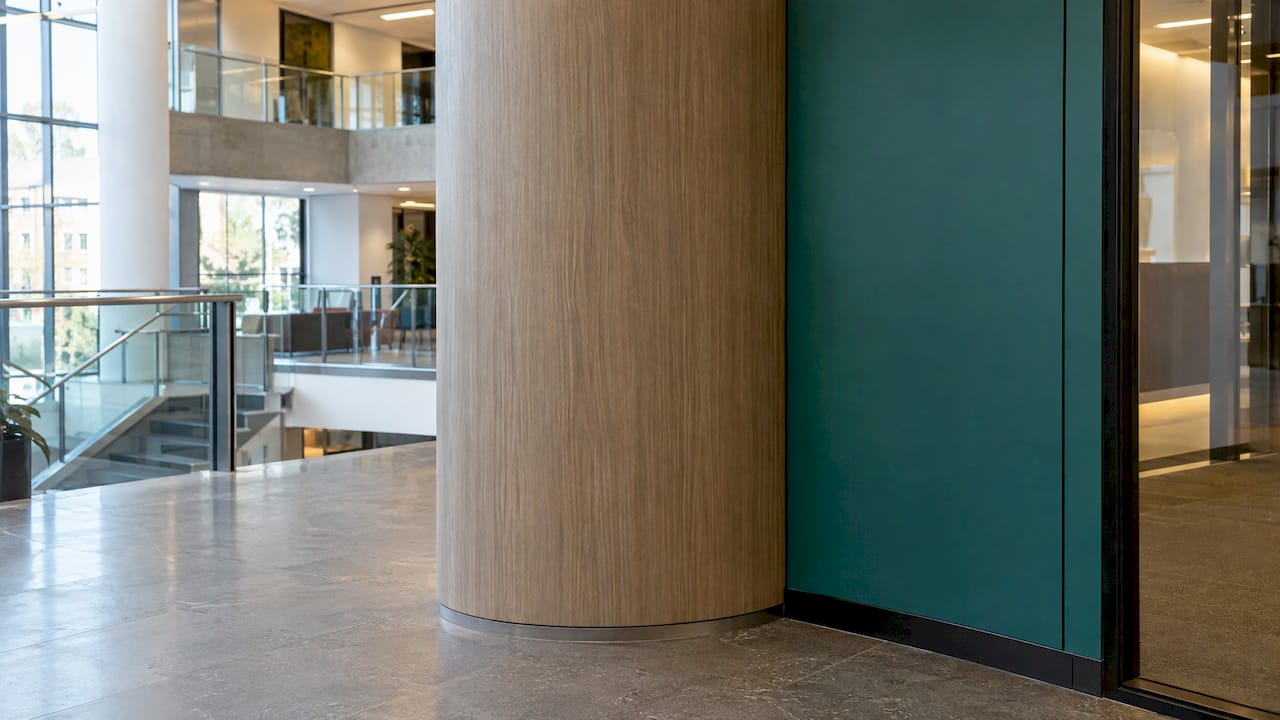
Columns, rounded counter edges, bulkheads and sculptural reception elements are where stretchability earns its keep. Conventional laminates and veneers fight curves. A film that stretches and relaxes can follow them, giving that immersive, wrapped-in-material effect designers love. Curves do need more skill and more material margin, which we cover below.
Elevators, lobbies and high-traffic zones
Elevator cabs, lobbies, stair cores and corridors are exactly where closures cost money. Film suits these places because the work can be staged in sections and finished quickly. For a closer look at turnaround, see how specifiers handle office renovation with film in hours, not weeks.
Surfaces to approach with care
Some substrates need extra attention before you commit to coverage:
- Fresh paint. Painted surfaces must be cured according to the paint manufacturer’s instructions before film is applied, according to Avery Dennison’s substrate preparation bulletin.
- Damp or sweating walls. The same bulletin warns that trapped moisture can cause premature failure, so address the moisture source first.
- Crumbling plaster, peeling paint or loose wallcovering. Film will only be as stable as what it sits on. Repair or remove the failing layer.
- Heavily textured or porous surfaces. These may need skim-coating or sealing to give the adhesive an even bed.
These are not reasons to avoid film. They are the checks that separate a finish that lasts from one that lifts at the edges.
Start with the substrate, not the pattern
Most failed installations trace back to preparation, not the film. The principle is simple: the surface should be completely clean, smooth and dry, as Avery Dennison states. Dust, grease, residue from cleaning sprays and uneven filler all show up later as bubbles, lifted corners or a faint outline under the film.
A practical sequence looks like this:
- Inspect. Look for cracks, holes, flaking paint, damp patches and old adhesive residue.
- Repair. Fill, sand and smooth defects. Any ridge or dent under thin film can telegraph through, especially with high-gloss or metallic finishes.
- Clean. Remove dust, oils and residue so the adhesive meets a bare, stable surface.
- Dry. Let the surface and the room reach stable conditions before application.
- Test. Apply a small trial piece in an inconspicuous spot to see how it bonds.
We lay out this routine in more depth in our five-step surface prep guide, and if moisture is a concern in a bathroom, spa or hospitality space, our 48-hour adhesion test gives specifiers a repeatable way to check before committing a whole floor.
How to estimate material coverage
Once you know a surface qualifies, you need to know how much film to order. The method is straightforward, and a little discipline here prevents both shortages and expensive overstock.
Measure by surface, not by room
Write down every surface separately: each wall, each door, each cabinet run. Record height and width, and subtract openings only when they are large and clean-cut, like windows or full-height glazing. Rough room totals hide the details that cause shortfalls.
Group surfaces by shape
Sort them into three groups:
| Group | Examples | Planning note |
|---|---|---|
| Flat and rectangular | Feature walls, door slabs, desk tops | Lowest waste; cut from continuous lengths |
| Profiled | Raised-panel doors, trim, millwork | Allow extra for wrapping edges and returns |
| Curved or complex | Columns, rounded counters, bulkheads | Allow the most margin; use the film’s stretch to your advantage |
Allow for trimming and pattern
Every cut needs a little overhang that is trimmed away after the film is set. Directional patterns such as wood grain, brushed metal and linen need the grain to run the same way across adjacent panels, which can consume additional length. Stone and marble patterns with a visible veining need alignment at seams if you want the pattern to read as one slab.
We do not publish a universal waste percentage, because the right margin depends on the pattern, the geometry and the installer’s experience. Ask your installer for the margin they work to, then add a modest reserve so a damaged cut never stalls the job.
Order from one batch
Colors and textures should come from the same production run where possible, so a repair a year later matches the original. Keep any leftover offcut labeled with the pattern code and location. It is the simplest insurance for future touch-ups.
Request samples before you order
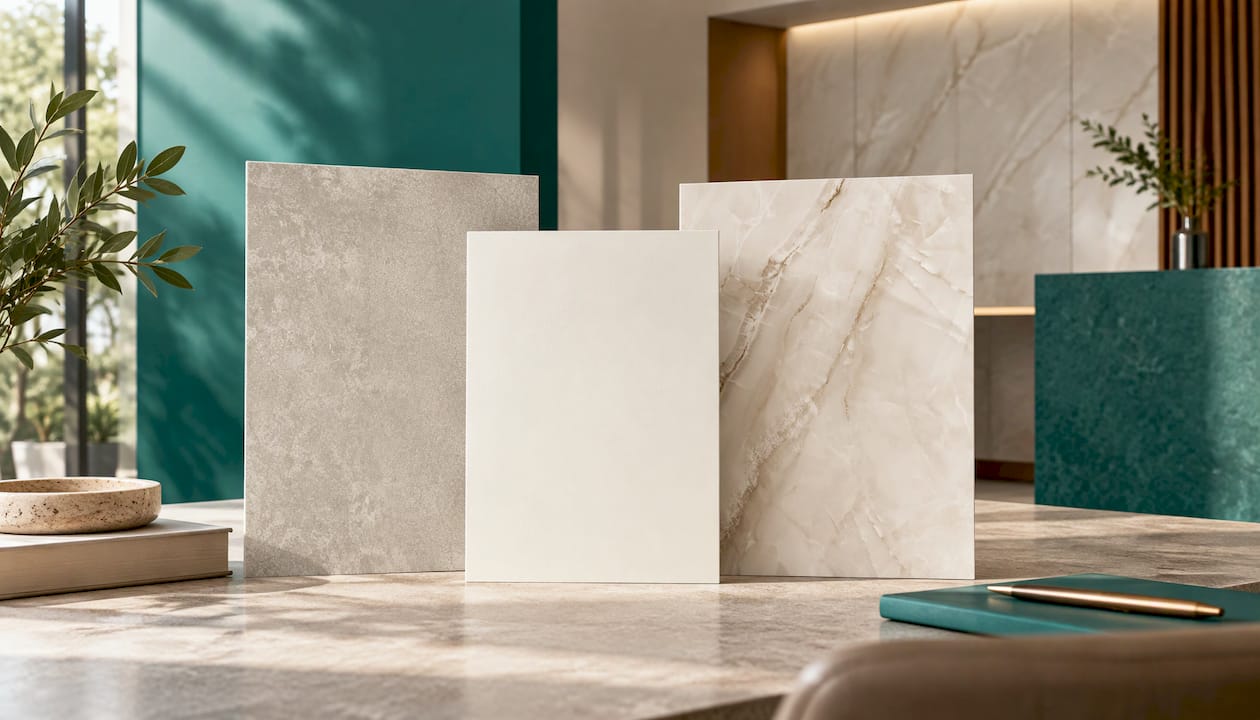
A small swatch will tell you more than a screen. Look at it in the room’s actual light, against adjacent finishes, at morning and evening. Bodaq offers samples and test kits so you can confirm the texture, sheen and color before committing a project-size order.
How film is installed on existing surfaces
Installation is where design intent becomes physical reality, and it is where the film’s construction matters. Bodaq’s film is stretchable and uses air-channeled adhesive, which is designed to help trapped air escape as the film is pressed down. That is our claim about the product’s design, and it is why many installers find it forgiving on large panels.
The general flow:
- Prepare and mask. Prep the surface, remove hardware, and protect adjacent areas.
- Cut oversize. Cut the film with a margin on each side.
- Position and tack. Align the film, peel back part of the liner and set the first edge.
- Squeegee progressively. Work from the center outward, pressing the film onto the surface.
- Relax and conform on curves. Use controlled heat and gentle stretch where the film turns around a profile.
- Trim and finish edges. Cut away excess with a sharp blade and press the edges down firmly.
- Inspect. Check seams, corners and edges after the film settles.
Professional installers use dedicated tools: squeegees, knives, heat guns and edge tools. Bodaq also supplies installation tools and dealer kits, and offers certified training for professional installers. If you are managing a large commercial project, certified crews reduce risk, because consistent technique matters across many identical doors or rooms.
Matching film grade to substrate
Not every film belongs on every surface. Texture depth, sheen and performance level should match the substrate and the traffic it faces. A deeply embossed wood grain on a smooth cabinet front looks beautiful, but the same texture on a heavily profiled door may be harder to conform. Our resource on matching film grade to substrate walks specifiers through the decision.
Collections to consider by purpose:
- Wood: warm, organic and widely used for doors, paneling and cabinetry.
- Stone and marble: a heavier, more monumental look for feature walls and reception areas. Our Rustic Stone EXF52 is one example from the high-performance range.
- Metal: cool, sculptural finishes for elevators, columns and corporate interiors.
- Solid colors: clean, brand-consistent surfaces. For washable areas, look at Easy Clean ECF01.
- Fabric and leather: tactile, softer finishes for hospitality and residential spaces.
The full range sits in our interior film collections.
Durability: what affects how long the finish lasts
Film durability is the sum of several factors, and you control most of them.
- Preparation quality. A clean, smooth, dry substrate gives the adhesive its best chance.
- Installation technique. Well-pressed edges and properly handled curves resist lifting.
- Traffic and contact. Door edges, corridor corners and desk fronts take the most abuse, so choose a performance-grade film for them.
- Cleaning habits. Harsh chemicals and abrasive pads can dull or damage any decorative surface.
- Environment. Steady humidity and temperature help. Constant moisture or heat sources near an edge create risk.
We design Bodaq for durability in busy interiors, and our materials are positioned around certified performance for high-traffic environments. For the technical side, the page on architectural film properties outlines what the film is built to do.
For property owners thinking about long-term value, durable finishes are a recurring theme in renovation planning. This overview of renovations for rental properties shows why surfaces that stand up to turnover deserve a place in the budget.
Cleaning and maintenance
Good news for facility teams: routine care is simple. Our guide on how to clean and maintain architectural film recommends a mild detergent diluted in warm water, a soft cloth, and a test on a small hidden area before you clean the full surface. It also advises avoiding harsh or abrasive cleaners.
A sensible routine:
- Dust or wipe regularly with a soft, lint-free cloth.
- Treat spills promptly rather than letting them dry.
- Test any new cleaning product on a hidden patch first.
- Inspect edges and corners periodically, and press down any early lift right away.
- Keep spare offcuts for patch repairs.
When film refreshes a space better than replacement
Film is not a universal answer, but there are clear situations where it wins.
You need speed. Hotels, clinics, offices and retail stores lose revenue when spaces close. Film can be applied in sections, in-place, with little demolition and no wet trades waiting to dry.
The structure is fine, the look is tired. Solid cabinet boxes with worn fronts, sound doors with dated veneer, or a plain wall that needs character are perfect cases. You keep the structure and change the skin.
You want less waste. Replacing doors, counters or paneling sends material to a dumpster. Refinishing in place keeps most of it in service. Our stretchable film is designed to minimize waste in the process itself.
You need consistency across many rooms. A repeated pattern code across a whole property gives a coherent look that is hard to achieve with mixed repaired surfaces.
You are testing a design. Film lets owners and designers try a bold direction, such as color drenching a lobby or adding a stone-look feature wall, without permanent commitment.
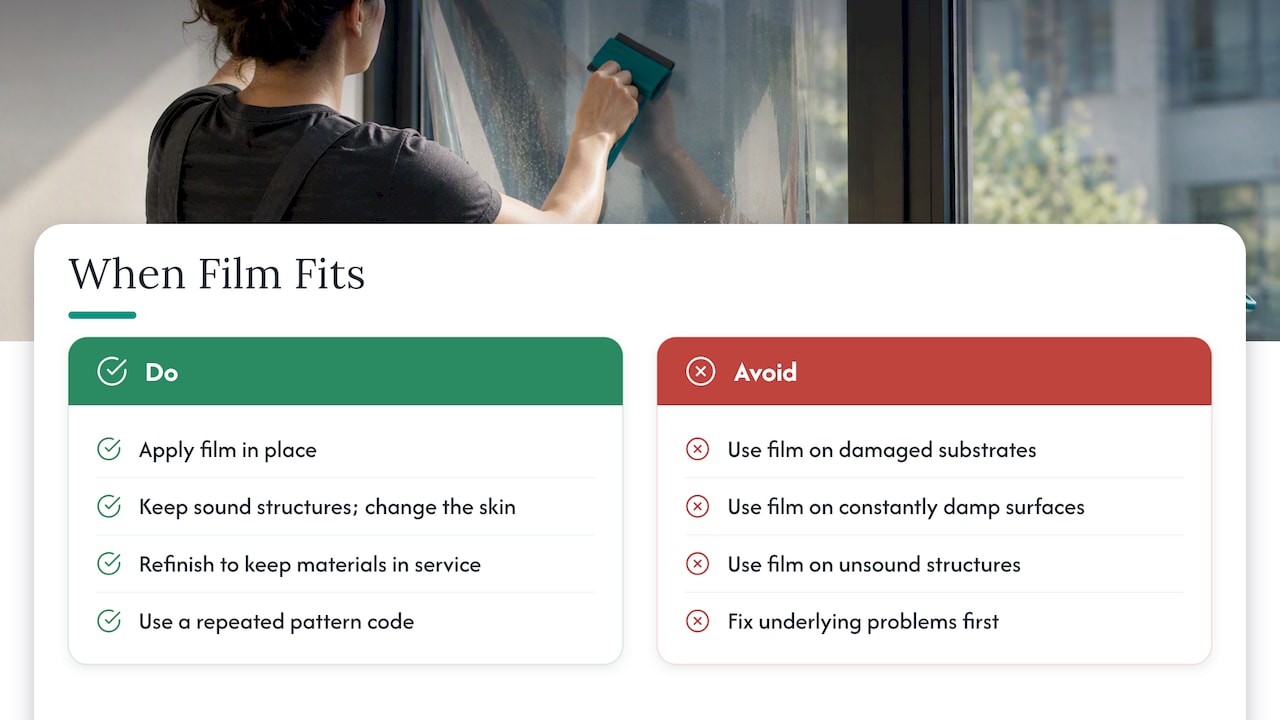
It is a weaker choice when the substrate is damaged beyond repair, constantly damp, or structurally unsound. In those cases, fix the underlying problem first and then decide on a finish. General contractors weighing the options can see how film fits their workflow in our overview of film benefits for general contractors, and our interior wall finishing materials page compares approaches. For homeowners, reinventing your home with architectural film offers room-by-room ideas.
A coverage checklist before you order
- List every surface, its material and its condition.
- Confirm each substrate is sound, clean, smooth and dry, and that painted areas are fully cured.
- Measure each surface separately and group by shape.
- Choose films by performance level and texture, matched to traffic.
- Request samples and view them in the room’s light.
- Add margin for trimming, pattern direction and repairs.
- Confirm installer experience, or arrange certified training.
- Keep leftover film and pattern codes on file.
Our perspective
We built Bodaq around a simple belief: a surface should never be a reason to tear a room apart. Most interiors have good bones and tired skins, and the fastest, cleanest way to renew them is to change the skin.
That is why we focus on stretchability and air-channeled adhesive. Coverage is only as good as the film’s ability to follow real surfaces: a curved column, a routed door, a long corridor wall. We designed our film to make those jobs cleaner and to cut the offcuts that make conventional refinishing so wasteful.
Variety matters too. With more than 450 textures and colors across wood, metal, stone and marble, solid colors, and fabric and leather, designers can match a brand palette or build a bold, sculptural statement without compromising on durability. We pair the range with eco-friendly standards, installation tools, samples and certified training, because a great film still needs a great installation.
Our advice is to treat the substrate with the same respect you give the pattern. Prep well, sample early, and plan material by surface. Do that and film becomes one of the most efficient tools in a designer’s kit.
Bodaq
Plan your project with Bodaq
Whether you are refinishing a single reception wall or a hundred hotel doors, we can help you choose a collection, order samples and line up the right installation tools or training. Explore the full range of Bodaq Interior Film and request samples to see the finishes in your own light.
Dealers, installers and commercial teams can also ask about dealer kits and certified training through our site.
FAQ
What does architectural film coverage mean?
It describes the surfaces an architectural film can refinish, such as walls, doors, cabinetry and furniture, and the amount of film needed to cover them. Good planning addresses both: whether the substrate is suitable, and how much material to order including trimming and pattern allowances.
Can architectural film cover painted walls?
Yes, once the paint is fully cured and the wall is clean, smooth and dry. Avery Dennison notes that painted surfaces must be cured according to the paint manufacturer’s instructions. Our guide to wrapping over painted walls explains what to check first.
How do I know how much film to order?
Measure each surface separately, group them by flat, profiled and curved, and add a margin for trimming and pattern matching. Curves and directional patterns need the most allowance. Ask your installer what margin they work to, and request samples before you place the full order.
How do I clean film once it is installed?
Use a soft cloth with mild detergent diluted in warm water, and test on a small hidden area first. Avoid abrasive pads and harsh chemicals. Our care guide covers the full routine.
Sources
- Substrate Cleaning and Preparation, Avery Dennison
- Best Renovations for Your Rental Property, Auben Realty