Most commercial wall wrap and wallcovering projects installed run between $2.00 and $4.50 per square foot for standard vinyl, while custom printed graphics climb to $8 to $25 per square foot depending on material and complexity, according to pricing data from a 2026 commercial vinyl wallcovering guide and a large-format wall wrap pricing guide. A 2,000 square foot lobby in mid-range vinyl often lands near a moderate to high range total cost installed. The three numbers that move your quote the most are material grade, substrate prep, and labor.
TL;DR:
- Custom printed wall wraps with complex imagery or branded graphics significantly increase costs, reaching up to $25 per square foot, especially for large areas.
- Site conditions such as damaged substrates or upper-floor installations influence labor hours and overall costs, with added charges for lifts, scaffolding, or after-hours work.
- Premium materials like embossed, metallic, or textured vinyl can add about $0.80 to $1.30 per square foot to the material cost and may enhance durability and visual impact.
- Larger projects typically negotiate lower unit prices with vendors, but minimum charges and preparation costs can still make small jobs relatively expensive per square foot.
- Proper vendor selection relies on experience, references, licensing, detailed bids, and transparent quote components to prevent cost overruns and ensure compatibility with project scope.
Table of Contents
- Typical per-square-foot and total-project price bands
- What you’re actually paying for: a line-item breakdown
- Three project scenarios to benchmark your own estimate
- Installation factors that quietly change your quote
- Material choice and what it means for lifecycle cost
- Smart ways to control cost without cutting corners
- Permits, fire ratings, and administrative costs to plan for
- How to evaluate a commercial wall wrap vendor
- Questions to ask before you sign a contract
- Red flags that signal a risky vendor
- What to expect from quote to completion
- Total cost: taxes, insurance, and ongoing maintenance
- A perspective on film, waste, and installation time
- Getting started: samples, quotes, and the right SKU for your space
- Sources
- FAQ
Typical per-square-foot and total-project price bands
commercial projects](https://currentcost.org/commercial-vinyl-wallcovering-installation-cost-price-range/). Custom printed wraps with photographic imagery or branded graphics run higher, from $8 to $25 per square foot, as reported in a large-format printing pricing breakdown. Translating that to totals: a 100 square foot accent wall might fall anywhere from $200 to $2,500 depending on material choice, a 1,500 square foot area typically lands between $3,000 and $37,500, and a 3,000 square foot corridor runs from $6,000 upward of $75,000 at the premium end.
Regional labor rates and market density widen that spread further. Installed rates tend to cluster lower across the Midwest and Sun Belt and higher along the West Coast and in major urban centers, per the same cost breakdown.
- Small jobs under 200 square feet often carry a minimum charge regardless of the per-square-foot rate.
- Large continuous runs above 3,000 square feet can negotiate lower unit pricing through volume.
- Custom printed graphics push costs toward the top of the range faster than solid color or textured film.
A 2,000 square foot mid-range installation typically totals $8,000 to $12,000, a useful anchor for budgeting a standard commercial project.
What you’re actually paying for: a line-item breakdown
A commercial wall wrap bid is really five cost categories stacked together, and knowing what belongs in each helps you catch a padded quote or a missing line item before you sign.
- Material cost: standard vinyl sits at the low end, while embossed textures, metallic inks, and specialty laminates add $0.80 to $1.30 per square foot to the material bill, according to material premium data.
- Labor: priced per square foot and tied to crew size, with most mid-size commercial jobs completing in a matter of days rather than weeks.
- Substrate prep: damaged drywall, uneven concrete, or moisture issues trigger surcharges before the first sheet goes up.
- Adhesives and primers: a smaller line item but one that varies with substrate type and the wrap material’s own backing.
- Delivery, handling, and disposal: freight for large rolls and removal of old wallcovering or debris add modest but real costs.
Installation often dominates the total for small, visually complex jobs, since mobilization and setup costs get spread across fewer square feet, per the large-format wrap pricing guide. Premium finishes raise the material line by roughly $0.80 to $1.30 per square foot, a number worth confirming against your vendor’s itemized bid before you compare it to a competing quote.
Three project scenarios to benchmark your own estimate
Seeing how the numbers play out across different project sizes makes it easier to judge whether your own quote is reasonable.
- Small accent wall: around 100 square feet in standard vinyl, priced near $2.00 to $4.50 per square foot installed, totaling roughly $200 to $450, though many vendors apply a minimum charge that pushes this higher.
- Mid-size lobby: 1,500 to 2,000 square feet using mid-range vinyl or light texture, landing in the $8,000 to $12,000 range for a 2,000 square foot space, consistent with commercial wallcovering cost data.
- Large continuous corridor: 3,000 square feet or more using premium embossed or printed material with complex seam work, where per-square-foot pricing can reach $25 for custom graphics, per the large-format wrap guide, though large, continuous orders often negotiate a lower unit rate.
Vendors frequently flex on unit price for bigger jobs while holding firm, or charging a premium, on anything below their practical minimum.
Installation factors that quietly change your quote
Labor is priced per square foot, but site conditions decide how many hours that square footage actually takes. A crew working a clear, ground-floor wall moves faster than one navigating a furnished lobby or a space that requires after-hours access.
- Overtime and after-hours scheduling, common in occupied office buildings or retail spaces, add a premium to the labor line.
- Lifts, scaffolding, and elevator time for upper floors or tall atriums extend the installation timeline and the bill.
- Staging, protecting furniture, and working around other trades slow productivity even when the wall itself is simple.
- Mobilization fees and small-job minimums mean a 50 square foot job can cost disproportionately more per square foot than a 2,000 square foot one.
Pro Tip: Ask your installer for a site-access assessment before the quote is finalized. A five-minute walkthrough catches lift and staging costs that otherwise show up as change orders.
Material choice and what it means for lifecycle cost
Not every wall surface needs the same material, and the right call depends on traffic, maintenance budget, and how long you need the finish to last.
- Standard calendered vinyl: the most economical option, suited to lower-traffic areas or shorter-term installations.
- Cast vinyl: more dimensionally stable and durable, a better fit for curved surfaces or high-visibility walls.
- Embossed, metallic, or textured finishes: add visual depth but carry the $0.80 to $1.30 per square foot premium noted earlier, per the commercial wallcovering cost breakdown.
- Fabric wraps: offer acoustic and tactile benefits but typically need more careful cleaning protocols.
- Architectural interior film: a stretchable, self-adhesive alternative that behaves differently during installation and cleaning than printed vinyl, covered in more detail in common areas of application for architectural vinyl.
Hospitality, retail, and healthcare settings tend to justify the higher upfront cost of premium film or cast vinyl because cleanability and durability reduce replacement frequency, a point worth weighing against other wall finishing materials.
Smart ways to control cost without cutting corners
Getting a fair price isn’t about picking the cheapest bid. It’s about removing the inefficiencies that inflate every bid equally.
- Bundle square footage across floors or buildings into one job to spread mobilization fees over more area.
- Request itemized bids that separate material, labor, prep, and disposal so you can compare vendors line by line, not just by a single bottom-line number.
- Consider stretchable, self-adhesive films instead of large-pattern printed vinyl, since they can cut installation hours and material waste in busy commercial settings.
- Confirm warranty terms and removal costs upfront, since a cheaper install that’s harder to remove later can cost more over its lifecycle.
Pro Tip: Tools built for construction budgeting, like the project-control resources on Buildberry’s blog, can help you track multiple vendor bids against the same line items so nothing slips through during comparison.
Permits, fire ratings, and administrative costs to plan for
Most commercial wallcovering installs don’t require a separate permit, but that isn’t universal. Some jurisdictions and certain fire-rating requirements, particularly in multi-zone commercial buildings or spaces with specific occupancy classifications, can add administrative costs ranging from $200 to $1,000 for larger projects, according to commercial installation cost data.
Fire-rated or code-compliant substrates matter most in corridors, stairwells, and other egress paths where local building codes set flammability standards for wall finishes. If your project touches any of these areas, ask your installer or material supplier for documentation confirming the product meets the relevant fire-rating class before the material arrives on site, not after installation begins.
Administrative costs beyond permits can include code-compliance inspections, documentation fees for fire marshal review, or coordination costs when a project spans multiple tenant zones with different code requirements. These line items are easy to miss in a verbal quote and should appear, itemized, in any written bid for a building with occupancy restrictions.
For smaller single-tenant spaces or standard office interiors, these costs are often minimal or nonexistent. The safest approach is to ask directly: does this project require a permit, and does the proposed material meet the fire-rating class for this space? A vendor who can’t answer confidently is worth a second look before you commit.
How to evaluate a commercial wall wrap vendor
Picking a vendor is where most budget overruns actually start, long before the first roll of material is cut. A handful of criteria separate a reliable installer from one that creates problems mid-project.
Experience with commercial, not just residential, installations matters because commercial jobs involve different scheduling constraints, code requirements, and substrate types. Ask how many similar-scale projects the installer has completed in the last year, not just over their entire career.
Reputation shows up in more than online reviews. Request references from recent commercial clients and, where possible, photos of completed work at a similar scale to your project. A installer who hesitates to provide this is signaling something worth noting.
Licensing and insurance are non-negotiable for commercial work. Confirm the installer carries general liability insurance and, where required by your state, any applicable contractor licensing. This protects your property if something goes wrong during installation.
Finally, look at how the vendor handles the quoting process itself. A detailed, itemized bid that separates material, labor, prep, and disposal signals a vendor who understands commercial budgeting. A vague, lump-sum number often hides gaps that surface as change orders later.
Questions to ask before you sign a contract
A short list of direct questions during the bidding phase can save weeks of frustration later.
Ask what material grade is being quoted and request the manufacturer’s spec sheet, not just a sample swatch. Ask how many installers will be on site and how many days the crew expects the job to take, since crew size directly affects both speed and the labor line on your bid.
Ask whether the quoted price includes substrate prep, and if so, what level of damage or unevenness is assumed. A quote that doesn’t address prep at all is incomplete. Ask about removal and disposal of existing wallcovering, since this is often a separate line item that gets left out of verbal estimates.
Ask about warranty terms for both material and installation, and get it in writing. Finally, ask how the vendor handles unexpected conditions discovered mid-project, such as hidden moisture damage behind an existing wallcovering. A vendor with a clear change-order process is more trustworthy than one who simply says “we’ll figure it out.”
Red flags that signal a risky vendor
A few warning signs show up repeatedly in problem commercial wrap projects, and catching them early avoids costly mistakes.
A quote with no breakdown, just a single number for the entire job, makes it impossible to know what you’re actually paying for or to compare it fairly against another bid. Be cautious of a vendor who can’t produce proof of insurance or licensing on request, or who pressures you to sign before a site walkthrough has happened.
Unusually low bids relative to the ranges discussed earlier in this article often mean corners are being cut on substrate prep, material grade, or crew experience. Watch for vague language around warranty coverage, since “satisfaction guaranteed” without specific terms on material defects or installation failure isn’t a warranty at all.
A vendor unwilling to provide recent commercial references, or one whose references are exclusively residential, may not have the experience your project actually needs.
What to expect from quote to completion
A typical commercial wall wrap project moves through a predictable sequence, though timelines stretch with project size and complexity. Initial site assessment and quoting usually take one to two weeks, longer if fire-rating documentation or permit research is required.
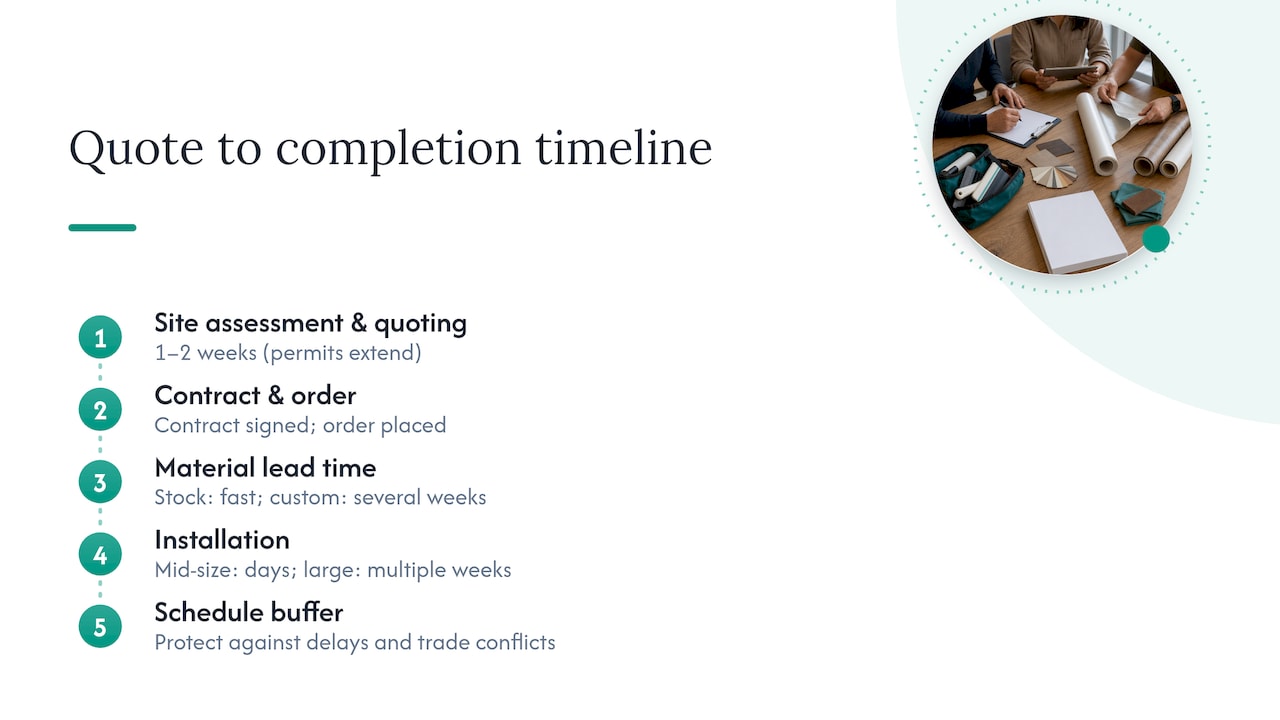
Once a contract is signed, material lead time depends on the product: stock vinyl ships faster, while custom printed graphics or specialty finishes can take several weeks to produce. Installation itself, for a mid-size lobby project, often completes within a matter of days given standard crew-day productivity assumptions, while larger corridors or multi-zone buildings extend into multiple weeks.
Building in buffer time between quote acceptance and your desired completion date protects against material delays and scheduling conflicts with other trades working in the same space.
Total cost: taxes, insurance, and ongoing maintenance
The installed per-square-foot price is only part of the real cost. Sales tax on materials applies in most states and should be confirmed in your written quote rather than assumed. Ask whether the vendor’s price is pre-tax or inclusive.
Insurance considerations work two ways: confirm the installer carries liability coverage, and check whether your own property insurance requires documentation of work performed by licensed contractors for claims purposes later.
Post-installation maintenance contracts are worth evaluating separately from the install itself. Some materials need periodic cleaning with specific products to maintain warranty coverage, and a maintenance agreement, where offered, should specify cleaning frequency, approved products, and what voids the warranty. Factoring these ongoing costs into your total budget, rather than treating installation as a one-time expense, gives a more accurate picture of what the wall finish costs over its full lifecycle.
A perspective on film, waste, and installation time
Architectural interior film’s stretchability and air-channeled adhesive can change installation time and waste generation compared to rigid printed vinyl sheets. Film that conforms to surfaces without heavy trimming often results in fewer installer hours and less offcut waste, a factor that may become more significant as project scale increases.

Getting started: samples, quotes, and the right SKU for your space
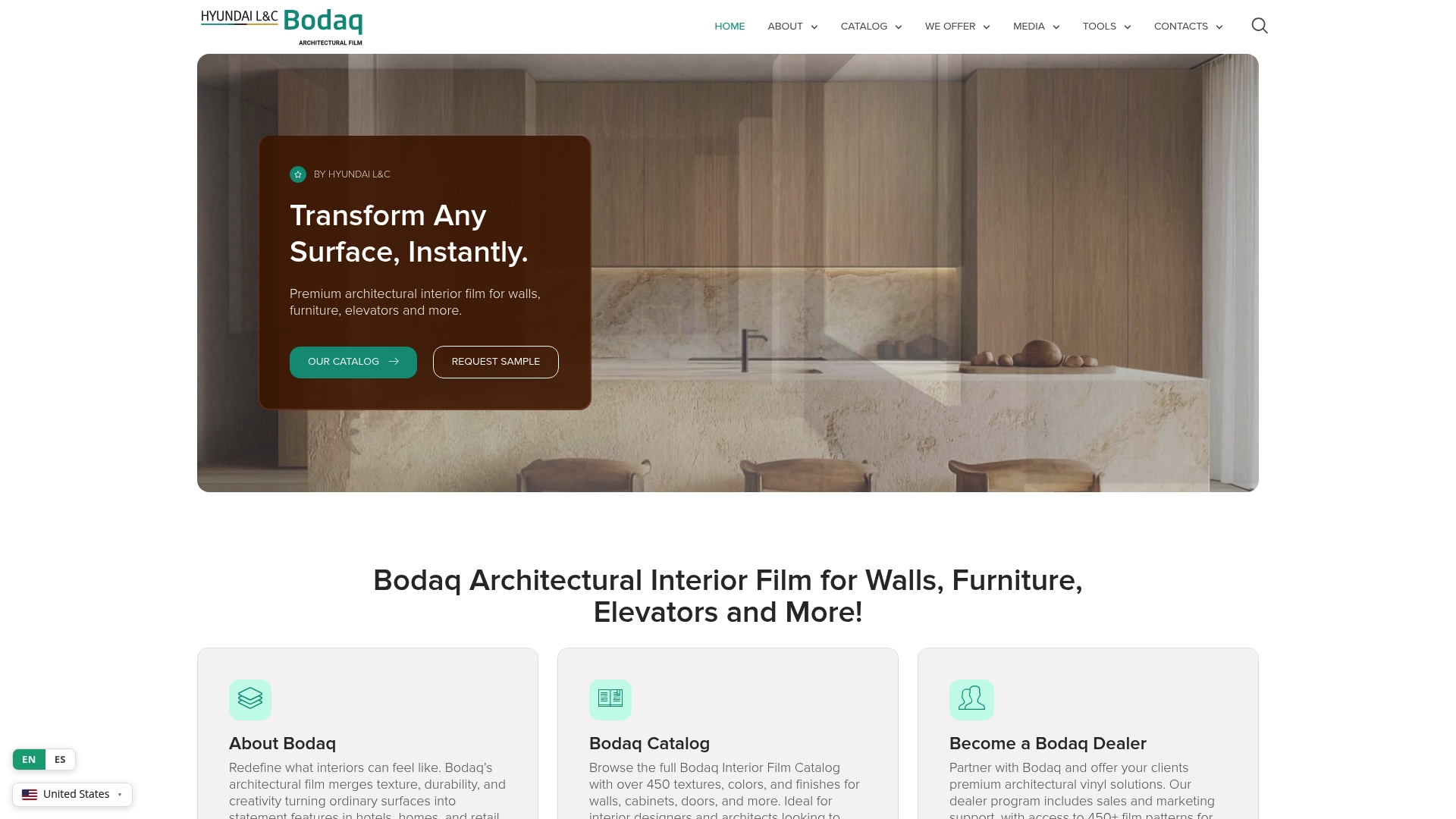
Once you know your budget range, matching it to the right material speeds up your quote request. Bodaq Interior Film covers several collections suited to different commercial looks and budgets, each available through the interior vinyl film collections catalog.
- Sierra Stone NS122 and NS123 (Stone & Marble Collection): suited for high-visual-impact lobbies where a stone look matters more than stone weight.
- Deep Walnut Oak LW109, Natural Oak LW108, and Sandstorm Oak LW116 (Wood Collection): warm, textured tones for hospitality and retail interiors.
- Grey Stone S258, Gentle Creme S257, and Evening Snow S260 (Solid Colors Collection): clean, minimal finishes for corporate and office spaces.
When you request a quote, include the material SKU, the installed per-square-foot price, any substrate prep needed, expected lead time, and warranty terms, the same line items that make any commercial bid comparable.
| Collection | Example SKUs | Best-fit use case |
|---|---|---|
| Stone & Marble | NS122, NS123 | High-traffic, upscale lobbies |
| Wood | LW108, LW109, LW116 | Hospitality and retail interiors |
| Solid Colors | S257, S258, S260 | Corporate and minimalist offices |
Request a sample or a quote through the architectural vinyl film buying guide to compare material and installation details against any other bid you’re holding.
Sources
Pricing figures draw from a commercial vinyl wallcovering cost guide, a custom wall wrap pricing guide, and a fleet wrap pricing analogy for coverage-based cost logic.
- How Much Do Custom Wall Wraps Actually Cost in 2026? | Large Format Printing & Event Graphics
- Commercial Vinyl Wallcovering Installation Cost: Price Range Breakdown for U.S. Projects 2026 – Current Cost
FAQ
How much do wall wraps cost?
Standard commercial vinyl wallcovering runs $2.00 to $4.50 per square foot installed, while custom printed wraps range from $8 to $25 per square foot depending on material and design complexity, according to commercial pricing data. A 2,000 square foot mid-range lobby project often totals $8,000 to $12,000.
How to price a vinyl wrap job?
Start with an itemized bid that separates material, labor, substrate prep, adhesives, and disposal, since lumping these into one number hides where the cost actually comes from. Coverage area, material grade, and installation complexity are the main drivers across both wall and vehicle wrap pricing, per cost driver analysis.
Can I vinyl wrap a wall?
Yes, most interior walls in good condition are suitable for vinyl wallcovering or architectural film, provided the substrate is clean, dry, and structurally sound. Walls with moisture issues, heavy texture, or damage typically need prep work first, which adds to the project cost.
What drives the price difference between cheap and expensive wall wrap materials?
Embossed textures, metallic inks, and specialty laminates add roughly $0.80 to $1.30 per square foot to the material cost compared to standard vinyl, according to commercial wallcovering cost data. Higher-grade materials also tend to last longer and clean more easily, which affects lifecycle cost beyond the initial install.
Do commercial wall wrap installations need a permit?
Most installations don’t require a separate permit, but fire-rating rules in certain building types or egress zones can trigger administrative costs between $200 and $1,000, per commercial installation cost guidance. Confirming code requirements with your installer before the project starts avoids surprise fees later.