Metallic architectural film is a self-adhesive interior vinyl printed and textured to look like brushed steel, aluminum, bronze, copper or aged patina, applied over an existing surface instead of real metal. You get the sheen and depth of metal on walls, doors, elevator cabs, cabinetry and furniture without the weight, the fabrication lead time or the demolition. Below we cover how the finish is built, the looks available, where it works best, which substrates it bonds to and what to check on the spec sheet before you commit.
TL;DR
- Metallic architectural film is a vinyl overlay that reproduces brushed, satin, hammered or oxidized metal on surfaces you already have, with no demolition.
- It suits feature walls, doors, reception fronts, elevator cabs, millwork and furniture in homes, offices, retail and hospitality.
- Match the film to the substrate and the traffic level, and confirm fire rating, emissions certification and warranty on the manufacturer’s data sheet.
- Bodaq’s stretchable, air-channeled film is designed for cleaner, faster installation, so spaces can be refreshed with little downtime.
- Metallic film for windows is a different product: it uses microscopic metal layers to control solar heat, not to decorate a surface.
Table of Contents
- What metallic architectural film actually is
- Metallic finishes and how their looks differ
- Where metallic film applications make the most sense
- Which surfaces it bonds to, and how to prepare them
- How installation works
- Durability, cleaning and maintenance
- What to check before you specify
- Why we believe in film for metallic looks
- Choosing a metallic film for your project
- See the finishes in person
- FAQ
- Sources
What metallic architectural film actually is
The term covers two quite different products, and it helps to separate them early.
Decorative interior film is a flexible vinyl with a pressure-sensitive adhesive on the back. The face carries a printed or embossed metal look, often with a subtle grain such as a linear brushed texture. You stick it onto a wall, door or piece of furniture, and the surface takes on the character of metal. This is the category Bodaq works in, and it is what most designers mean when they search for metallic architectural film.
Metallic window film is a performance product. Window films made with sputtering technology deposit thin metal layers that reflect solar energy, which reduces heat and glare while keeping a modern, neutral-metallic look. It belongs on glazing and solves an energy or comfort problem rather than a styling one.
If you are specifying finishes for walls, doors, cabinets and fixtures, you want the first kind. The rest of this guide is about it.
Why it looks like metal without being metal
Three things sell the illusion. First, the pigments and coatings reproduce the way metal reflects light: a tight, directional sheen for brushed finishes, a soft glow for satin, a broken sparkle for hammered looks. Second, the surface texture follows the real thing, so the grain you see is also a grain you can feel. Third, the film is thin and flexible enough to follow edges and profiles, so seams and corners read as fabricated metal rather than a sticker.
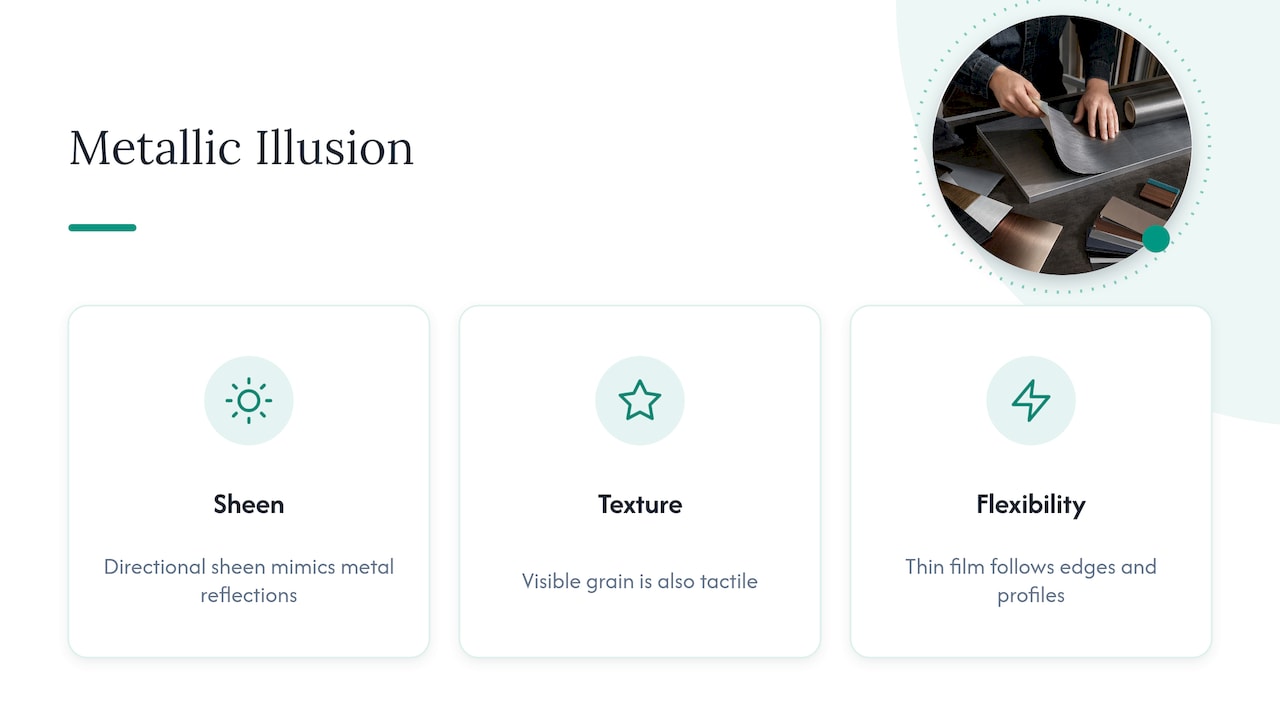
The result is a bit like a tailored garment: it follows the form of what is underneath and reads as intentional rather than applied.
Metallic finishes and how their looks differ
Metal looks fall into a handful of families. Knowing which family you want narrows a catalog of hundreds of options quickly.
| Finish family | Visual character | Where it tends to work |
|---|---|---|
| Brushed steel and aluminum | Fine directional lines, cool and architectural | Elevator cabs, doors, reception fronts, appliance surrounds |
| Satin or matte silver and pewter | Soft, low-glare, quiet | Corporate corridors, healthcare, large wall runs |
| Warm metals: bronze, brass, copper, gold | Rich, heritage feel, color shifts with light | Hospitality lobbies, bars, restaurant millwork, feature walls |
| Oxidized and patina | Aged, mottled, sculptural | Accent walls, retail backdrops, statement furniture |
| Hammered or textured metal | Dimpled, light-catching, tactile | Counter fronts, columns, feature panels |
| Dark metals: gunmetal, blackened steel | Dramatic, immersive | Bars, boutiques, media rooms, cabinetry |
Two practical points. Direction matters on brushed finishes: the grain should run the same way across every panel, so plan your cuts before you start. And finish affects maintenance: high-gloss metallics show fingerprints faster than satin or textured ones, which is worth weighing for door pushplates, handrails and anything touched all day.
Bodaq’s Metal Collection sits alongside wood, stone and marble, solid colors, and fabric and leather collections, in a catalog of more than 450 textures and colors. That breadth is useful because metallic film rarely works alone. A brushed-steel door against a solid-color wall, or a warm copper tone beside a rustic stone surface, often looks better than metal everywhere.
Where metallic film applications make the most sense
Commercial interiors
Offices, lobbies and corridors take a beating, and replacing real metal cladding is slow and expensive. Film lets you change the look of a reception desk front, a run of doors or an elevator interior over a weekend rather than a quarter. Our guides on renovating offices with film in hours, not weeks and on a commercial interior refresh in two days walk through how property teams plan that work.
Elevator cabs are a classic case. Worn panels can be refinished in place, and our piece on an innovative cab interior upgrade shows the approach.
Hospitality
Hotels and restaurants lose revenue every day a room or dining area is closed. Metallic film suits bars, lobby feature walls, guest-room doors, headboard panels and banquette fronts, and installation does not involve the dust, noise or curing time of tile, plaster or metal fabrication. Because a refresh can happen in hours, you can work floor by floor and keep the property open.
Residential spaces
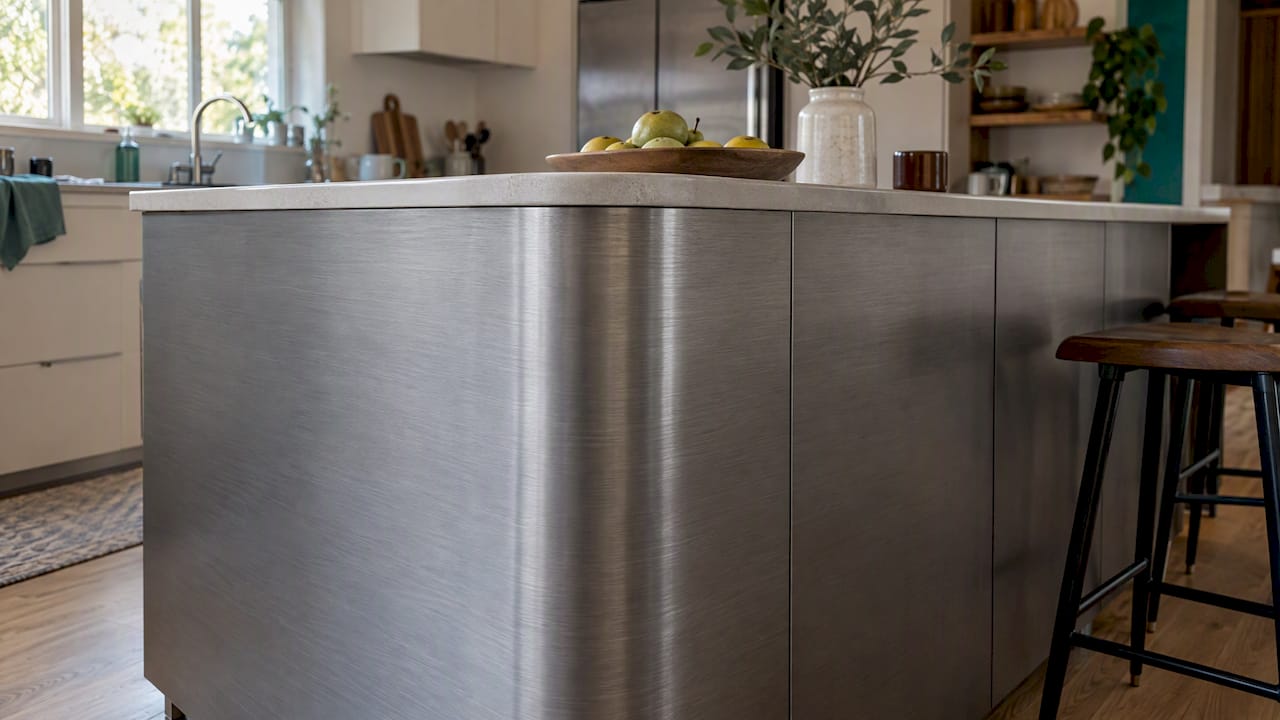
In homes, metallic film is a way to introduce a bold detail without committing to a remodel: a brushed-metal kitchen island, a bronze-toned fireplace surround, a gunmetal door, or worn appliance fronts brought back into line with the rest of the room. Our guide to reinventing your home with architectural film has more ideas.
Retail and branded environments
A metallic finish gives a store a consistent look across locations, because the same film can be specified for every build. That repeatability is a quiet advantage for brands rolling out a design language to many sites.
Furniture and millwork
Tables, credenzas, shelving, lockers and cabinet doors all take film well, particularly on flat or gently curved faces. It is a practical way to unify mismatched pieces under one finish.
Which surfaces it bonds to, and how to prepare them
Architectural films of this type are generally applied to wood, metal, glass, plastic, laminate and expanded PVC, according to the manufacturer data for a widely used film line. Smooth, non-porous, clean surfaces give the best result. Our spec guide, match film grade to substrate, covers the pairing in more depth.
Whatever film you choose, preparation decides how long it lasts:
- Clean thoroughly. Remove dust, grease, wax and residue. Adhesive bonds to the surface, not to dirt.
- Repair defects. Fill dents and gouges and sand rough areas. A metallic finish is reflective, and reflective surfaces reveal every imperfection underneath.
- Let the surface dry and cure. Fresh paint, filler or sealant needs to be fully cured before film goes over it.
- Test a small area. A sample on the actual substrate shows adhesion and appearance in your lighting before you order rolls.
- Condition the room. Install at a stable, moderate temperature, and let the film acclimate in the room first.
Textured plaster, heavily porous masonry or flaking paint are poor candidates until they are skimmed, sealed or stripped. If you are unsure about a substrate, ask for a sample first. Bodaq offers samples and test kits for exactly this reason.
How installation works
Pressure-sensitive adhesive films are applied by hand with a squeegee, and many can conform to flat or curved surfaces, including complex curves, as one manufacturer’s data sheet describes for its own line. Heat, used carefully, helps the film relax around contours.
We designed Bodaq around making that process more forgiving. The film is stretchable, so it follows edges and profiles with less cutting and fewer seams, and the adhesive uses air channels so trapped air can escape instead of leaving bubbles. Our claim is easier, cleaner installation and less waste, and it is the reason many installers favor it on jobs with tight schedules.
A typical sequence looks like this:
- Measure each surface and add a margin for trimming.
- Cut panels to size, keeping the grain direction consistent on brushed metals.
- Peel back part of the liner and position the film, starting from a straight reference edge.
- Squeegee from the center outward, working the air toward the edges.
- Warm and stretch the film into recesses and around corners.
- Trim excess with a sharp blade and press down the edges.
For professional work, trained installers make a visible difference, especially on elevator interiors, wraps around columns and long continuous runs. Bodaq also provides certified training and installation tools for installers and dealers.
Durability, cleaning and maintenance
Film sits on the surface that people touch, kick and lean on, so wear resistance is worth checking. Spec sheets typically quote an abrasion figure; one widely used line lists 7,000 Taber cycles and cleaning with water-based cleaners. Use that as an example of what to look for, and ask for the equivalent figure from whichever film you specify.
A few habits protect any metallic finish:
- Clean with mild, water-based cleaner and a soft cloth.
- Avoid abrasive pads, scouring powders and strong solvents, which can dull the surface.
- Wipe fingerprints from gloss finishes regularly; satin and textured looks hide them better.
- Treat damaged panels locally. Because film is applied in sheets, you can often replace a single panel rather than a whole surface.
Bodaq’s Easy Clean ECF01 from the High-Performance Collection is worth a look for pairing with metal tones in hard-working areas. Our Steel Grey SL402 adds a cool, understated tone to a scheme that leans toward metal.
What to check before you specify
A good finish is only part of the decision. Before you put any metallic film into a drawing set, confirm these on the manufacturer’s documentation:
Fire performance
Interior finishes in the US are classified by flame spread and smoke development under ASTM E84. Under the building code classification, Class A means a flame spread index of 0 to 25 and a smoke-developed index of 0 to 450, with Class B covering higher flame spread ranges. Which class a space needs depends on occupancy and location, such as exit corridors versus rooms, so check the local code and your authority having jurisdiction. Then confirm that the film’s tested class applies to the pattern you are specifying, because ratings can differ between designs.
Emissions and certifications
For offices, schools and healthcare, low-emission credentials matter. CDPH Standard Method V1.2 is widely known as CA Section 01350, and manufacturers use it to document emissions from building products. Ask for the certificate that covers your exact product. Bodaq adheres to eco-friendly standards; our sustainability approach is explained in Refinish, Don’t Replace.
Warranty
Read the term, what it covers, and what conditions it assumes: substrate, environment, installer qualifications. Warranty terms differ by product, so rely on the written document for your film rather than a generalization.
Environment
Exterior sun exposure, steam, constant moisture and heavy cleaning regimes all affect film differently. State the environment when you request samples and ask which grade is intended for it.
Why we believe in film for metallic looks
Metal is one of the most sought-after finishes in interiors, and also one of the most demanding. Solid metal is heavy, costly to fabricate and slow to install, and once it is in, it is hard to change.
We built Bodaq to separate the look from the logistics. A stretchable, air-channeled film means installers can work faster and more cleanly, and with less waste, on the surfaces a project already has. For a property manager, that means a finish refreshed in days instead of weeks. For a designer, it means metal can sit next to wood, stone and fabric patterns in one coherent scheme from one catalog of more than 450 options.
Our advice is to treat metallic film as an accent first. Use it where light and touch will show it off, such as doors, cab interiors, counters and feature walls, then let calmer textures carry the larger surfaces around it. That balance is what makes a space feel layered rather than shiny.
Bodaq
Choosing a metallic film for your project
A short checklist keeps the choice practical:
- Define the role. Is the metal an accent or the main event? Accents allow bolder, warmer or more textured finishes.
- Match finish to traffic. Satin and textured looks forgive handling; gloss rewards low-contact areas.
- Confirm the substrate. Smooth and sealed wins. Test anything doubtful.
- Check lighting. Metallics change dramatically under warm, cool and natural light, so view a sample in place at different times of day.
- Verify the paperwork. Fire class, emissions certification and warranty for the specific pattern.
- Plan the install. Grain direction, seam positions and who will do the work.
If you manage a number of properties or build for clients, our pages on benefits for general contractors and new business opportunities with interior film show how film fits into project workflows. For broader context on surface options, see our guide to interior wall finishing materials.
See the finishes in person
Photos flatter and screens mislead, especially with metallics. Request samples of the metal tones you are considering and view them on your own walls, doors or furniture. Bodaq offers sample and test-kit requests, a full range of installation tools, certified installer training and a dealer program for resellers.
Browse the full Bodaq collections, or start at the Bodaq Interior Film home page to request samples or a quote for your project.
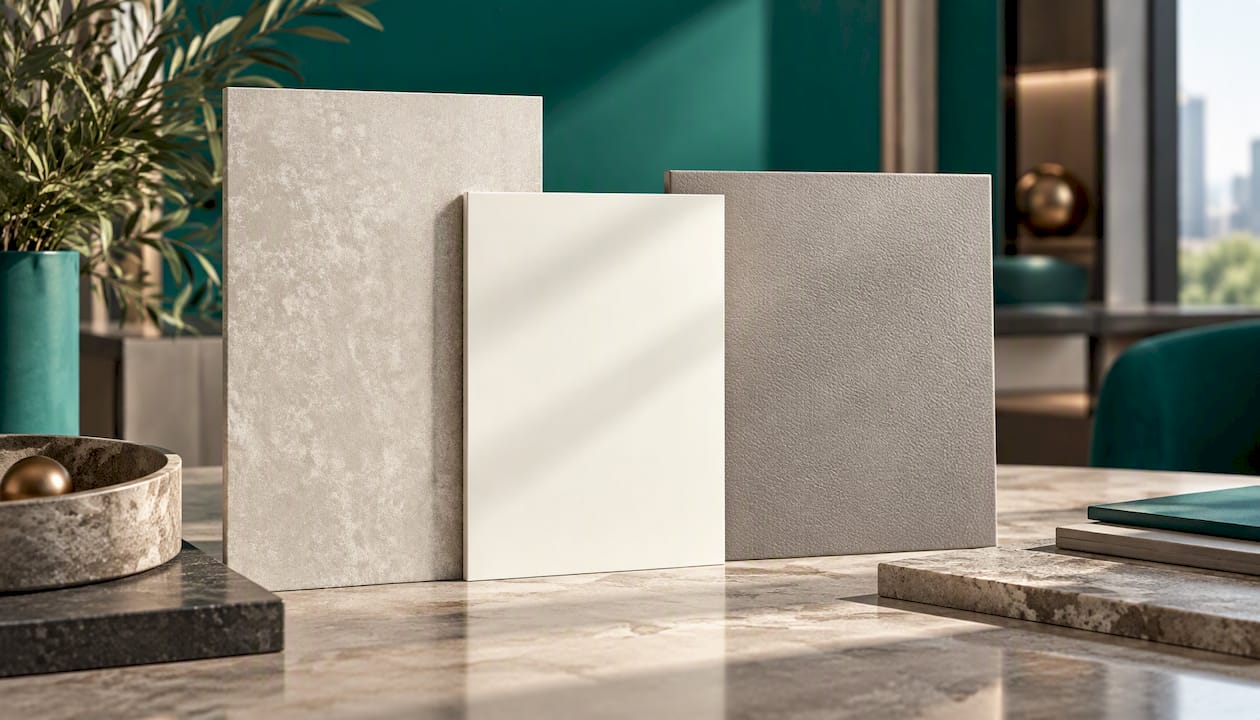
If you want a stone or mineral counterpoint to your metals, Rustic Stone EXF52 is a natural companion.
FAQ
Is metallic architectural film the same as metallic window film?
No. Decorative metallic film is a vinyl overlay used on walls, doors and furniture to imitate metal. Metallic window film uses thin metal layers on glass to reflect solar energy and reduce heat and glare. They share a name but solve different problems.
Can metallic film be used on curved surfaces and columns?
Yes, in most cases. Flexible films can conform to curves, and stretchable films such as Bodaq’s are designed to follow contours with less cutting. Complex compound curves need more skill and some heat, so use an experienced installer and test a sample first.
Does metallic film need to be fire rated?
Often, yes. Interior finishes are classified as Class A, B or C under ASTM E84, and the class a space requires depends on its occupancy and location in the building. Confirm the rating for your specific pattern on the data sheet and with your local code official.
How do I clean it?
Use a soft cloth and a mild, water-based cleaner. Skip abrasive pads and harsh solvents, which can dull the finish. Gloss metallics need more frequent wiping than satin or textured ones.
Can I order samples before committing?
Yes. We offer sample and test-kit requests so you can judge color, grain and sheen on your own surface and in your own lighting before buying rolls.
Sources
- Geoshield USA: metallic window film using sputtering technology
- Manufacturer sales sheet for an architectural film line: substrates, installation, abrasion, warranty
- Classification in accordance with ASTM E84 (interior finish classes)
- CDPH Standard Method V1.2 (CA Section 01350)