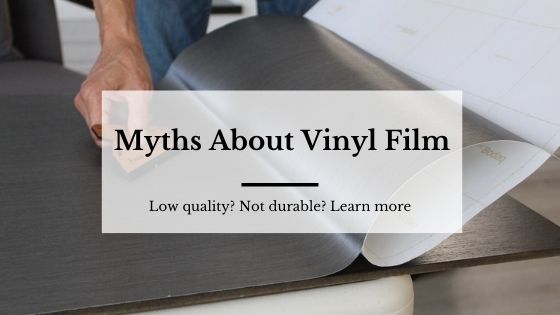
An eco-friendly interior film is a thin, self-adhesive surface material that refinishes existing walls, doors, furniture and elevator cabs instead of replacing them. It earns the label by what it keeps out of the landfill, what it releases into indoor air, and how long it lasts. Judge it on five points: emissions, material makeup, adhesive, third-party standards and service life. This guide walks through each one, then shows how Bodaq interior film fits.
TL;DR
- Refinishing a surface in place avoids demolition debris. That is often the biggest sustainability gain in a renovation.
- Check VOCs and other outgassed compounds, ink type, adhesive chemistry and cleanability before you choose any wall covering.
- Ask for documentation. NSF/ANSI 342 is the American national standard for assessing the sustainability of wallcovering products across their life cycle.
- Eco-friendly does not have to mean fragile. Durability and responsible design can go together in high-traffic spaces.
- Bodaq is our stretchable, self-adhesive film in over 450 textures and colors, made by Hyundai L&C and designed for low-waste, low-disruption upgrades.
Table of Contents
- What eco-friendly interior film actually means
- 1. Start with indoor air: VOCs and outgassing
- 2. Look at material makeup, then at the adhesive
- 3. Ask for standards, not slogans
- 4. Durability is part of sustainability
- 5. Count the waste you never create
- 6. Downtime counts too
- How to choose the best eco-friendly wall covering for your space
- Matching texture to intention
- Perspective: why we believe in refinishing
- Ready to see it on your surfaces?
- FAQ
- Sources
What eco-friendly interior film actually means
The phrase gets used loosely, so it helps to break it into parts. A wall covering or architectural film can be called eco-friendly when it does well on at least four fronts:
- Indoor air quality. It releases few volatile organic compounds (VOCs) and other emissions once it is on the wall.
- Material makeup. The substrate, inks and additives are chosen with care, and the film avoids unnecessary hazardous compounds.
- Process waste. Installation creates little scrap, and the old surface stays in place instead of heading to a dumpster.
- Service life. It lasts long enough that nobody has to redo the job in a few years.
The last two get overlooked. A “green” product that peels, stains or needs replacing in three years is not green in any practical sense. Likewise, a spotless emissions profile matters less if the project still generates a pile of demolition debris.
Interior film is a good fit for this thinking because it works over what is already there: drywall, laminate cabinetry, tired wood doors, metal frames, column wraps, reception desks, elevator panels. You change the look and feel of a surface without tearing it out. For a deeper look at how we think about this, see our overview of sustainable interior design materials and examples.
1. Start with indoor air: VOCs and outgassing
Indoor air is where wall coverings can do the most quiet harm. According to a trade-press overview of wallcovering chemistry, the EPA ranks indoor air pollution among the top five environmental risks to public health, and some wallcovering products contain compounds such as phthalates, heavy metals and toxic flame retardants that can affect room air quality (What’s in a Wallcovering?). The same source points to two practical responses: PVC-free alternatives or vinyl made without additives such as phthalates, and moisture-stable aqueous adhesives.
So when you evaluate any film or wall covering, ask these questions:
- Which VOCs and other emissions does it release, and is there test data?
- Does the formulation include phthalates or other additives of concern?
- What inks are used for printed or textured designs?
- What adhesive is used, and is it water-based or low-VOC?
- How easily does the surface clean without harsh chemicals?
That last question is easy to skip. A surface that needs aggressive cleaners adds its own chemical load to a room over the years. A tough, wipeable finish lets facilities teams use mild cleaning routines. Our Easy Clean High-Performance Collection ECF01 was developed with that day-to-day reality in mind.
If low-emitting finishes are a priority for your project, our guide to choosing low-VOC interior finishes goes deeper on paints, coatings and adhesives.
2. Look at material makeup, then at the adhesive
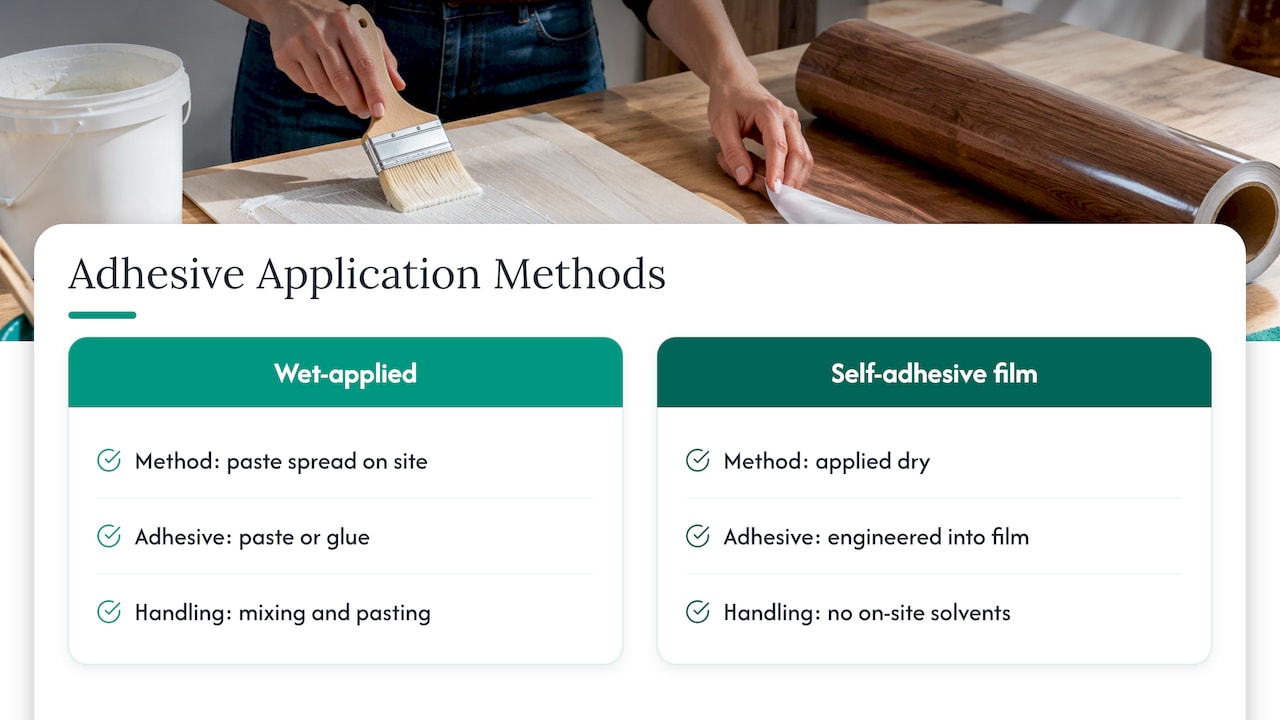
Material choice is only half of the emissions picture. The adhesive that holds the covering to the wall matters just as much. Wet-applied systems rely on paste or glue spread on site, and the chemistry of that paste goes into the room with the covering. A self-adhesive film, by contrast, arrives with its adhesive engineered into the product and applied dry, with no mixing, pasting or on-site solvent handling.
Our film is designed around that idea. It is stretchable, so it conforms around curves and edges without heavy heat work or aggressive trimming, and its air-channeled adhesive lets trapped air escape as you work. That means fewer bubbles, fewer restarts and fewer ruined sheets. Fewer ruined sheets means less waste, which is the whole point of a sustainability-minded finish.
Pro tip: whatever product you choose, match it to the substrate. Surface prep (clean, dry, sound, and free of loose paint or dust) is the difference between a finish that lasts a decade and one that lifts at the corners in a year.
3. Ask for standards, not slogans
Green claims are cheap. Documentation is not. Before you specify, ask the manufacturer what independent frameworks and test results back up each claim.
One useful reference point in the U.S. is NSF/ANSI 342, an American National Standard that gives a sustainability assessment framework for wallcovering products, covering the full life cycle from raw material extraction to end-of-life management (NSF/ANSI 342). Because it looks at the entire life cycle, it is a more meaningful lens than a single “low VOC” sticker.
A practical documentation checklist for any eco-friendly wall covering:
| What to request | Why it matters |
|---|---|
| Emissions test data | Shows what the product releases into indoor air |
| Material and additive disclosure | Reveals phthalates, heavy metals or flame retardants of concern |
| Adhesive specification | Confirms the bond system fits your air-quality goals |
| Life-cycle or sustainability standard documentation | Gives a recognized framework behind environmental claims |
| Durability and cleanability data | Predicts how long before the surface needs replacing |
| Installation and care instructions | Protects performance and any warranty |
For Bodaq specifically, we design to eco-friendly standards and encourage project teams to request current documentation for their specification package. Our write-ups on sustainability in design and Bodaq as a sustainable solution explain how we approach it.
4. Durability is part of sustainability
A common assumption is that the greenest wall covering must be the most delicate. That is outdated. A manufacturing-industry perspective notes that historically only vinyl substrates met the strictest durability requirements for Type II and Type III wallcoverings, but newer fiber-based papers and PVC-free fabrics have since been engineered to meet Type II specifications (What’s in a Wallcovering?).
The lesson for specifiers: durability and responsible material choice are no longer a trade-off. Match the product to the traffic. A guest-room accent wall faces very different wear than a hospital corridor, a school hallway or a restaurant host stand.
Here is a quick way to think about wear by space:
- Low traffic (bedrooms, home offices, accent walls): texture and color matter most. Almost any quality film performs well.
- Medium traffic (living areas, retail displays, offices): look for scuff resistance and easy cleaning.
- High traffic (corridors, lobbies, elevators, hospitality back-of-house): prioritize abrasion resistance, cleanability and edge adhesion.
That last category is where certified durability earns its keep, and where our high-performance collections are aimed.
5. Count the waste you never create
Most sustainability checklists focus on what a product is made of. Fewer ask what happens to the old surface. In a typical wallcovering replacement or cabinet swap, the old material gets demolished, hauled away and replaced. Refinishing skips that step.
With a film, you cover the existing surface. The cabinet door stays, the wall stays, the elevator panel stays. You are changing the skin, not the structure. This is why our renovator-focused guide on sourcing sustainable renovation materials treats reuse as the first sourcing decision.
There is a second kind of waste: installer scrap and failed attempts. Stretchability lets installers work around corners and contours with less cutting, and the air-channeled adhesive helps reduce rework. Both mean less material thrown away on the job.
6. Downtime counts too
For commercial and hospitality owners, “sustainable” has to be practical. A refresh that closes a room for two weeks costs real money and creates real disruption. Film installs without the dust, wet trades and curing time of conventional finishing.
A concrete example comes from the elevator industry. One trade-magazine feature describes an elevator refresh service that applies a self-adhesive finish on site directly over existing doors, interior panels and landing frames, typically within one or two days and without taking the elevator out of service. The same article notes that the service has partnered with Bodaq Finishes, the supplier of Bodaq architectural film (Surface Deep, Elevator World).
We cover the process in more detail in our guide to elevator refinishing with Bodaq, and in our look at cab interior upgrades. For property managers running occupied buildings, the same logic applies to lobbies, corridors, conference rooms and guest rooms: work in sections, keep the space open, and finish quickly.
Contractors will find a fuller breakdown in architectural film benefits for general contractors.
How to choose the best eco-friendly wall covering for your space
Use this sequence for any room, from a home office to a hotel corridor.
- Define the surface. Drywall, wood, laminate, metal, glass frame or existing wallcovering? Each has different prep needs.
- Define the wear. Estimate traffic, cleaning frequency and contact with luggage, carts, chairs or hands.
- Set your air-quality goals. Decide which emissions, additives and adhesive types you want to avoid, and request documentation to match.
- Ask about standards. Look for documentation that covers the product’s full life cycle, such as the framework in NSF/ANSI 342.
- Request samples. See the color and texture in your own light. A sample on the actual wall beats any screen image.
- Plan the installation. Confirm room conditions, surface prep, installer experience and sequencing.
- Plan the care routine. Choose a finish your team can clean with gentle products.
On step 6, product instructions matter. Some wallcovering systems have strict temperature and timing windows. One industry roundup, for instance, notes that a specific wallcovering needs room conditions above 65°F for several days before, during and after installation (Choosing Sustainable Wallcoverings). Always follow the manufacturer’s installation guide for the product you use, and treat a climate-controlled, clean, dry space as the baseline for any film job.
Matching texture to intention
Sustainable does not mean beige. Our catalog spans over 450 textures and colors across five collection families, and each can support a different design intention:
- Wood: warm, organic grain that brings a cocooning effect to offices, hospitality rooms and homes without the cost and resource demand of real veneer.
- Metal: crisp, reflective surfaces that read as sculptural in elevators, retail fixtures and feature walls.
- Stone & Marble: the drama of mineral veining with none of the weight. Rustic Stone EXF52 is a good example of a bold, tactile look.
- Solid Colors: immersive color drenching, from calm neutrals to saturated tones. Deep Forest S266 brings a grounded, nature-inspired mood.
- Fabric & Leather: soft, tailored textures for headboards, lounge walls and reception areas.
Pro tip: use film where it earns its keep. A single wrapped feature wall, a refinished set of doors or a consistent finish across a hotel corridor changes how a space feels while keeping the rest of the structure intact.
Perspective: why we believe in refinishing
We designed Bodaq on a simple belief: the most responsible material is often the one you do not have to throw away. Most interiors do not fail because the structure is bad. They fail because the surface looks tired. Refinishing addresses that directly.
Our film is stretchable and self-adhesive, with an air-channeled adhesive that makes installation cleaner and more forgiving. That matters for sustainability because a forgiving product creates less scrap, fewer redos and shorter disruption for the people using the space. It also gives architects and designers a catalog of over 450 textures and colors, so choosing a lower-impact route never means compromising the look.
We also think specifiers should push every supplier, including us, for clear documentation. Eco-friendly is a claim that should come with paperwork. We build to eco-friendly standards, and we welcome project teams who want to review what that means for their specification.
Durability closes the loop. A finish that holds up to traffic, cleaning and time is a finish nobody has to replace early. That is where our high-performance collections are aimed, from hospitality corridors to elevator cabs.
Bodaq
Ready to see it on your surfaces?
If you are planning a renovation or fit-out and want a low-waste, low-disruption finish, start with our full range of interior film collections. You can browse Wood, Metal, Stone & Marble, Solid Colors and Fabric & Leather, then request samples to test color and texture in your own space. Professional installers and resellers can also ask about installation tools, certified training and the dealer program through Bodaq Interior Film.
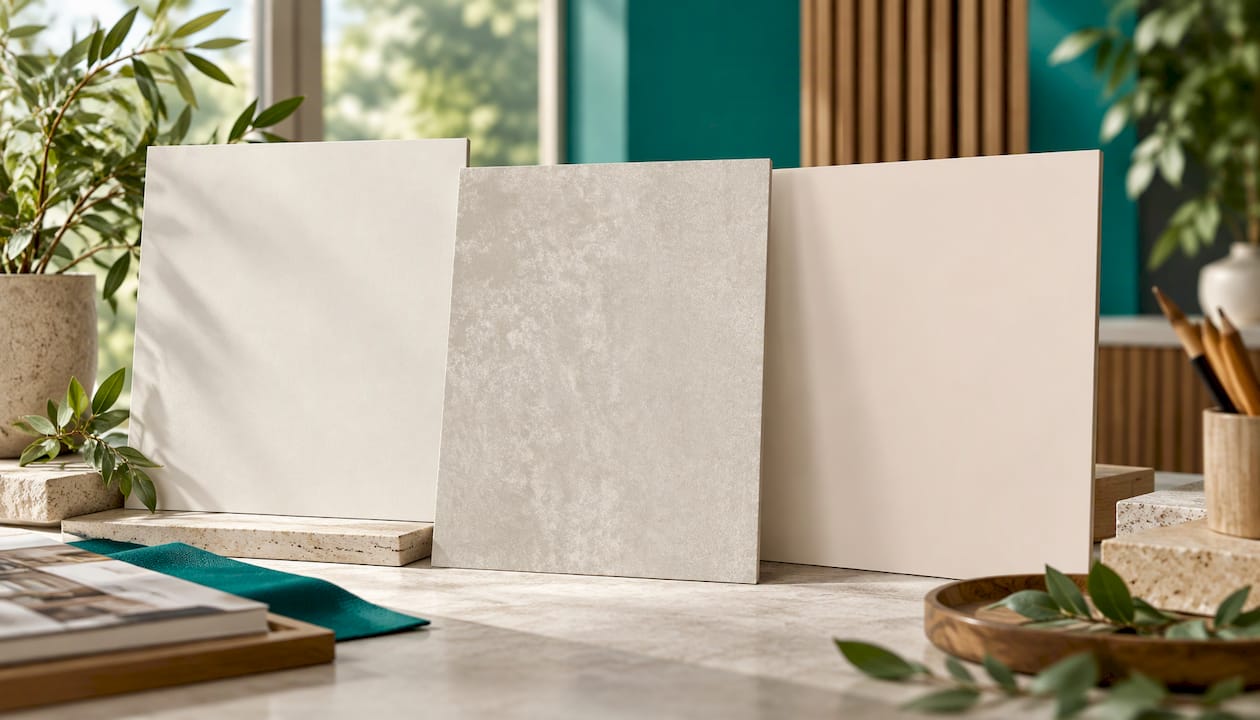
Designers, property managers and contractors can use the same route to get specification support for a project, so the finish you choose matches your performance and sustainability goals from day one.
FAQ
Is interior film an eco-friendly alternative to wallpaper or paint?
It can be, depending on the product and project. Film covers the existing surface, so it avoids demolition debris, and a self-adhesive format avoids on-site pastes. Compare emissions data, adhesive type and durability for each option, and ask suppliers for documentation.
What should I look for in an eco-friendly wall covering?
Check VOC and other emissions, whether additives such as phthalates are present, what inks and adhesive are used, and how easily the surface cleans. Then look for life-cycle documentation, such as the framework in NSF/ANSI 342, and match the product’s durability to your traffic level.
Does eco-friendly mean less durable?
Not anymore. Industry sources note that PVC-free and fiber-based wallcoverings can now meet Type II durability specifications. Our high-performance collections are designed for demanding settings, so you can pursue responsible choices and still expect a finish that wears well.
Can film be installed without closing a space?
Often, yes. Film installs without wet trades or curing time, so work can proceed in sections. In one documented elevator example, a refresh using Bodaq film was typically finished in one or two days without taking the elevator out of service.
How do I choose a color or texture before committing?
Request samples and view them on the actual surface in your lighting, morning and evening. Our collections span wood, metal, stone and marble, solid colors, and fabric and leather, so you can compare several looks side by side.
Sources
- What’s in a Wallcovering?
- NSF/ANSI 342 – 2019
- Surface Deep, Elevator World
- Choosing Sustainable Wallcoverings: Types, Emissions, and Non-PVC Alternatives