Elevator wrap installation is a prep-heavy, finish-light job. You confirm what your local code allows, clean and degrease every surface, measure, apply an architectural film panel by panel, and trim around the controls and clearances. Done well, a cab or a set of doors can go from dated to design-forward in a day or two, with no demolition and no weeks of downtime.
This guide walks through the whole process the way we would brief a facility manager, designer or general contractor: what to check before you order, how the work runs on site, and where installs go wrong.
TL;DR
- Check with your local authority having jurisdiction (AHJ) before you buy film. Permit rules for cosmetic wraps differ by state and city, and fire-rated doors need special attention.
- Surface prep decides the result. Degrease with isopropyl alcohol, fix dents and remove old adhesive before any film touches the wall.
- Stretchable, air-channel film forgives curves, door edges and trim far better than rigid sheet goods, which shortens the job and cuts waste.
- Never cover controls, required markings or the door clearances your elevator contractor has set.
- Plan the work in phases so one car stays in service while the other is finished.
Table of Contents
- What elevator wrap installation actually covers
- Before you order: code, permits and safety
- Choosing film that will survive an elevator
- The installation process, step by step
- What a wrap does and does not fix
- Our perspective: why stretch and prep beat speed
- Bring Bodaq into your elevator project
- Common mistakes to avoid
- FAQ
- Sources
What elevator wrap installation actually covers
An elevator wrap is a self-adhesive architectural film applied over existing surfaces: cab walls, interior and exterior door panels, door frames, return panels and sometimes the hoistway-side landing doors. The film replicates wood grain, stone, metal, fabric or a solid color, so a scuffed stainless or laminate cab reads as a new finish.
It is a different product from printed graphic wraps used for advertising. Those carry artwork and are designed to be swapped out. Architectural film is chosen for the look of a material and for durability in a space people touch hundreds of times a day. The installation method overlaps, but the expectations differ: a finish film is meant to disappear into the architecture and stay put for years.
Most projects fall into three scopes:
- Door-only wraps. Car doors and landing doors on each floor, often the most visible upgrade in a lobby.
- Cab interior wraps. Side and back walls, plus return panels and sometimes the ceiling frame.
- Full refresh. Doors, cab, frames and nearby millwork wrapped in one coordinated palette so the lobby, hallway and elevator read as one design.
If you are still deciding between a wrap and a larger remodel, our guide to choosing the right elevator cab interior upgrade lays out the options, and our elevator wrap cost breakdown covers budgeting for U.S. projects.
Before you order: code, permits and safety
This is the step most guides skip, and it is the one that can stop a project after the film arrives.
Check with the authority having jurisdiction
Rules for elevator wraps are not uniform across the United States. Some jurisdictions treat even a cosmetic wrap as an alteration that needs a permit, while others exempt decorative wraps under conditions. Nevada, for example, lists specific exemptions in its administrative code for work that does not trigger the permit requirement. Your state or city elevator inspection office is the authority that decides for your building, so call it first and get the answer in writing.
Interior materials and flame performance
The model elevator safety code, ASME A17.1, limits what can be exposed inside a car. Rule 204.2a requires materials exposed to the car interior to be metal or to meet flame-spread and smoke-development limits in their end-use configuration. You can read the rule text on UpCodes, and California’s Division of Occupational Safety and Health explains how it applies in its elevator circular letter. Practically, that means you should ask any film supplier for the test documentation that supports use in a car, and give it to your elevator contractor and inspector before the install date. Our technical bulletins are the place to start for Bodaq product documentation.
Fire-rated doors need extra care
Landing doors are frequently part of a fire-rated assembly. UL explains that the certification covers the door panel and its construction, not aftermarket additions, and that adding a wrap or cladding can compromise the rating unless the whole assembly is retested. If your landing doors carry a fire rating, confirm with your AHJ and elevator contractor whether film is acceptable before you wrap them.
Respect the door clearances
Elevator doors operate within tight tolerances. The widely cited 3/4 and 4 rule limits the gap between the hoistway door and the landing sill edge to 0.75 inches, and the distance between the landing door face and the car door to 4 inches, as summarized in a manufacturer’s planning guide built on ASME A17.1. Film is thin, but stacked layers at door edges, overlapping seams and thick trim pieces can matter. Keep film off the sill and the moving edges unless your elevator contractor says otherwise.
Keep controls and markings clear
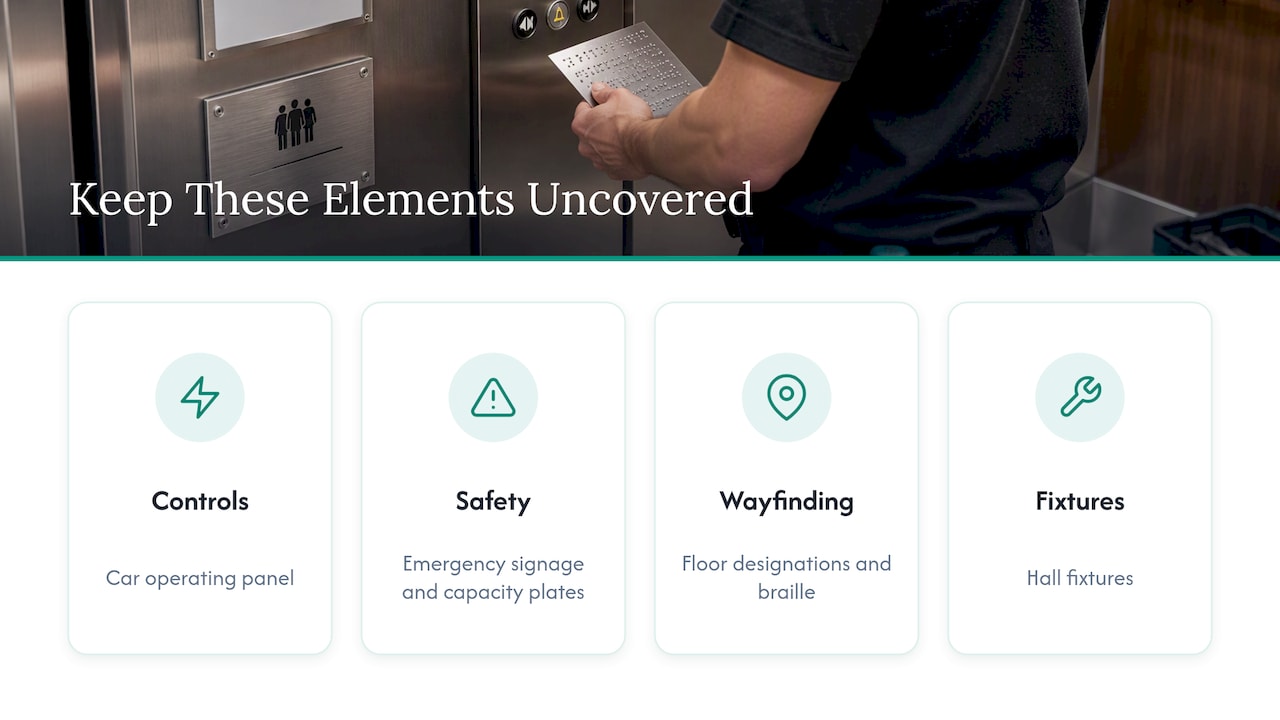
Never cover the car operating panel, emergency signage, capacity plates, floor designations, braille or hall fixtures. Accessibility requirements for elevators, including controls and signage, are set out in the U.S. Access Board’s ADA guidance. Cut the film cleanly around each element rather than over it.
Choosing film that will survive an elevator
An elevator cab is one of the hardest finishing environments in a building. Luggage carts, handbags, keys, cleaning chemicals and constant hand contact all take a toll. A few criteria matter most:
- Stretch and conformability. Cab walls and door panels often have flanges, reveals and slight curves. A stretchable film wraps these without tenting or lifting.
- Air-channel adhesive. Tiny channels let trapped air escape as you squeegee, so bubbles are easier to chase out and repositioning is more forgiving.
- Surface durability. Look for a protective top layer and documented performance for high-traffic interiors.
- Pattern repeat and seam planning. Wood and stone patterns need grain direction and vein matching planned before you cut.
- Cleanability. Check that your cleaning crew’s products are compatible with the film.
Bodaq interior film by Hyundai L&C is built around those needs: a stretchable, self-adhesive architectural film in more than 450 textures and colors. For elevators, designers tend to gravitate toward a handful of looks:
| Look | Where it works | Example from the catalog |
|---|---|---|
| Warm wood | Hospitality, residential towers, medical offices | Natural Oak LW108 |
| Dark, moody wood | Boutique hotels, executive floors | Smoked Charcoal Oak LW113 |
| Stone and marble | Lobbies, luxury condos | Arabescato NS815 |
| Brushed or warm metal | Corporate offices, retail | Brass RM008 |
| Calm solid color | Healthcare, minimalist interiors | Silver Mist S263 |
| Easy-clean surface | Heavily trafficked service cars | Easy Clean ECF01 |
Browse the full range in our collections of interior vinyl film patterns, or request samples and tape them inside the actual cab. Elevator lighting is often warm and low, and a stone that looks crisp in a showroom can turn muddy under cab LEDs.
The installation process, step by step
Exact steps vary by film, substrate and site, and certified installers will follow the manufacturer’s instructions. This is the general sequence of a well-run job.
1. Survey and measure
Walk the cab and every landing with the installer. Note substrate type (painted steel, stainless, laminate, old film), damage, hardware, door gaps and anything that must remain exposed. Measure each panel and add allowance for trimming and wrapping edges. For patterned film, plan layout so grain or veining runs the same direction on every panel, and order enough material from the same production run.
2. Plan the shutdown
A single cab can usually be finished in one to two working days, depending on scope and substrate condition. Door-only jobs go faster. In a building with multiple cars, take one out of service at a time and keep the others running. Our guide to planning work without disrupting your building covers phasing in occupied properties, and hospitality teams in particular will want overnight windows for lobby-facing doors.
3. Protect and prepare the cab
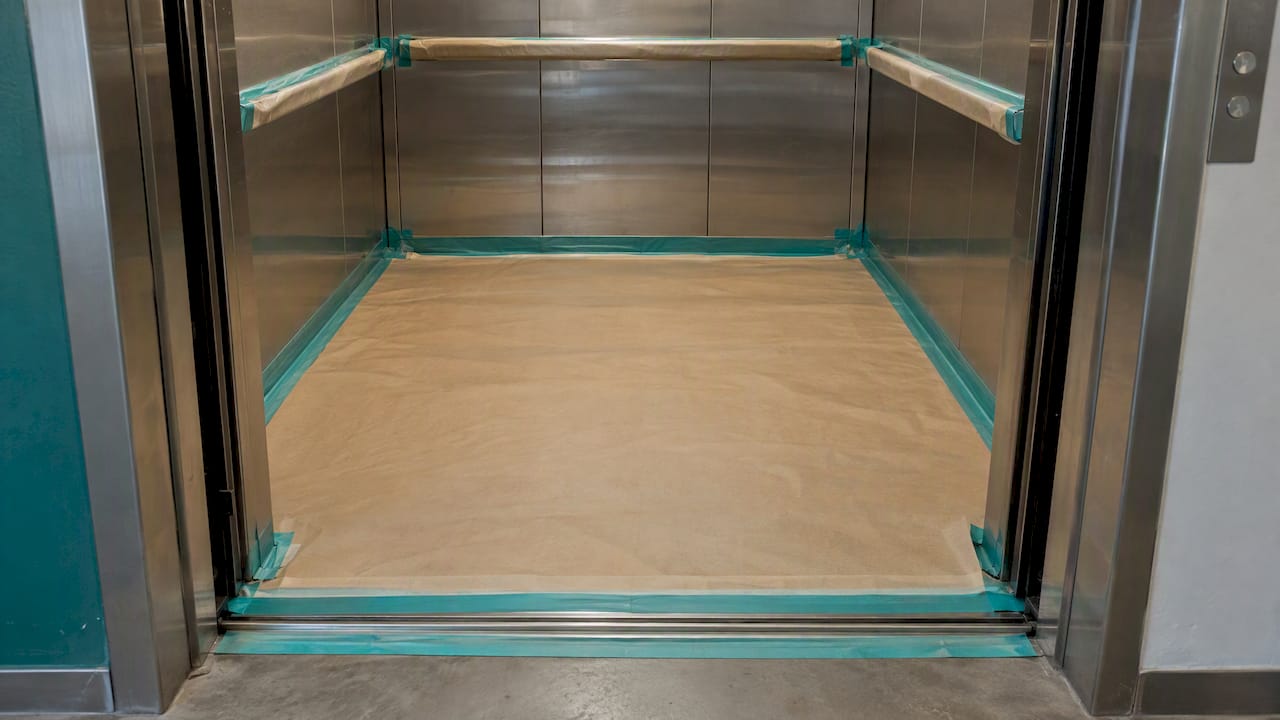
Lift out or mask handrails, kick plates and trim where possible. Cover the floor and the sill. Remove or tape off the operating panel, lighting and signage according to your elevator contractor’s direction. Anything that cannot be removed gets masked with care so tape never touches the film’s bonding area.
4. Clean and degrease
Elevator surfaces collect hand oils, cleaning residues and sometimes lubricants, and these are adhesion killers. A dry wipe rarely does the job. Wash with a mild cleaner, then degrease with isopropyl alcohol and lint-free cloths, changing cloths often so you lift contamination rather than spread it. If you are wrapping over an older film, remove it completely along with every trace of residual adhesive, or the new film will inherit the old one’s failure points.
5. Repair the substrate
Film follows what is under it. Dents, deep scratches, raised seams and rust spots telegraph through, especially with glossy or metallic films. Fill, sand and prime damaged areas, then clean again. Smooth, sound, non-porous surfaces such as properly prepared painted metal or laminate bond best. If a surface is flaking, porous or poorly bonded itself, film is not the fix until that is resolved.
6. Cut and test-fit
Cut panels oversize, with a few extra inches on each side for handling. Dry-fit with low-tack tape to check pattern alignment, seam placement and clearance around fixtures. Seams in a cab should land at natural breaks such as panel joints, not in the middle of a wall at eye level.
7. Apply the film
Remove the liner gradually while keeping the film taut. Start at a reference edge or centerline, tack down the first section and work outward with a felt-edged squeegee, using overlapping strokes so the air-channel adhesive can push air toward the edges. Stretchable film lets you ease around reveals and door flanges, and heat applied carefully helps it conform to recesses. Avoid overstretching, particularly with patterned films, since distortion shows in the grain or the veining.
8. Trim, edge and detail
Use a sharp blade and change it often. Cut around controls and hardware, wrap door edges where the design and clearances allow, and keep the film clear of the sill and moving gaps as discussed above. Finish edges with firm pressure so they do not catch a sleeve or a cart.
9. Post-heat, inspect and clean up
Heat-set edges and recessed areas per the manufacturer’s guidance, then walk the cab with raking light to catch bubbles, lifted corners and pattern mismatches. Reinstall hardware, remove protection and hand the car back to the elevator contractor for functional checks before it returns to service.
What a wrap does and does not fix
Be honest at the scoping stage. Film restores and transforms appearance. It does not repair mechanical problems, fix ride quality, replace worn flooring, or correct structural damage. If panels are bent, rusted through or delaminating, replace or repair those first. If the car is due for modernization anyway, ask whether a refinish gives the building a few more good years at a fraction of the disruption. Our piece on avoiding costly replacements with elevator wraps goes through that decision, and our scope and finish checklist for facility managers helps you avoid the usual spec errors.
Lighting also changes how a new finish reads. Many teams pair a cab or lobby refinish with fresh illumination, and custom interior accent lighting can bring out the grain of a wood film or the veining of a stone pattern, as long as any change inside the car goes through your elevator contractor.
Our perspective: why stretch and prep beat speed
We develop Bodaq to solve a specific problem: surfaces that still work but look tired, in buildings that cannot afford to close. The elevator is the perfect test. It is small, visible to everyone and unforgiving of mistakes.
Here is what we believe after watching how these projects succeed and fail:
- The finish is only as good as the prep. A great film on a greasy wall is a short-lived film. Budget time for cleaning and repair, and treat it as part of the scope rather than an extra.
- Stretch is a design tool, not just a convenience. When film conforms to door flanges and reveals, you can wrap the whole assembly and avoid awkward visual breaks. It also means less rework and less scrap on site.
- Cohesion matters more than any single pattern. A warm oak cab that picks up the lobby millwork feels intentional. Use the same material family across elevator, reception desk and corridor doors, and the building reads as a single design idea.
- Code conversations belong at the start. The best installs we see involve the elevator contractor and the inspector from the first day, not the last.
Film is not a shortcut around good building practice. It is a way to get a high-end result while keeping a building alive and occupied.
— Bodaq
Bring Bodaq into your elevator project
If you are specifying a cab or door refinish, we can help you match a look to your building and supply the film, installation tools and samples your installer needs. Start with the Bodaq collections to see wood, metal, stone and marble, solid color, and fabric and leather options, then request samples to test in your own cab lighting. Contractors can also explore our certification and training through the Bodaq team, and our guide for general contractors explains how film fits into a larger fit-out schedule.
Common mistakes to avoid
- Skipping the AHJ call. A film installed without clearing permit or code questions can be ordered removed.
- Wrapping fire-rated doors without confirmation. The rating applies to the assembly, so ask first.
- Under-preparing the surface. Most lifting and bubbling traces back to oils, residue or old adhesive.
- Ignoring seam and pattern layout. Mismatched grain on adjacent panels is the most visible flaw in a finished cab.
- Covering what must stay visible. Controls, markings and signage stay accessible.
- Choosing from a small online swatch. Test samples in the car under its own lighting.
- Sending in a general crew. Elevator work benefits from installers trained on architectural film. Ask about certification and references on comparable cabs.
FAQ
How long does elevator wrap installation take?
A door-only wrap can often be finished in hours per car, while a full cab interior usually takes one to two working days. Time depends on substrate condition, the number of panels, pattern matching and how much old film must come off. Schedule the longer window if you are removing an existing wrap.
Do I need a permit to wrap an elevator?
It depends on where you are. Some U.S. jurisdictions require an alteration permit even for cosmetic work, and others exempt decorative wraps under conditions, as Nevada does in its code. Ask your local AHJ and your elevator contractor before ordering anything.
What is the 3/4 rule for elevators?
It is shorthand for the 3/4 and 4 rule in ASME A17.1: no more than 0.75 inches between the hoistway door and the landing sill edge, and no more than 4 inches between the landing door face and the car door. When wrapping, you keep film from adding bulk or interfering with these clearances.
Is vinyl wrap easy to install?
Flat panels are straightforward for a trained installer, but elevators add tight tolerances, door edges, fixtures and code considerations. Stretchable film with air-channel adhesive makes the work more forgiving. For a result that lasts, use an installer experienced with architectural film rather than treating it as a casual DIY project.
Sources
- Nev. Admin. Code § 455C.506, Legal Information Institute
- Material for Passenger Car Enclosure, UpCodes
- Elevator Circular Letter E-02-01, California DIR
- Elevator Door Wraps and Claddings: What Code Authorities Need to Know, UL
- Vuelift planning guide
- Chapter 4: Elevators and Platform Lifts, U.S. Access Board