Tenant improvement finishes are the visible surface layers of a leased space: paint, wall coverings, flooring, ceilings, millwork, doors and counters. They are also where most of a TI budget turns into something people actually see. Choose them well and a plain suite becomes a branded, durable workplace. Choose them badly and you repaint, replace or patch within a few years, usually while the lease clock is running.
This guide covers what counts as a finish, what the numbers look like in the US, how to match finishes to the lease, and where self-adhesive architectural film fits when you need a bold result without a long shutdown.
TL;DR
- Finishes are the surface layer of a TI project. They are the part of the scope you can still change late, so spec them with the lease term and the allowance in mind.
- Budgets swing widely by use. Office build-outs commonly run $50 to $85 per square foot, medical $150 to $300, restaurants $200 to $500, so finishes are one of the few places to control cost.
- Wet trades such as paint, laminate, tile and wallcovering add cure time and dust. Self-adhesive film lets you refinish existing walls, doors and millwork in place.
- Low-emitting materials matter for LEED v5 interior credits, so check emissions documentation before you commit to any finish.
- Ask your accountant how finish work will be treated for tax before you sign the scope.
Table of Contents
- What counts as a tenant improvement finish
- What tenant improvement finishes cost
- How finishes affect your schedule
- Matching finishes to the lease
- Durability and health: what to check before you specify
- Architectural film as a tenant improvement finish
- Our perspective: finish the surface, not the whole room
- How to specify film in a TI scope
- Ready to see the finishes in person?
- FAQ
- Sources
What counts as a tenant improvement finish
A tenant improvement, or TI, is the interior build-out of leased commercial space so it works for one specific tenant. The landlord delivers a shell or a previously used suite, and the tenant (or the landlord, under a work letter) builds out what the business needs. Finishes are the last layer of that build-out, after framing, MEP and drywall.
In practice, the finish schedule usually includes:
- Walls: paint, vinyl or fabric wallcovering, wood or laminate panels, feature walls, reception backdrops.
- Floors: carpet tile, LVT, polished concrete, tile.
- Ceilings: acoustic tile, open plenum paint, baffles.
- Doors and frames: wood, hollow metal, glass, and their surface treatments.
- Millwork and counters: reception desks, break room cabinets, built-in storage.
- Specialty surfaces: elevator interiors, column wraps, storefront details.
The industry shorthand “finish out” or “tenant finish” describes the same idea: customizing a space for the incoming business. If you are reading a lease, the finish scope is normally spelled out in the work letter, which also says who pays for what.
What tenant improvement finishes cost
Finishes sit inside the overall build-out number, so start with the big picture. One 2026 estimating guide puts basic office build-outs at $50 to $85 per square foot, retail at $75 to $150, medical or dental at $150 to $300, and restaurants at $200 to $500. Another 2026 source shows lower averages for lighter scopes, which is a reminder that scope, region and finish level drive everything. Treat any published range as a starting point and get local bids.
Then look at the other side of the ledger: the allowance. A 2026 broker guide lists typical TI allowances of $10 to $30 per square foot for second-generation office space, $30 to $60 for office white box and $60 to $100 for cold shell. Second-generation space is the most common situation for small and mid-size tenants, and it is also where the allowance is thinnest.
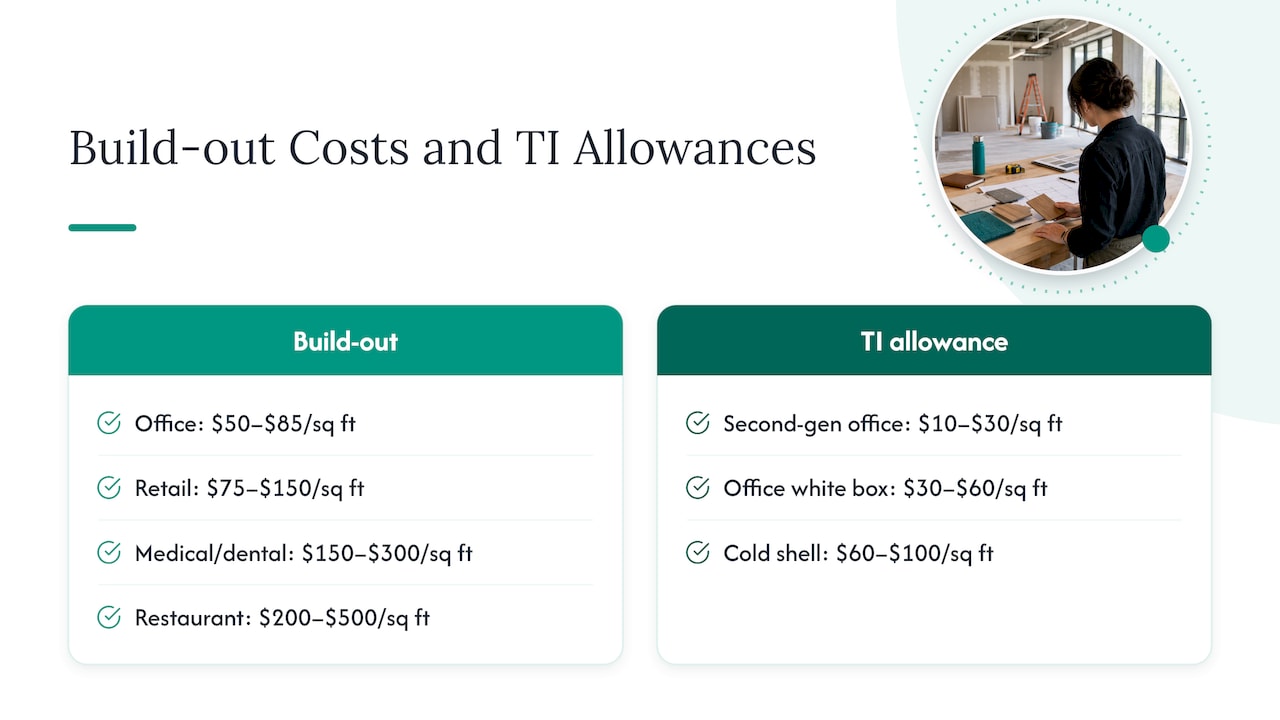
That gap is the whole story of finish selection. When the allowance is $10 to $30 per square foot and the space is already built out, you cannot afford to demolish and rebuild every wall. You need finishes that change the look of what is already there.
Where finish money usually goes
| Finish decision | Cost pressure | Schedule impact | Lease-end consideration |
|---|---|---|---|
| Paint | Low material cost, labor-heavy in high-traffic zones | Short, but touch-ups never end | Easy to return to neutral |
| Vinyl or fabric wallcovering | Moderate, depends on substrate prep | Needs smooth, dry walls; paste cure time | Removal can damage drywall |
| Laminate or wood panels | Higher, with fabrication and install trades | Lead times for custom work | Hard to reverse |
| Tile or stone | High | Long, multi-trade | Permanent |
| Architectural film | Depends on collection and scope | Installed over existing surfaces, no cure wait | Designed to be refinished or removed |
The last row is where we come in, and we cover it below. First, timing.
How finishes affect your schedule
Most commercial build-outs run 10 to 30 weeks from design to move-in, with permitting taking 2 to 6 weeks of that and construction 8 to 16. The same source notes cosmetic refreshes can finish in roughly 6 to 8 weeks. Finishes land at the end of the critical path, so any slip upstream squeezes them, and a late finish delays occupancy and rent commencement.
Three habits protect the schedule:
- Lock the finish schedule before permit drawings are final. Late changes in laminate or tile can mean new lead times.
- Separate dusty work from finishing work. Sanding, cutting and demolition should be done before any surface goes on.
- Choose finishes that install in one visit. Every extra trade visit is a coordination risk.
For occupied buildings, hotels and retail centers, there is a fourth: pick finishes that do not force you to close. Film is installed dry, with no paste, no primer cure and little dust, so a corridor or lobby can often be refinished in sections with minimal disruption. Our guide for specifiers on renovating offices with film in hours, not weeks walks through that sequencing.
Matching finishes to the lease
The right finish depends less on taste than on three lease facts.
Lease term. On a three to five year lease, a finish that costs more and lasts 15 years is usually wasted. On a ten-year lease, durability in high-traffic areas pays back.
Restoration obligations. Many leases require you to return the space to its original condition. Anything glued, tiled or built in may need to be removed at your cost. Choose finishes you can take off or cover over without wall repair.
Who owns the improvement. Landlords often keep ownership of permanent improvements at lease end. That is a good argument for spending allowance dollars on durable, shared infrastructure and using lighter, removable finishes for branding.
A quick note on accounting
How a finish is treated for tax depends on whether it is a repair or an improvement. Under federal rules, amounts paid to improve tangible property generally have to be capitalized-3) when they result in a betterment, restoration or adaptation to a new use, rather than being deducted as routine maintenance. Interior improvements to nonresidential property made under a lease can also fall under special depreciation rules. The classification of any particular finish is a question for your CPA, so ask before the scope is final, not after the invoice arrives.
Durability and health: what to check before you specify
High-traffic commercial surfaces take abuse: luggage carts, chairs, cleaning chemicals, backpacks. Ask for cleanability and abrasion data from the manufacturer, and check that the finish suits the substrate it will sit on. Moisture is the usual culprit when finishes fail, which is why we publish a 48-hour adhesion test for moisture-resistant wall finishes aimed at specifiers.
Indoor air quality is the other check. If the project is pursuing LEED, the LEED v5 low-emitting materials credit covers paints, coatings, adhesives, sealants, flooring, walls, ceilings, insulation and furniture, awarding points by how many product categories meet the criteria. The USGBC reference guide advises specifying products that meet recognized emissions standards or are inherently nonemitting. Request the documentation early, because finding out at submittal that an adhesive does not comply is expensive.
Architectural film as a tenant improvement finish
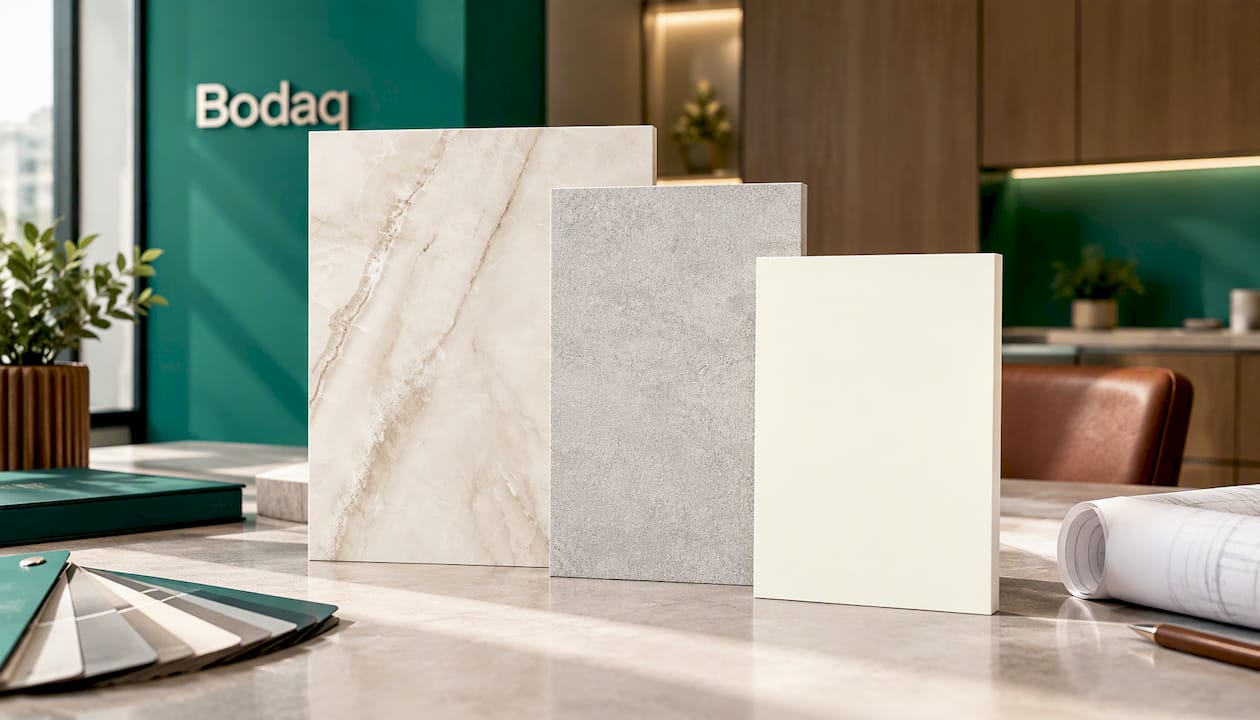
We make Bodaq, a premium architectural interior film from Hyundai L&C. It is a stretchable, self-adhesive film that goes over existing surfaces: walls, doors, columns, millwork, counters, elevator interiors. The catalog runs to more than 450 textures and colors across wood, metal, stone and marble, solid colors, and fabric and leather.
For tenant improvements, four properties matter.
It works on what is already there. In second-generation space you rarely want to demolish a perfectly sound door or reception counter just because it looks dated. Film changes the surface, not the structure, which keeps the allowance for work that truly needs trades.
Stretch and air channels simplify install. The film stretches around curves and profiles, and the adhesive is air-channeled so installers can push out bubbles instead of fighting them. That means cleaner installs on rounded columns, routed doors and shaped millwork.
There is little waste. Film is cut to size on site, with no demolition debris from tearing out old finishes.
It is built to be refinished. When the lease ends or the brand changes, you refinish instead of rebuilding. That suits short terms and restoration clauses.
For general contractors, the schedule story is just as strong: see our overview of architectural film benefits for general contractors for how it fits a TI sequence.
Finish ideas by space type
Office reception and conference rooms. A warm wood grain on a reception front or conference wall gives a sculptural, organic feel without millwork lead times. Pair it with a solid color on adjacent walls so the texture carries the room.
Medical and dental suites. Cleanability drives decisions here. Solid colors in the Easy Clean line suit exam-room doors and cabinet fronts where wipe-downs are constant. See the Easy Clean collection ECF01.

Retail and showrooms. A concrete or stone look gives a bold, industrial backdrop for product. The Wild Concrete collection EXF53 is one way to get that look over existing walls.
Hospitality and lobbies. Metal and fabric-and-leather textures can restyle front desks, corridors and elevator cabs fast. Our piece on why architectural films suit hospitality design covers the reasoning, including keeping rooms and public areas in service.
Multi-tenant brand programs. If you manage several suites or locations, one film specification keeps the look consistent across sites. We cover this in transforming commercial spaces with Bodaq interior film.
Our perspective: finish the surface, not the whole room
We see the same pattern on TI projects. The allowance is modest, the lease is finite, and the space already has good bones: sound drywall, working doors, serviceable casework. The budget gets spent on tearing out surfaces that only look tired.
Our view is that finish decisions should start with a question: does this surface need to be replaced, or only re-dressed? When the answer is re-dressed, film gives you the full design range of wood, stone, metal and fabric without the demolition, the cure times or the permanence. It is the design equivalent of a tailored garment: made to fit what is there, and changeable when your needs change.
There are limits, and we would rather you know them. Film is a surface solution. It does not repair a damaged substrate, and it needs a sound, clean surface to bond to. Test on a representative area first, request samples, and have a certified installer handle large or complex jobs.
— Bodaq
How to specify film in a TI scope
- Survey the surfaces. Note substrate type, condition, moisture and any existing coatings.
- Request samples. Look at them under the suite’s actual lighting, since texture reads differently under warm and cool light.
- Run an adhesion test. Apply a sample to a hidden area of each substrate type, as described in our moisture-resistant finish guide.
- Write the finish schedule. List film by collection and code, the surfaces it covers and the installer qualifications you expect.
- Request emissions documentation if the project pursues LEED or a similar rating.
- Sequence the install after dust-generating trades and before furniture goes in.
If you want a broader look at wall options before narrowing down, our overview of interior wall finishing materials compares the main categories.
Ready to see the finishes in person?
Bodaq offers samples, installation tools and certified installer training alongside the film itself. Browse the Bodaq collections for wood, metal, stone and marble, solid colors and fabric and leather, then request samples for your project. If you are specifying for a larger scope, start at the Bodaq US site and tell us about your space.
FAQ
What is the difference between tenant improvements and leasehold improvements?
Tenant improvements describe the physical build-out work done to a leased space. Leasehold improvements is the accounting and tax term for that work once it is paid for and capitalized. Your CPA decides how a given finish is classified, so confirm it before the scope is set.
What are some examples of tenant improvement finishes?
Common examples include paint, wallcoverings, wood or laminate panels, carpet tile, ceiling tile, door finishes and millwork surfaces. Architectural film also qualifies as a finish, since it refinishes walls, doors and counters in place.
How long do tenant improvement finishes take to install?
Finish work falls inside the construction phase, which commonly runs 8 to 16 weeks on a full build-out. Cosmetic refreshes can be much shorter. Dry-installed finishes such as film avoid paste and paint cure time, so they shorten the end of the schedule.
Who pays for tenant improvement finishes?
It depends on the lease. Landlords often offer an allowance per square foot, and typical ranges depend on space type and condition. The tenant pays for anything above the allowance, so confirm what the work letter covers and what it excludes.
Sources
- Commercial Tenant Improvement (TI) Estimating: Build-Out Pricing, Allowances, and Winning Bids
- Commercial Build Out Guide: Key Components, Types, Process, and Cost
- Tenant Improvement Cost Per Square Foot 2026
- Tenant Improvement Allowance: 2026 Ranges + Calculator
- 26 CFR § 1.263(a)-3: Amounts paid to improve tangible property-3)
- LEED v5 CI MRc3: Low-Emitting Materials
- Low-Emitting Materials reference guide, U.S. Green Building Council