
The renovation decision that moves ROI the most is picking hospitality-grade, easy-to-clean finishes and staging delivery so rooms don’t sit half-finished. Three fixes pay off fastest: hard-surface flooring over softer alternatives, non-porous bathroom systems, and self-adhesive surface film where you need brand-consistent looks without ripping out substrates. Everything else in a renovation plan should support those three priorities.
TL;DR:
- Hospitality-grade finishes like non-porous bathroom systems and self-adhesive wall film provide fast, durable upgrades that minimize maintenance and downtime.
- Floors in high-traffic areas should be porcelain or rated LVT, while softer finishes like carpet are best for noise-sensitive zones, all selected based on expected wear resistance.
- Fire certification is mandatory for all materials, with proper documentation required before installation to avoid renovation delays.
- Using impact-absorbing flooring, mass wall assemblies, and quality door seals significantly reduces noise transfer between guest rooms.
- Prioritize spending on surfaces guests touch and see, such as fixtures and wall finishes, while saving on back-of-house materials that are less visible to improve overall ROI.
Table of Contents
- What Materials Matter Most in Hospitality Renovations?
- How Long Should Hospitality Materials Actually Last?
- Building a PIP-Ready Specification Package
- Sustainable and Biophilic Materials That Still Perform
- Managing Supply Chains for Multi-Room Renovations
- Where Architectural Film Fits in a Hospitality Renovation
- Do Renovation Materials Need Fire Certification?
- How Do You Control Noise in Hotel Renovations?
- What Hygiene Materials Protect Guests Best?
- An Editorial Note on Where to Spend and Where to Save
- Get Samples, Specs, and Training From Bodaq
- Sources
- FAQ
What Materials Matter Most in Hospitality Renovations?
Every zone in a hotel asks a different question of its materials. A lobby floor needs to survive rolling luggage and stiletto heels; a guest bathroom needs to shrug off humidity and bleach cleaners without staining. Matching the right material family to the right zone is where most renovation budgets either stretch or snap.
Flooring carries the heaviest traffic load in the building. Porcelain tile handles lobbies and corridors well because it resists scratching and never needs refinishing, but it’s unforgiving underfoot in guest rooms. Luxury vinyl tile (LVT) has become the default for guest rooms and meeting spaces since it mimics wood or stone at a fraction of the maintenance cost and installs faster during phased renovations. Commercial-grade carpet still wins in areas where acoustic comfort matters more than moisture resistance, provided it meets a hospitality-rated abrasion standard.
Wall finishes split into three practical camps. Paint is cheapest but shows scuffs within a year in high-traffic corridors. Heavy-duty wallcoverings resist tears better but require seam maintenance. Architectural interior film offers a third path: it stretches over walls, doors, and millwork without the downtime of a full wallcovering strip-and-reinstall, and a wide range of wall finishing materials can match a brand’s exact palette without matching its budget for custom paneling.
Bathrooms benefit most from waterproof panel systems that eliminate grout lines entirely, since grout is where mold and cleaning time both accumulate. Rounded, one-piece fixtures reduce crevices housekeeping has to scrub by hand.
For soft goods, look for fabrics rated to commercial abrasion and flame standards, not residential ones. FF&E decisions come down to modular casegoods (faster to replace piece by piece) versus built-in millwork (better brand cohesion, slower to update).
- Flooring: porcelain for public areas, LVT for guest rooms, rated carpet where acoustics matter
- Walls: film or heavy-duty covering over paint in high-traffic zones
- Bathrooms: panel systems and rounded fixtures over tiled surrounds
- Soft goods: commercial flame and stain ratings, non-negotiable
- FF&E: modular casegoods for flexibility, millwork for brand permanence
How Long Should Hospitality Materials Actually Last?
Procurement teams that skip lifecycle math end up replacing the same surfaces twice as often as budgeted. The metric that matters isn’t just “durable” or “not durable.” Its abrasion resistance measured against expected foot traffic, plus how many labor hours a material saves or costs housekeeping every single day.
Soft goods in guest rooms typically need refreshing every few years, while full hard-good renovations, flooring, casegoods, wall systems tend to run roughly every decade depending on brand tier and occupancy volume, according to the hotel room interior design guide from Mingsun Group. Budgeting against those windows, instead of guessing, keeps capital planning realistic.
Pro Tip: Ask every material supplier for their published abrasion-cycle rating (Taber or Martindale test data) before specifying, not after the samples arrive on-site.
Cutting several minutes of cleaning time per room in a 100-room property saves significant staff hours daily, based on EHL’s analysis of hotel interior design efficiency.
Watch for these red flags in samples and spec sheets:
- Delamination at seams or edges after simulated wear testing
- Grout systems with no documented sealing warranty
- Moisture barrier gaps behind bathroom panels
- Fabric with no listed flame-resistance certification
Building a PIP-Ready Specification Package
Brand inspectors don’t reward good taste. They reward documentation. A Property Improvement Plan (PIP) packet that’s missing even one data sheet can stall an approval by weeks, and specialty suppliers who bundle PIP-compliant product lines with project support routinely shorten that friction, according to HD Supply’s hotel renovation and brand conversion programs.
A complete packet should include:
- Manufacturer spec sheets with dimensions, finish codes, and warranty terms
- Fire and flame-spread datasheets referencing the relevant ASTM or NFPA standard
- Slip-resistance (coefficient of friction) ratings for flooring in wet zones
- Physical sample swatches matched to the brand’s approved finish library
- Installation instructions detailing substrate prep and expected labor hours
Match a brand’s finish language (their exact wood tone or fabric name) while quietly upgrading the substrate underneath to a hospitality-grade version. Value-engineering usually means keeping the visual spec identical while swapping in a more cleanable or longer-wearing material behind it, something architectural film handles particularly well since it can replicate a brand-approved wood grain or fabric texture on a far more durable base.
Sustainable and Biophilic Materials That Still Perform
Biophilic design and durable, future-proof finishes have shifted from a nice-to-have to a baseline guest expectation, and that shift comes with a measurable ROI story: fewer replacement cycles and higher satisfaction scores, per the Mingsun Group’s hotel design guide. Organic textures and natural materials also reduce measurable travel stress for guests, which is a harder sell to skip once you frame it as a retention lever rather than a design trend.
Four choices consistently pay off without sacrificing performance:
- Low-VOC coatings and adhesives, which protect indoor air quality without a maintenance tradeoff
- Recycled-content materials with third-party certification documentation procurement can file alongside PIP paperwork
- Recyclable architectural films that mimic natural wood, stone, or linen textures at end-of-life without landfill bulk
- Warm, textured accents concentrated in high-visibility zones (lobbies, corridors, headboard walls) rather than spread thin across every room
Document sustainability claims the same way you’d document a fire rating: certificate number, issuing body, and expiration date, so the claim survives an audit, not just a sales conversation. As guest experience increasingly blends lodging with wellness and food and beverage programming, as explored in Wild Foodz’s guide to combining lodging and gastronomy, material choices in shared spaces carry more weight in the overall guest impression than they used to.
Managing Supply Chains for Multi-Room Renovations
The single biggest cause of schedule drift on a hotel renovation isn’t a bad material choice. It’s a supply chain that doesn’t match the room-block sequence. Experienced contractors coordinate phased delivery so materials arrive in the order rooms actually close, not in the order a purchase order happened to be entered, a pattern documented in PMA Inc.’s analysis of complex hotel renovation execution.
- Tie delivery schedules directly to housekeeping’s room-block closure calendar, not a fixed weekly shipment
- Label and stage materials by floor and room number before they hit the job site, not after
- Order 10 to 15% contingency stock on specialty finishes with long lead times
- Hold a weekly sync between design, procurement, and the installation crew to catch mismatches early
Pro Tip: Specialty finishes like custom film patterns or imported stone almost always have the longest lead times on the project. Order those first, even before demolition starts.
Sourcing partners that already stock hospitality MRO and renovation staples, plumbing fixtures, HVAC components, lighting, and janitorial supplies, can shrink the number of separate vendor relationships a renovation team has to juggle, as Ferguson’s hospitality facilities supply program illustrates. Fewer vendors generally means fewer scheduling surprises.
Where Architectural Film Fits in a Hospitality Renovation
Architectural interior film solves a specific problem: how do you refresh a brand-facing surface without the downtime and waste of a full material swap? The film is stretchable and self-adhesive, so it wraps curved millwork, doors, and furniture that a rigid material never could, and it generates far less waste than tearing out an old surface entirely, a benefit detailed in Bodaq’s breakdown of why architectural film suits hospitality design.
Real hospitality projects use it on elevator surrounds, casegoods, headboard walls, door faces, and reception desks, anywhere brand refresh needs to happen fast, often overnight, without shutting a public space for days. Cleaning is typically a wipe-down with standard non-abrasive cleaner, and the surface holds its finish across the same multi-year cycles as the substrate underneath it.
Three finishes cover the most common hospitality applications:
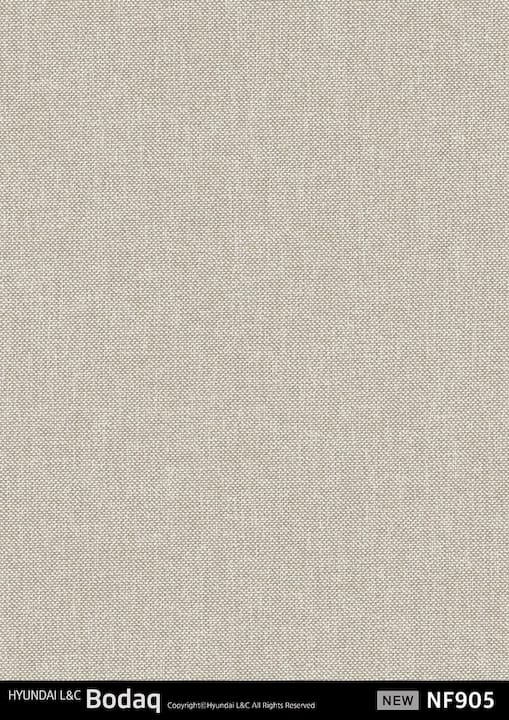
- Oatmeal Linen (NF905): a neutral woven-fabric look suited to lobbies, corridors, and other public-facing surfaces that need warmth without pattern.
- Valen Cream (BLC02): a premium solid finish built for guest-room casegoods and doors where a clean, brand-consistent tone matters most.
- Woven Linen (SF803): a textured specialty surface for feature walls and design-forward public spaces that want visual depth.
| Film Collection | Best Use Zone | Visual Character |
|---|---|---|
| Oatmeal Linen NF905 | Lobbies, corridors, public walls | Neutral woven fabric texture |
| Valen Cream BLC02 | Guest-room casegoods, doors | Premium solid tone |
| Woven Linen SF803 | Feature walls, specialty accents | Textured woven pattern |
Case examples of film-based hotel refreshes, including before-and-after installs on furniture and wall panels, are documented on Bodaq’s hotel transformation page.
Do Renovation Materials Need Fire Certification?
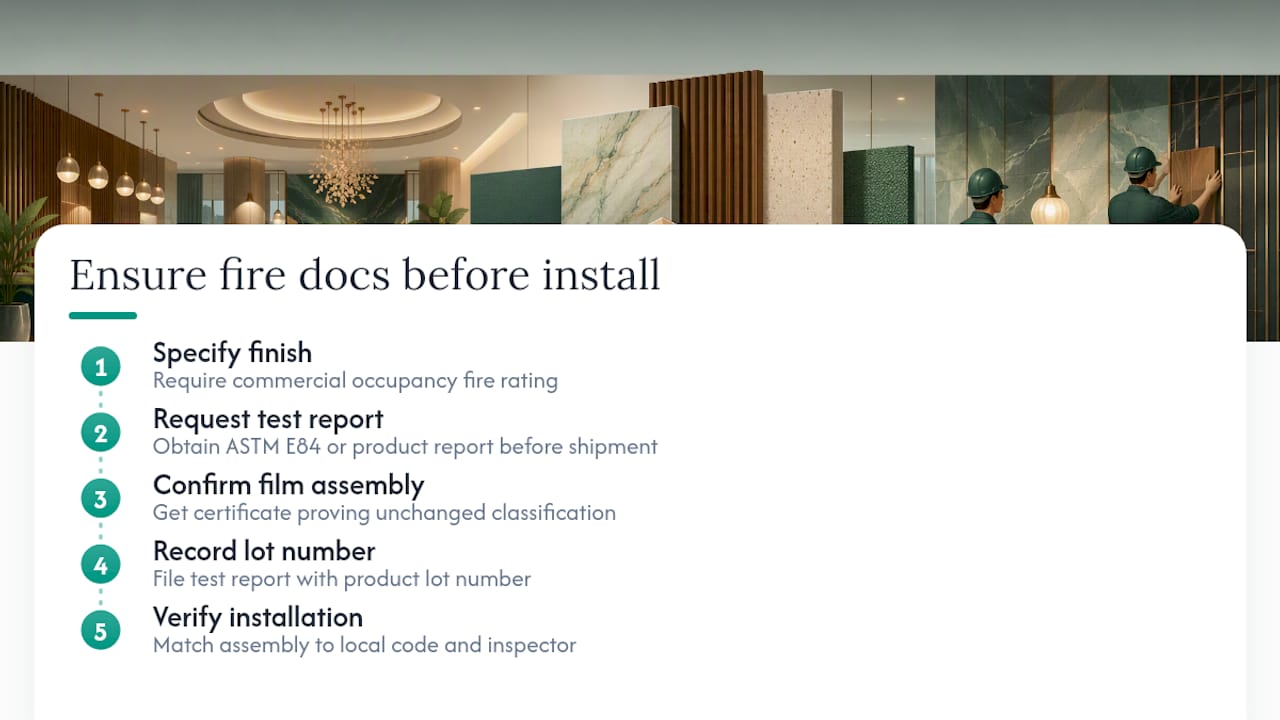
Yes, and the requirement is stricter than most residential contractors expect. Hospitality buildings fall under commercial occupancy codes, which means wall coverings, upholstery, carpet, and window treatments all need documented flame-spread and smoke-density ratings before a brand or a local fire marshal will sign off.
Wall and ceiling finishes are typically tested against ASTM E84, which classifies materials by flame-spread and smoke-development index. Upholstered furniture and mattresses need to meet flammability standards specific to those product categories, and carpet is tested separately for critical radiant flux in corridors and means-of-egress paths. Architectural film applied over an already-rated substrate needs its own documentation showing it doesn’t change the assembly’s fire classification, so always request that certificate specifically rather than assuming the base material’s rating carries over automatically.
Local fire marshals and brand PIP inspectors will ask for the actual test report, not a marketing claim of “fire-resistant” or “flame-retardant.” Keep every certificate on file with the product’s lot number, since brands increasingly spot-check installed materials against submitted paperwork during property inspections. Renovation delays tied to missing fire documentation are almost entirely avoidable. The certificate exists before the material ships; the only failure point is not requesting it during specification instead of after installation.
Sprinkler coverage, egress path materials, and door assembly ratings fall under a parallel set of building code requirements that a renovation’s general contractor should verify against the local jurisdiction’s adopted code cycle, since adoption dates vary by state and municipality.
How Do You Control Noise in Hotel Renovations?
Guest complaints about noise consistently rank among the top drivers of negative reviews, which makes acoustic performance a material specification issue, not just an HVAC or wall-thickness issue. The materials chosen for floors, walls, and ceilings either absorb sound transfer between rooms or transmit it straight through.
Carpet with a dense pad underlayment absorbs impact noise (footsteps, dropped luggage) far better than hard flooring, which is why many upscale properties keep carpet in guest-room interiors even as they shift to LVT in corridors. Where hard flooring is required for durability or brand standard, an acoustic underlayment rated for impact sound reduction closes most of that gap.
Wall assemblies benefit from mass and decoupling more than from any single finish material. Adding resilient channel or additional layers of drywall between guest rooms addresses airborne sound transfer that a wallcovering or film alone cannot fix, since surface finishes affect room acoustics (echo, reverberation) but not wall-to-wall sound transmission. Acoustic wall panels with a fabric or felt face handle meeting rooms and restaurants well, cutting reverberation without the bulk of traditional soundproofing materials.
Door assemblies and their seals matter more than most renovation budgets account for. A solid-core door with proper weatherstripping blocks corridor noise significantly better than a hollow-core door, regardless of what finish sits on its face. Window assemblies facing street noise or pool areas should carry a Sound Transmission Class (STC) rating appropriate to the property’s location, verified against the actual ambient noise level outside, not a generic industry assumption.
What Hygiene Materials Protect Guests Best?
Guest health expectations around surface hygiene haven’t fully receded from where they moved several years ago, and material choice remains one of the most direct levers a renovation has over perceived and actual cleanliness. Non-porous surfaces are the foundation of every hygiene-focused specification, since porous materials trap moisture, bacteria, and odor in ways that no cleaning routine fully reverses.
Antimicrobial-treated surfaces, where the material itself carries a bacteria-inhibiting additive rather than relying solely on cleaning chemicals, have expanded well beyond hospital settings into hospitality touchpoints: door handles, elevator buttons, bathroom hardware, and high-touch casegood surfaces. These treatments don’t replace a cleaning protocol, but they extend the window of protection between housekeeping visits.
Grout-free bathroom systems remain one of the highest-value hygiene upgrades available, since traditional grout lines are near-impossible to fully sanitize once they’ve absorbed moisture over a few renovation cycles. Rounded fixture edges and integrated sink-counter assemblies eliminate the seams where grime accumulates and hand-scrubbing becomes necessary.
Fabric selection matters just as much as hard surfaces. Commercial upholstery rated for moisture resistance and stain-release performance allows housekeeping to sanitize a chair or headboard without waiting for a deep-clean cycle. Surfaces that can tolerate a broader range of disinfectant chemicals without degrading, rather than requiring a single narrow-spectrum cleaner, give housekeeping teams more flexibility during turnover and outbreak-response periods alike.
An Editorial Note on Where to Spend and Where to Save
Spend on what guests touch and see up close, bedding, bathroom fixtures, and entry-door finishes, since that’s where brand perception forms in the first ninety seconds. Save on back-of-house durability where function beats flourish. Call manufacturer reps early, before design lock, so samples and installation timing are settled before the PIP clock starts ticking.
— Bodaq
Get Samples, Specs, and Training From Bodaq
Architectural interior film covers a wide range of textures and colors, offering procurement teams options to match many brands’ approved finish language while upgrading the substrate underneath for durability and low-downtime installation. This combination of brand alignment plus fast, low-waste application aligns with key priorities in hospitality renovations: cleanable, durable, PIP-ready, and quick to install without shutting down guest-facing spaces for days.
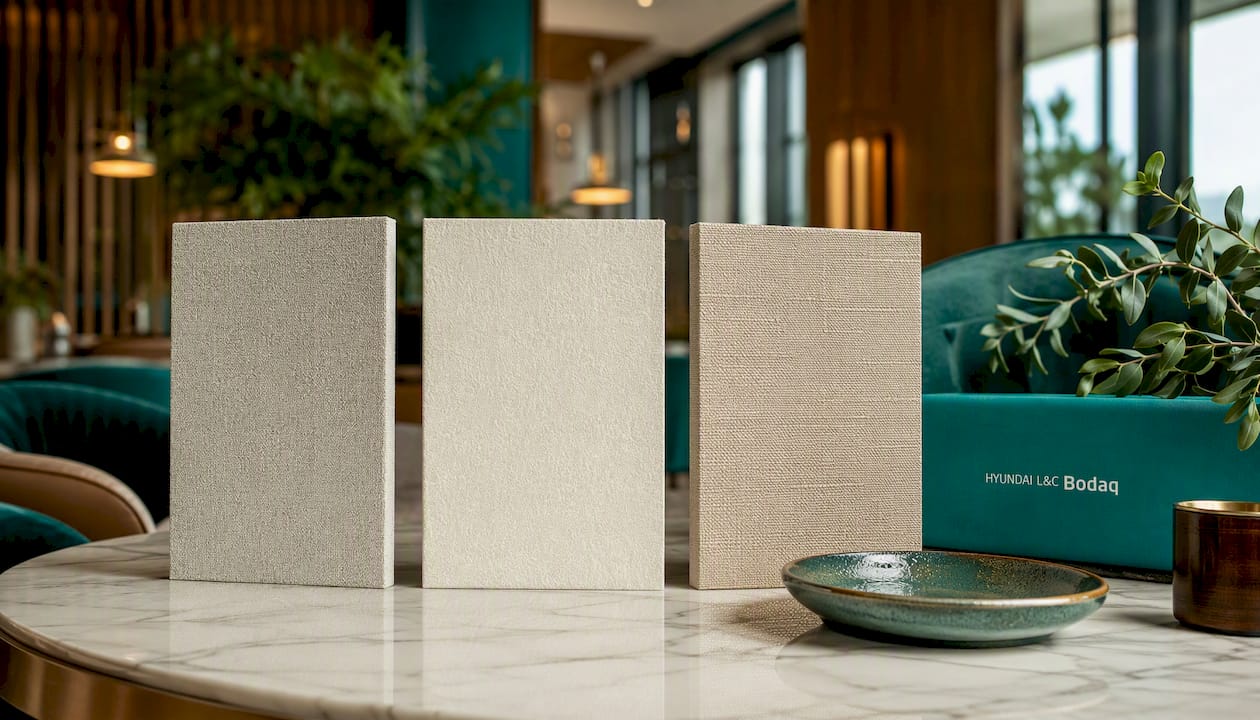
If you’re specifying finishes for an upcoming renovation, three steps make the process concrete. Request physical film samples like Oatmeal Linen NF905 to test against your brand’s approved palette. Download spec sheets covering fire ratings, installation instructions, and warranty terms for your PIP packet. Then reach out for a project consult or quote to map lead times against your room-block schedule before demolition starts.
Sources
- Hotel Interior Design: Creating Spaces That Work Smarter
- Ultimate Guide to Hotel Room Interior Design in 2026
- Hotel Renovations & Brand Conversions | HD Supply
- Ferguson Facilities Supply — Hospitality solutions
FAQ
What Are the 5 C’s of Hospitality?
The 5 C’s commonly cited in hospitality service training are courtesy, communication, consistency, cleanliness, and comfort, all of which tie directly to material choices since cleanliness and comfort depend heavily on surface performance.
What Is the 15/5 Rule in Hotels?
The 15/5 rule is a guest-service standard where staff acknowledge a guest by eye contact or smile at 15 feet and offer a verbal greeting at 5 feet. It’s a service protocol, not a material specification, though well-lit, well-finished public spaces support staff in executing it naturally.
What Are the 7 Pillars of Hospitality?
Definitions vary across training programs, but common versions include safety, comfort, cleanliness, personalization, efficiency, ambiance, and consistency, several of which are shaped directly by the durability and cleanability of chosen materials.
What Business Tools Do Hospitality Teams Use for Renovation Planning?
Common tools include property management systems (PMS) for tracking room-block status, procurement platforms for vendor sourcing, project scheduling software, spec-sheet and PIP documentation databases, and design collaboration tools for matching finishes across a renovation program.
Is Architectural Film Durable Enough for High-Traffic Hospitality Areas?
Yes, when applied to appropriate substrates and maintained with standard non-abrasive cleaning, architectural film performs well on doors, casegoods, and wall panels, and it installs with less waste and downtime than a full material replacement.