
Yes, you can renovate a hotel without closing it, and most properties already do. The winning formula combines phased, room-by-room work, off-peak noisy tasks, sealed construction zones, and fast-install finishes that return rooms to inventory in days instead of weeks. Fire and life-safety systems stay fully functional throughout, per USFA guidance, while surface-refinish products like architectural film shrink the gap between “under construction” and “guest-ready.”
TL;DR:
- Boutique hotels under 100 keys can phase room by room; midsize properties can work floor by floor, while resorts can phase by tower or wing.
- Cosmetic refreshes take 2 to 4 days per room with parallel crews; full bathroom renovations commonly take 1 to 2 weeks per room block.
- Schedule demolition, drilling, and flooring after checkout but before check in, and target shoulder season for the loudest, longest work phases.
- Keep alarms, sprinklers, emergency lighting, and clear exit routes operational throughout construction; sealed zones, negative air pressure, and HEPA scrubbers limit dust in occupied areas.
- Tell guests before arrival which areas are active and when noise is expected; provide a direct contact and offer quiet rooms near construction.
Table of Contents
- Top strategies checklist for renovating while open
- Operational planning: phasing, timelines, and cost expectations
- Guest experience: communication, signage, and service continuity
- Construction best practices and safety controls
- Low-disruption materials and finishes
- Procurement, contractor coordination, and temporary services
- Measuring success and post-renovation maintenance
- Integration with hotel operations and staff training
- Case studies or examples of successful renovations without downtime
- Publisher perspective: how Bodaq approaches low-disruption hospitality projects
- Why Bodaq interior film is a practical choice for renovating while staying open
- FAQ
- Sources
Top strategies checklist for renovating while open
Phasing is the backbone of any no-closure renovation. Room-by-room phasing suits boutique properties with fewer than 100 keys, floor-by-floor phasing works for mid-size hotels needing predictable blocks of out-of-order (OOO) inventory, and vertical phasing (stacking work by tower or wing) lets large resorts keep full floors operational while crews move methodically upward.
- Schedule demolition, drilling, and flooring work during documented off-peak windows, typically mid-morning after checkout and before check-in.
- Build sealed construction zones with negative air pressure and dedicated dust barriers separating guest corridors from work areas.
- Swap in fast-install finishes and FF&E packages that cut turnover time per room.
- Keep contingency plans ready: temporary amenity stations, alternate dining setups, and flexible staffing for surge cleaning.
A few operational habits make the difference between a smooth project and a guest-relations headache:
- Post clear “quiet hours” signage at elevator banks and stairwells near active work zones.
- Route housekeeping carts and construction material deliveries through separate service corridors whenever the building layout allows it.
- Pressure-test room readiness the night before a guest is due to check in, not the morning of.
Operational planning: phasing, timelines, and cost expectations
Build your phased timeline around occupancy forecasts, not just contractor availability. Target shoulder-season weeks for the noisiest, longest phases, and reserve lighter touch-ups for peak periods when every room needs to sell. Gensler’s work on The Clift shows how selective FF&E replacement and careful phasing let a large historic hotel manage both budget and construction time without a full shutdown.
Typical duration ranges vary by scope:
- A cosmetic room refresh (paint, soft goods, surface finishes) often runs 2 to 4 days per room when crews work in parallel.
- A full bathroom renovation, including plumbing and tile, commonly takes 1 to 2 weeks per room or room block.
- Public-space refits (lobbies, corridors, elevator cabs) usually stretch several weeks, since these areas see continuous foot traffic and require tighter scheduling.
Budget contingency for two cost drivers that surprise owners most often: accelerated turnover labor (overtime to compress a schedule) and guest compensation for noise or access disruptions. Staging a thorough quality-assurance walkthrough before a room reopens, and resolving punch-list items immediately rather than batching them, prevents the kind of rework that quietly adds days to every phase.
Guest experience: communication, signage, and service continuity
Clear communication keeps complaint rates low even when construction noise is unavoidable. Pre-arrival emails should flag active renovation areas and expected hours, while an in-room note on the pillow or desk can reiterate the schedule and offer a direct contact for concerns. Research on renovation communication ties guest satisfaction during construction closely to perceived control, meaning guests who know what to expect complain far less than those caught off guard.
Several operational shifts reduce friction without adding headcount:
- Offer a quiet-room guarantee or a small upgraded amenity to guests booked near active work zones.
- Stagger housekeeping so rooms near construction get serviced earlier in the day, away from peak noise hours.
- Assign one staff member as a guest-liaison point of contact for renovation-related questions.
- Push mobile check-in and keyless entry to cut front-desk traffic during lobby renovations.
A sample pre-arrival line might read: “We’re upgrading select guest floors this month. Your room is outside the active work zone, and quiet hours are strictly enforced from 9 PM to 9 AM.”
Pro Tip: Train front-desk and housekeeping staff on a single, consistent response script for renovation complaints so every guest hears the same reassurance and the same offer.
Construction best practices and safety controls
Life-safety systems take priority over every other renovation decision. Before any demolition begins, verify that fire alarms, sprinklers, and emergency lighting remain fully operational across the property, and confirm that egress routes stay clear even when corridors are partially blocked by equipment.
Dust and air quality controls protect both guests and staff:
- Seal construction zones with floor-to-ceiling plastic partitions and maintain negative air pressure to keep dust from migrating into occupied areas.
- Run HEPA-filtered air scrubbers continuously in active work zones.
- Clean shared corridors and elevator landings on a daily cadence, not just at project milestones.
- Restrict access with clear signage and physical barriers, directing guests along a protected path that never crosses active work.
Fire safety compliance during renovation is non-negotiable: USFA guidance on hotel fires stresses that life-safety systems must remain functional throughout any building work, since renovation periods are exactly when alarm coverage and egress paths are most likely to be compromised.
Low-disruption materials and finishes
Full surface replacement means demolition, drying time, and days of lost room inventory. Refinishing with architectural film skips most of that: a stretchable, self-adhesive product installs directly over existing doors, millwork, headboards, and elevator cabs without the dust, odor, or downtime of a tear-out.
Several collections suit hospitality environments specifically:
- Sierra Stone (NS122 and NS123) from the Stone & Marble Collection, suited for lobby accent panels and bathroom vanities.
- Travertine (NS202) from the Natural Stone Collection, a warm option for guest bathrooms and public-area walls.
- Evening Snow (S260), Gentle Creme (S257), and Deep Forest (S266) from the Solid Color Collection, versatile for high-traffic corridors and accent walls.
- Smoked Charcoal Oak (LW113) and Natural Oak (LW108) from the Wood Collection, well matched to headboards, case goods, and millwork refreshes.
These collections and the reasoning behind choosing refinish over replace are covered in more depth on our page on architectural films for hospitality design and our hospitality renovation materials guide.
Pro Tip: Sequence film installation to finish right before the room-ready (RR) inspection, so the surface work is the last touch before a room returns to inventory rather than an extra step that delays it.
Procurement, contractor coordination, and temporary services
Contracts should require staged access windows tied to your phasing plan, defined noise-hour clauses, a dedicated on-site supervisor, and daily cleanup standards before crews leave each evening. For specialized turnover needs, bring in temporary partners: a post-construction cleaning crew to reset rooms fast, or an emergency turn team when a phase runs behind. My Lemon Maids offers this kind of post-construction cleaning support for properties coordinating rapid turnovers.
Before breaking ground, run a coordination meeting and daily standups with operations, engineering, housekeeping, and F&B:
- Confirm the week’s work zones and expected OOO room counts.
- Review noise-hour compliance from the prior day.
- Flag any guest complaints tied to active zones.
- Align the next day’s housekeeping and front-desk staffing against the schedule.
Measuring success and post-renovation maintenance
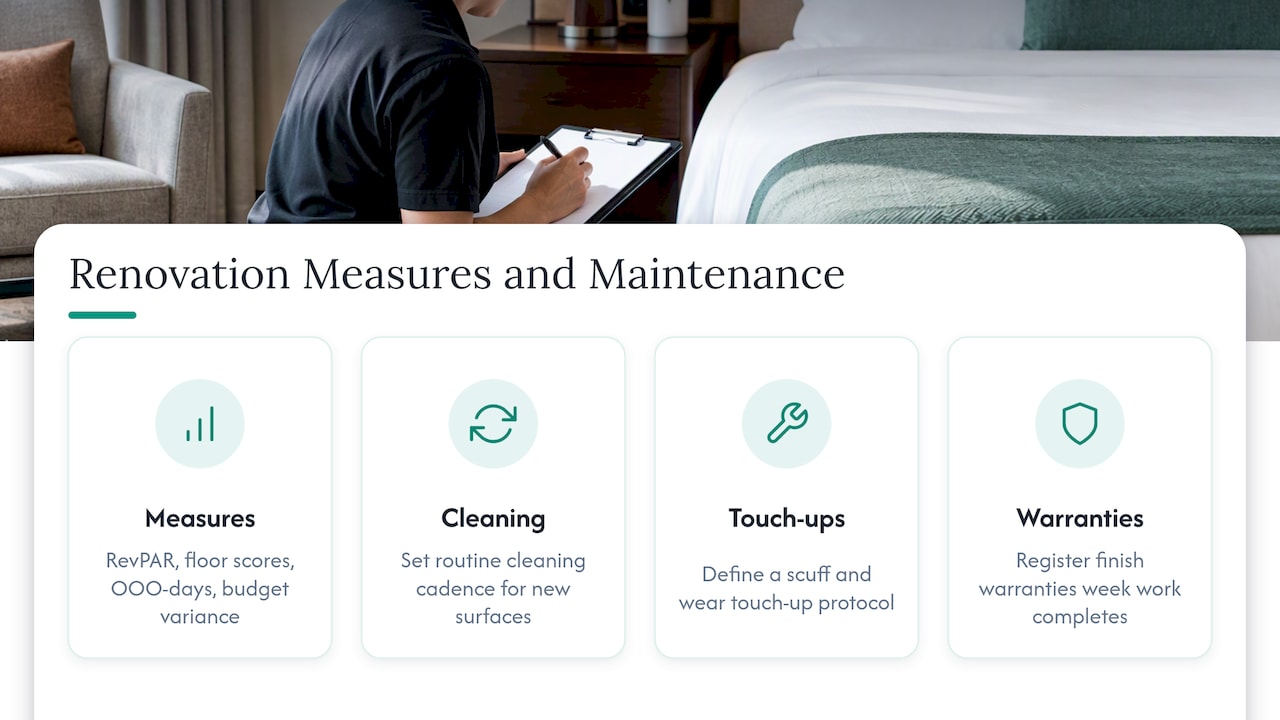
Track RevPAR recovery against your pre-renovation baseline, guest satisfaction scores for renovated floors, total room OOO-days, and budget versus actual spend by phase. A short maintenance plan protects the investment: set a routine cleaning cadence for new surfaces, define a touch-up protocol for scuffs or wear, and register warranties on installed finishes the week work completes. Once renovated floors are back online, refresh your photography and booking descriptions so marketing reflects the upgraded product immediately.
Integration with hotel operations and staff training
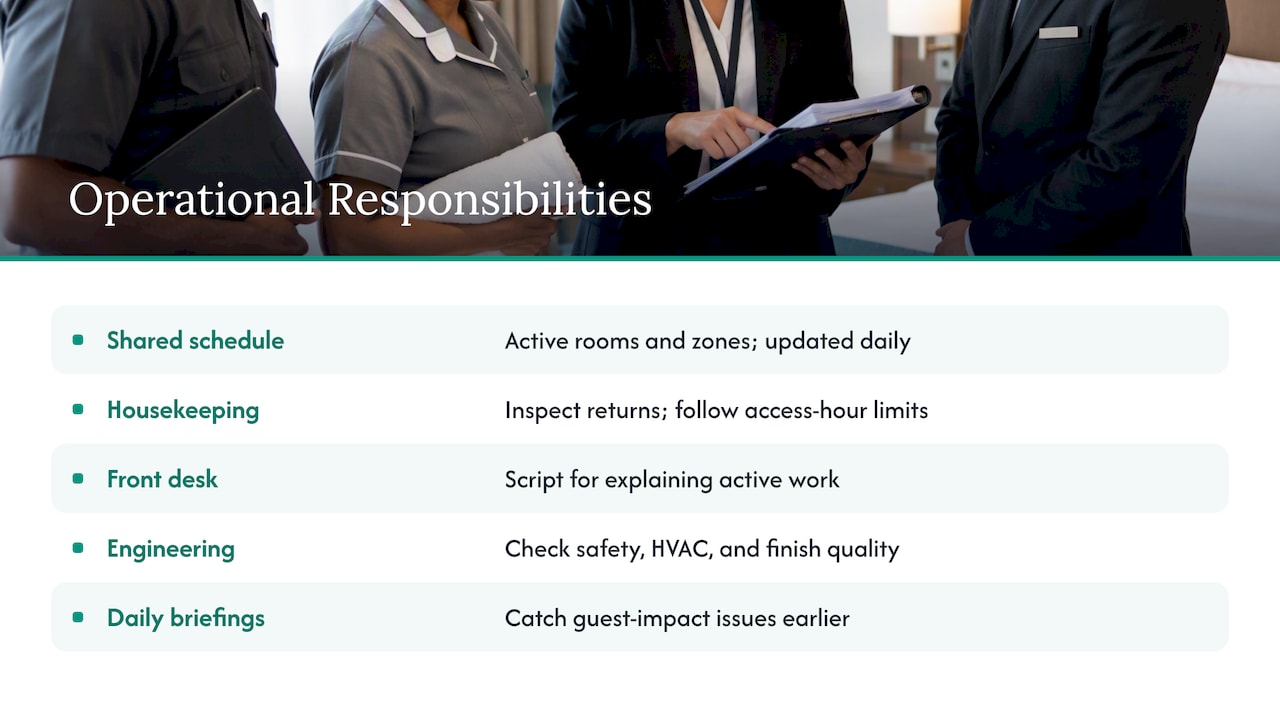
A renovation plan only works if the operations team runs it day to day, not just the project manager. Engineering, housekeeping, and front-desk leads need a shared schedule showing which rooms and zones are active each week, updated daily as phases shift. Housekeeping supervisors should know which rooms are newly returned to inventory and need an extra inspection pass before the first guest checks in.
Staff training matters as much as the construction schedule itself. Front-desk agents need a short script for explaining active work to arriving guests, and housekeeping staff need clear guidance on which corridors or service elevators are off-limits during specific hours. Engineering teams should walk every reopened room against a standardized checklist, confirming life-safety devices, HVAC function, and finish quality before releasing it back to reservations.
Building this into daily standups, rather than treating it as a one-time kickoff memo, keeps everyone aligned as phases shift and timelines compress or stretch. Properties that integrate renovation updates into their existing pre-shift briefings tend to catch guest-impact issues earlier, since front-line staff are the first to hear complaints or spot problems with barrier placement and signage.
Case studies or examples of successful renovations without downtime
The Clift Royal Sonesta Hotel renovation illustrates how phased work and selective FF&E replacement let a historic property modernize without a full closure, preserving the building’s character while managing both schedule and budget. Broader trend reporting from TopHotelProjects points to adaptive reuse and interior-upgrade approaches, rather than full rebuilds, as the dominant model across hotel renovations heading into 2026, specifically because they minimize demolition and reduce disruption to ongoing operations.
Specialty trades offer a smaller-scale version of the same logic. One Day Doors & Closets demonstrates how digital measurement and pre-manufactured components let door and closet replacements happen in a single day with minimal mess, a model worth borrowing for any hotel renovation scope where speed and low disruption matter more than custom fabrication.
Publisher perspective: how Bodaq approaches low-disruption hospitality projects
We’ve watched hospitality teams treat surface refinishing as a last resort rather than a first option, and that’s backward. A single guest-floor corridor refresh using film over existing millwork can go from scuffed to presentable in an afternoon, with no drying time and no dust barrier left standing overnight. That kind of quick win changes how owners plan every phase after it.
— Bodaq
Why Bodaq interior film is a practical choice for renovating while staying open
We designed our film system to address the challenge of upgrading surfaces efficiently during hotel renovations. Our stretchable, self-adhesive film installs over existing surfaces quickly, reduces waste compared to full replacement, and withstands daily wear in high-traffic environments. With a wide range of textures and colors available, matching an existing design language or refreshing it entirely involves selecting an appropriate pattern.

- Request a sample from our Wood, Metal, and Stone & Marble collections before committing to a full floor.
- Order an installer kit for your in-house maintenance team or certified contractor.
- Contact our sales team for a project quote tailored to your renovation scope.
Browse our full product catalog to start planning which surfaces come first.
FAQ
What is the most expensive part of renovating a house?
Costs vary widely by project and scope, but structural work (plumbing, electrical, and framing changes) tends to carry the highest price tags in most residential renovations because it requires licensed trades and often uncovers hidden issues. Kitchens and bathrooms typically follow close behind due to fixtures, tile, and cabinetry costs.
What is the 15-5 rule in hotels?
Hospitality service standards commonly reference a courtesy guideline where staff acknowledge a guest with eye contact and greet them verbally at close range. It’s a staff-training convention rather than a formal regulation, and definitions can vary slightly between properties and brands.
What are the key hotel design trends for 2026?
Hotel design trends heading into 2026 favor adaptive reuse and interior upgrades over full demolition, along with smarter room layouts, flexible furniture, and energy-efficient systems, according to TopHotelProjects. These approaches also tend to shorten renovation timelines since they avoid the extended downtime that comes with structural rebuilds.
Why is there no room 420 in hotels?
Many hotels skip certain room numbers due to superstition, as with skipping a 13th floor. This is a property-by-property choice rather than an industry rule, so some hotels number all rooms without issue.
How long does a typical hotel room renovation take without closing?
A cosmetic guest room refresh using fast-install finishes often takes 2 to 4 days per room when crews work in parallel across a floor, while a full bathroom renovation can run 1 to 2 weeks per room block. Phasing work floor-by-floor or wing-by-wing keeps the rest of the property fully operational throughout.
Sources
- USFA — Hotel fire prevention
- Cvent — 12 Hotel renovation ideas to revitalize your property
- TopHotelProjects — Top hotel renovation projects around the world 2026
- Gensler — The Clift Royal Sonesta Hotel project