A low-VOC interior finish is one that releases fewer volatile organic compounds, either because the product contains less of them as manufactured or because it emits less of them into the room once installed. Those are two different things, and labels do not always say which one they mean. The strongest choices pair a third-party emissions certification with a low-odor, low-disruption installation method, and that applies to paint, wallcoverings and architectural film alike.
If you are specifying finishes for a home, an office, a hotel or a clinic, this guide shows you how to read the claims, which materials are worth shortlisting, and where the adhesive and the installation process matter as much as the surface itself.
TL;DR
- “Low-VOC” is not a standardized term. Some labels describe VOC content in the can or roll, others describe emissions in the finished room, so ask which one is meant.
- Look for third-party emissions certifications such as GREENGUARD GOLD, SCS Indoor Advantage Gold or Green Seal GS-11, and ask for the documentation.
- The adhesive counts. Peel-and-stick and water-based systems are generally described as healthier than vinyl-on-vinyl adhesives.
- Judge the whole wall: moisture performance, cleanability, installer exposure and ventilation matter alongside the VOC number.
- Self-adhesive film can cut wet trades, odor and downtime, which is why we see it chosen for occupied and fast-turnaround spaces.
Table of Contents
- What “low-VOC” actually means
- Which low-VOC finishes are available
- How to read the certifications
- Look past VOCs: adhesives, additives and the whole wall
- Comparing performance: durability, cleaning and installation
- Installation: where VOC exposure really happens
- Our perspective: why we think film belongs on the shortlist
- Choosing by space type
- Ready to see the finishes in person?
- FAQ
- Sources
What “low-VOC” actually means
Volatile organic compounds are organic chemicals that can evaporate at normal indoor temperatures. The EPA’s technical overview of VOCs explains that its regulatory definition was written around outdoor air: carbon compounds that take part in atmospheric photochemical reactions, excluding those with negligible reactivity. In other words, the definition began as a smog rule, not an indoor health rule.
That history explains why two products can both say “low-VOC” and behave differently in a room. One useful distinction:
- VOC content is the concentration of VOCs present in a product as manufactured.
- VOC emissions are the types and concentrations of VOCs that actually leave the product and enter the air.
The Informed project, which publishes guidance for healthier building materials, points out that Low-VOC and Zero-VOC labels are not standardized: some refer to emissions, others to content under regulatory definitions. Its advice to designers is to look past the basic label.
A 1999 EPA study of low-VOC latex paints shows why. The low-VOC paints had significantly lower VOC content than conventional ones, yet some still emitted formaldehyde. Content is a starting point. Emissions testing tells you more about the air you will breathe.
Which low-VOC finishes are available
The category is wider than paint. According to the Building Clean product guidance for paints and wallcoverings, the options include:
- low-VOC paints
- wallpaper, textile, cork, vinyl and wood-veneer wallcoverings
- adhesives that are clear, wheat-based, clay-based, vinyl-on-vinyl or peel-and-stick
There is also a category that sidesteps the question. Under the U.S. Green Building Council’s guidance, inherently nonemitting materials such as stone, ceramic, powder-coated metals, glass, concrete and unfinished solid wood do not need emissions testing, as long as they have no organic-based surface coatings, binders or sealants. That is a strong option where the material suits the room, though it is heavy, slow to install and not always practical on existing walls or furniture.
For everything in between, such as walls that need a new look without demolition, doors, millwork, elevator cabs and furniture, the choice is usually paint, a wallcovering or a surface film. Each trades off differently.
Paint
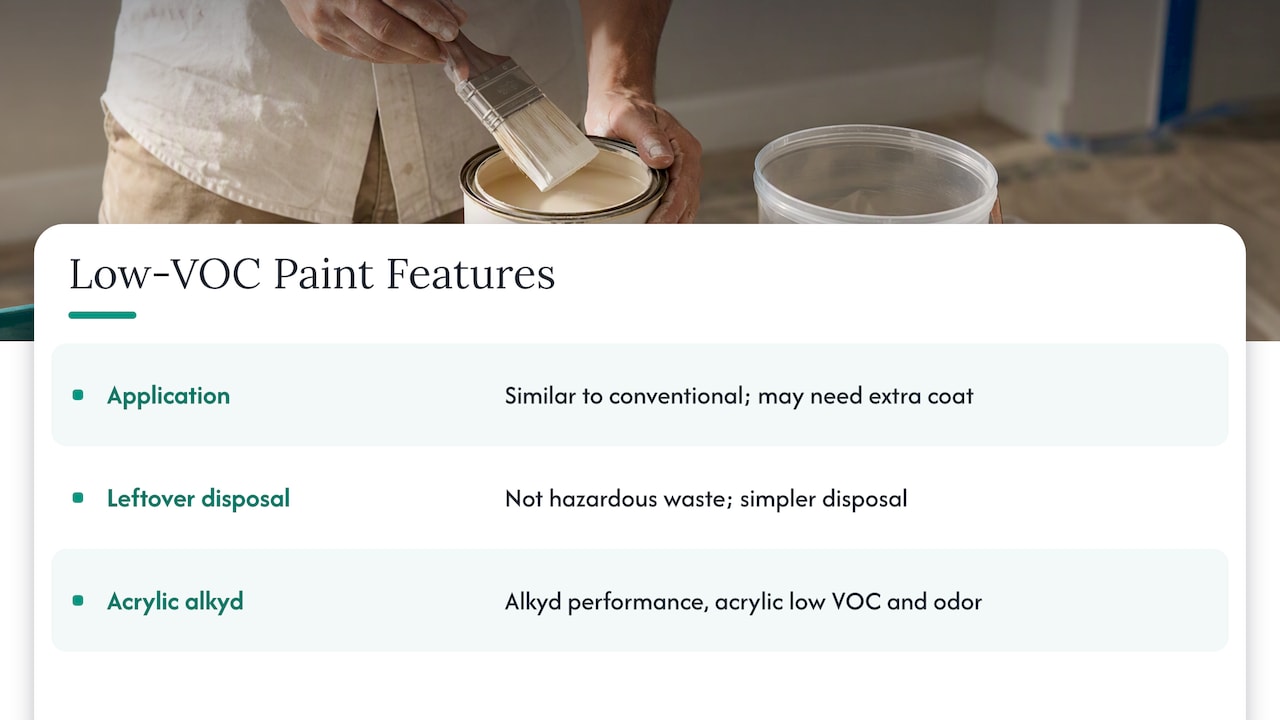
Paint remains the default, and modern low-VOC and no-VOC formulations apply much like conventional ones. EPA’s 2007 materials guidance for healthcare notes they can be applied in nearly the same way, though they may be thinner and need an extra coat for full coverage. The same document notes that low-VOC and no-VOC paints are not treated as hazardous waste, which makes leftover disposal simpler.
The EPA’s Green Chemistry award summary describes water-based acrylic alkyd paints that aim to pair the gloss, adhesion and moisture resistance of alkyds with the low VOC content and low odor of acrylics. That hybrid approach is relevant for trim, doors and kitchens where a hard-wearing sheen matters.
Wallcoverings
Textile, cork, wood-veneer and vinyl coverings all appear in the Building Clean guidance. Here the covering is only half of the story. The paste or adhesive is applied across the whole wall, so its chemistry and its cure time shape the air quality during and after installation.
Architectural film
Self-adhesive architectural film comes with its adhesive already engineered into the product, which removes a separate paste step on site. Because it is installed dry, there is no drying time between coats and no wet trades working in the space. This is the category we work in, and we come back to it below.
How to read the certifications
A claim on the front of a package is marketing. A certificate with a test method behind it is evidence. The Pacific Northwest National Laboratory’s guide to certified low and no-emission interior paints and finishes lists the programs worth knowing:
| Program | What to look for |
|---|---|
| GREENGUARD GOLD | Third-party emissions certification, commonly requested for schools, healthcare and sensitive occupants |
| SCS Indoor Advantage Gold | Emissions certification covering a range of interior products |
| Green Seal GS-11 | A standard specific to paints and coatings |
| CDPH Standard Method V1.2-2017 | The emissions test method behind many low-emitting product lists |
The same guide advises you to obtain the product’s certification documentation rather than rely on a catalog line.
If you are working toward a green building rating, note that under the LEED v4.1 low-emitting products credit, interior adhesives, sealants, paints and coatings must meet both VOC content and VOC emissions requirements. Content and emissions are checked together, which is a good model for any project, rated or not.
A short verification routine
- Ask whether the claim is about content, emissions or both.
- Ask for the certificate and confirm it covers the exact product line and colors you are buying, including the adhesive.
- Check the test method and the date on the document.
- Confirm what is not covered, for example tints, primers or sealers that you add on site.
Look past VOCs: adhesives, additives and the whole wall
BuildingGreen, a publication for building professionals, stresses in its material selection resource that product selection is a multi-attribute exercise. VOC rules grew out of smog prevention, so a good specification also considers indoor air quality and installer health, and different certifications use different methodologies. That is also why specifiers often combine several lines of evidence. If you are weighing a natural material, this look at specifying sustainable interior wood shows the same approach: environmental product declarations, chain-of-custody and low-VOC finishes read together rather than one label on its own.
Two points from Building Clean’s guidance are worth carrying into any wall project:
- Adhesive choice. Vinyl-on-vinyl adhesive tends to have higher VOC levels, while water-based adhesives and peel-and-stick systems are described as healthier alternatives.
- Other chemistry. Vinyl wallcoverings may contain stabilizers and flame retardants, including endocrine-disrupting chemicals, which should be weighed alongside VOC emissions. Ask for ingredient or declaration documents where they exist.
A research summary from BuildingGreen on whole wall assemblies takes the idea further: evaluate toxicity, carbon footprint, and moisture and thermal performance for the assembly, not just the surface product. A finish that looks perfect on paper but traps moisture behind it is not a healthy finish.
Comparing performance: durability, cleaning and installation
Indoor air quality is the headline, but nobody keeps a finish that fails in a year. Here is how the main options usually compare in practice. Treat this as a framework and confirm figures with each manufacturer’s technical data.
| Criterion | Low-VOC paint | Textile or paper wallcovering | Self-adhesive architectural film |
|---|---|---|---|
| Installation | Wet, multiple coats, drying time | Paste or adhesive, trimming, cure time | Dry, peel-and-stick, can be stretched around curves |
| Odor during work | Low with modern formulas | Depends on adhesive | Typically minimal, depends on the product |
| Surface range | Walls, trim, some furniture | Mostly flat walls | Walls, doors, furniture, columns, millwork |
| Pattern range | Color only, texture by technique | Wide, but fixed rolls | Wood, stone, metal, fabric and solid looks |
| Touch-up | Easy to match if you keep the batch | Hard once the roll is gone | Replace a panel or section |
The point is not that one beats all others in every room. It is that the installation method changes the air and the schedule, so it belongs in the VOC conversation.
What about humid rooms?
Bathrooms, spa areas, laundry rooms and hotel wet zones add a second requirement: the finish has to tolerate moisture without peeling or growing mildew. Look for products marketed for kitchens and baths, such as mildew-resistant formulas, and note that tints can add a small amount of VOCs to an otherwise zero-VOC base, as general consumer reviews like this bathroom paint roundup mention. For a film, ask for moisture test data and adhesion results on the real substrate; our own 48-hour adhesion test for moisture-resistant wall finishes walks through what a specifier should request. In every case, ventilate during and after installation.
Installation: where VOC exposure really happens
Most people think about emissions after the project. The EPA’s indoor air quality design tools for schools advise avoiding VOC-containing materials where feasible in spaces with exposed acoustical surfaces, and providing adequate ventilation during installation of finish materials that emit indoor pollutants. That is practical guidance you can write into a scope of work:
- Schedule the wettest, most odorous trades first and let the space ventilate before furniture, textiles and ceiling tiles go in. Porous materials can absorb emissions.
- Keep occupied areas separate from active work, or phase the job so spaces return to service quickly.
- Choose products that need fewer layers, fewer primers and no separate adhesive mixing.
- Request the safety data sheet for every product used, including cleaners and primers.
Cost is part of the picture too. In the EPA healthcare guidance cited above, facilities estimated 5 to 15 percent higher initial costs for low-VOC building materials, while also reporting lower overall interior finish costs where other sustainable material choices reduced the need for paints and finishes. Budget with that range in mind, and compare lifecycle cost instead of price per gallon or per roll.
Our perspective: why we think film belongs on the shortlist
We design Bodaq interior film, made by Hyundai L&C, around a simple idea: a finish should change a space without taking the space out of service. Because the film is stretchable and self-adhesive, with air-channeled adhesive for a cleaner application, installers can work on walls, doors, furniture and columns without wet coats, paste buckets or long drying windows. For hospitality and commercial teams, that translates into shorter disruption and fewer odor complaints. For architects, it means one system across surfaces, in over 450 textures and colors, from wood and stone to metal, fabric and solid colors.
We describe our film as supporting healthier indoor environments through low-VOC, eco-conscious manufacturing, and we encourage specifiers to do exactly what this article recommends: ask for the documentation for the exact pattern and project, and compare it against your own criteria. We would rather you verify than assume. If you want to see how the thinking applies to your building type, our guides on sustainable renovation materials, hospital wall finish options and why film beats painting for a mess-free renovation go deeper.
The design equivalent of a tailored garment is a finish that fits the surface precisely, installs cleanly and still looks sculptural years later. That is the standard we build to.
— Bodaq
Choosing by space type
Homes and apartments
For bedrooms and nurseries, prioritize low odor and certified emissions, and allow ventilation time before the room is used. Film is useful for refreshing a dated door, a kitchen cabinet face or a feature wall without sanding and repainting.

Offices and tenant improvements
Tight schedules and occupied floors favor dry, fast installation. Our guide to tenant improvement finishes covers what to specify and how to budget. Always check fire-rating requirements too, as covered in our note on ASTM E84 wall finishes under IBC Chapter 8.
Hotels and restaurants
Downtime is lost revenue, so a finish that avoids drying and curing time pays back quickly. See three high-ROI hospitality renovation materials for how procurement teams weigh it.
Healthcare and schools
These settings put the strictest emphasis on certified emissions, cleanability and documentation. Request every certificate before specifying, and plan ventilation and phasing around the occupants.
Ready to see the finishes in person?
If you are shortlisting low-emitting finishes for a project, start with the samples and the documentation. Our U.S. team can help you match patterns to surfaces and discuss the technical files that apply to your project.
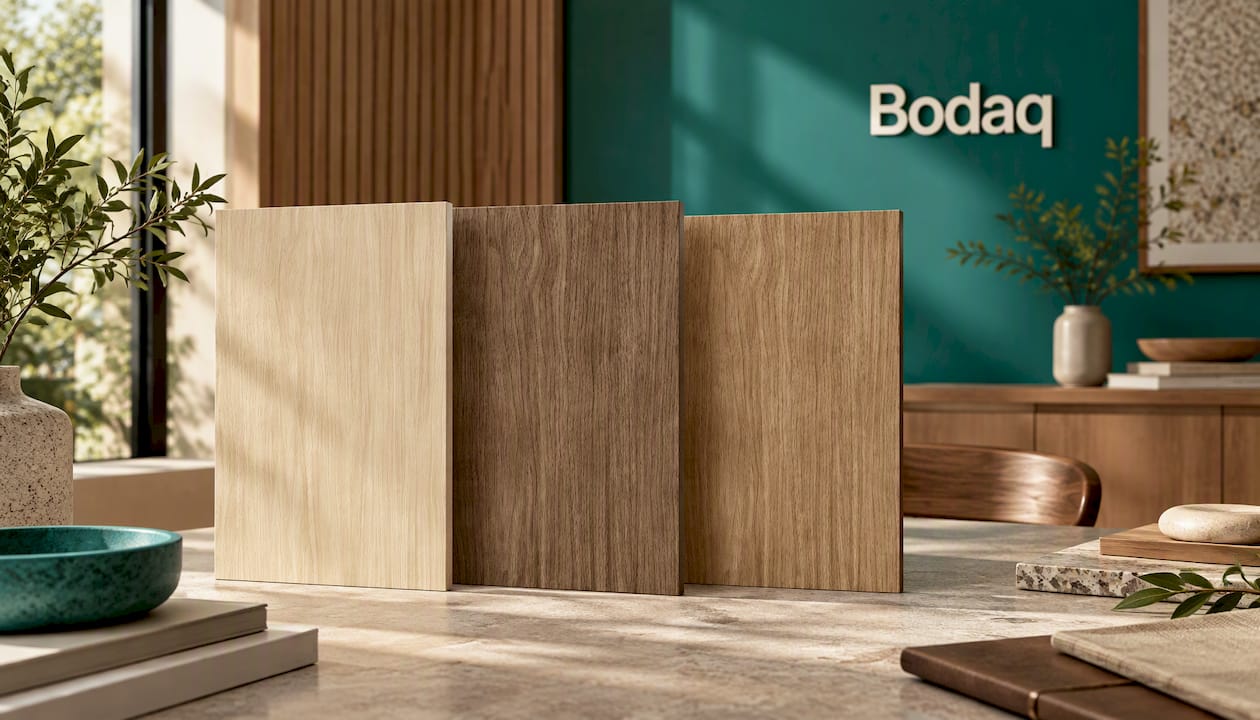
Browse the full range of Bodaq interior film collections, from wood and metal to stone, fabric and solid colors, or begin on the Bodaq Interior Film page to request samples. If wood grain is your direction, the Velvet Oak W957 and Smoked Velvet Oak W958 patterns are good starting points.
FAQ
What does low-VOC finish mean?
It means the finish contains or emits fewer volatile organic compounds than a conventional product, but the term is not standardized. Some labels describe VOC content as manufactured, and others describe emissions into the room. Ask which one applies and request the certificate.
Is zero-VOC paint completely free of emissions?
Not necessarily. Zero-VOC and low-VOC claims can be based on regulatory definitions of content, and tints added at the store can contribute small amounts. A 1999 EPA study also found some low-VOC latex paints still emitted formaldehyde, so look for emissions certification as well.
Which certifications should I look for?
Common choices include GREENGUARD GOLD, SCS Indoor Advantage Gold and Green Seal GS-11, along with product lists based on the CDPH Standard Method V1.2-2017. Obtain the documentation and confirm it covers the exact product and color you plan to buy.
Are peel-and-stick wall coverings a low-VOC option?
Peel-and-stick systems are described by Building Clean as a healthier adhesive approach than vinyl-on-vinyl adhesive, because there is no separate paste to apply. Still check the emissions documentation for the specific product, and ventilate the room during installation.
Do low-VOC finishes cost more?
Often slightly. Healthcare facilities in EPA guidance estimated initial costs 5 to 15 percent higher for low-VOC materials, though they also cited lower overall finish costs from smarter material choices. Compare lifecycle cost, not only the purchase price.
Sources
- Technical Overview of Volatile Organic Compounds, US EPA
- Low VOC? Don’t Stop There, Informed
- Characterization of Low-VOC Latex Paints, US EPA (1999)
- Product Sector Guidance: Paints and Wallcoverings, Building Clean
- Low-Emitting Materials reference guide, U.S. Green Building Council
- Indoor Air Quality: Materials Selection, Healthcare, US EPA (2007)
- Presidential Green Chemistry Challenge 2011, US EPA
- Certified Low/No Emission Interior Paints and Finishes, PNNL
- LEED v4.1 Low-Emitting Products, U.S. Green Building Council
- Material Selection, BuildingGreen
- Study Vets Materials for Entire Wall Assemblies, BuildingGreen
- Controlling Pollutants and Sources, US EPA
- Specifying sustainable interior wood
- The Best Paint for Bathrooms, Bob Vila