Architectural film lead time is the stretch between the moment you commit to a film and the moment rolls are on site and ready to apply. It is rarely one number. It is a chain of approvals, production or picking, freight and site readiness, and the teams that stay on schedule are the ones that plan the whole chain instead of the quoted ship date. Film also has a built-in advantage over most finishes: once material arrives, the installation itself is short and can be phased around a working space. Bodaq interior film is stretchable, self-adhesive and comes in over 450 textures and colors, so the decisions that eat the calendar (choosing, approving, ordering) can be finished early, and the physical work stays brief.
TL;DR
- Lead time is not just production. The clock for a manufacturer usually starts only when the purchase order, deposit and approvals are all in, according to hospitality procurement specialists.
- Selection, sample sign-off and quantity takeoff are the steps you control, and they are where most film projects lose their first week.
- Installation time is a separate number from lead time. Plan it in phases around how the space is used.
- Build a buffer for freight, holidays and approvals, and order a little over your measured quantity.
- Ask for a written ship estimate with your quantity and collection numbers when you request a quote, and schedule installers against the delivery date, not the order date.
Table of Contents
- What lead time actually means for film
- The parts of the timeline, in order
- Lead time is not installation time
- What adds weeks you did not plan for
- How to plan orders so the install stays short
- Phasing installation in occupied spaces
- Who should plan for what
- Our perspective
- Ready to put a date on it
- FAQ
- Sources
What lead time actually means for film
In interior design practice, lead time is the amount of time that passes between starting a process and completing it, for example fabricating, building and shipping a product. Sygrove notes that items with long lead times are identified early because they can affect a project’s critical path. The critical path is simply the sequence of tasks that determines the earliest possible finish date: if one of them slips, the whole job slips.
For film, that framing matters because film is often the last finish to go on. A delayed roll does not just delay the film. It holds up furniture reinstallation, punch lists, reopening dates and sometimes final payment.
When the clock starts
The most common misunderstanding is that lead time begins on the day you place the order. In hospitality procurement, lead time is described as the period from when a manufacturer commences production until the item reaches the project site or warehouse, and that start only happens once the manufacturer has the purchase order, the deposit and any required approvals such as signed-off samples or shop drawings.
Translated to film, “approvals” means the designer, owner or brand standards team has agreed to the exact collection, color and finish. A sample taped to a wall that nobody has initialed is not an approval. Get it in writing before you place the order.
The parts of the timeline, in order
Think of a film order as five segments. Only some of them are in the supplier’s hands.
| Segment | Who controls it | What commonly stretches it |
|---|---|---|
| Selection and sample approval | You and your client | Several decision makers, lighting changes between sample and site |
| Quantity takeoff and order entry | You | Re-measuring, late scope changes, missing surface list |
| Order processing and fulfillment | Supplier | Stock status, order size, payment or deposit timing |
| Freight and delivery | Carrier and site | Distance, holidays, loading access, receiving hours |
| Site readiness and installation | You and your installer | Surfaces not prepped, areas occupied, access approvals |
The first two segments are entirely yours, and in our experience of how projects are typically organized, they are the largest source of avoidable delay because they depend on people agreeing, not on machines running.
Selection and sample approval
With a catalog of more than 450 textures and colors across wood, metal, stone and marble, solid colors, and fabric and leather, choosing is the real work. Narrow the field early. A shortlist of three per surface type makes sample review quicker and lets stakeholders compare in the actual room, under the actual light. Bodaq offers samples, so you can put real material on the real substrate before you commit to a full quantity. Browse the full interior film collections to build your shortlist.
Takeoff and order entry
Measure every surface that will receive film, add the allowance for trimming and pattern matching, and list quantities by collection and color. The more complete the list on the first submission, the less likely you are to place a second small order that ships on its own timeline. If you are not sure how to convert square footage into rolls, our guide to what architectural film coverage includes and how to plan it walks through the allowances.
Processing and fulfillment
This is the number people quote: the time the supplier needs to process the order and release it for shipment. It depends on stock position and order size, so it is the piece to confirm in writing for your specific quantity. When you request a quote, ask which of your line items are ready to ship and which are not, and have the answer attached to the quote.
Freight and delivery
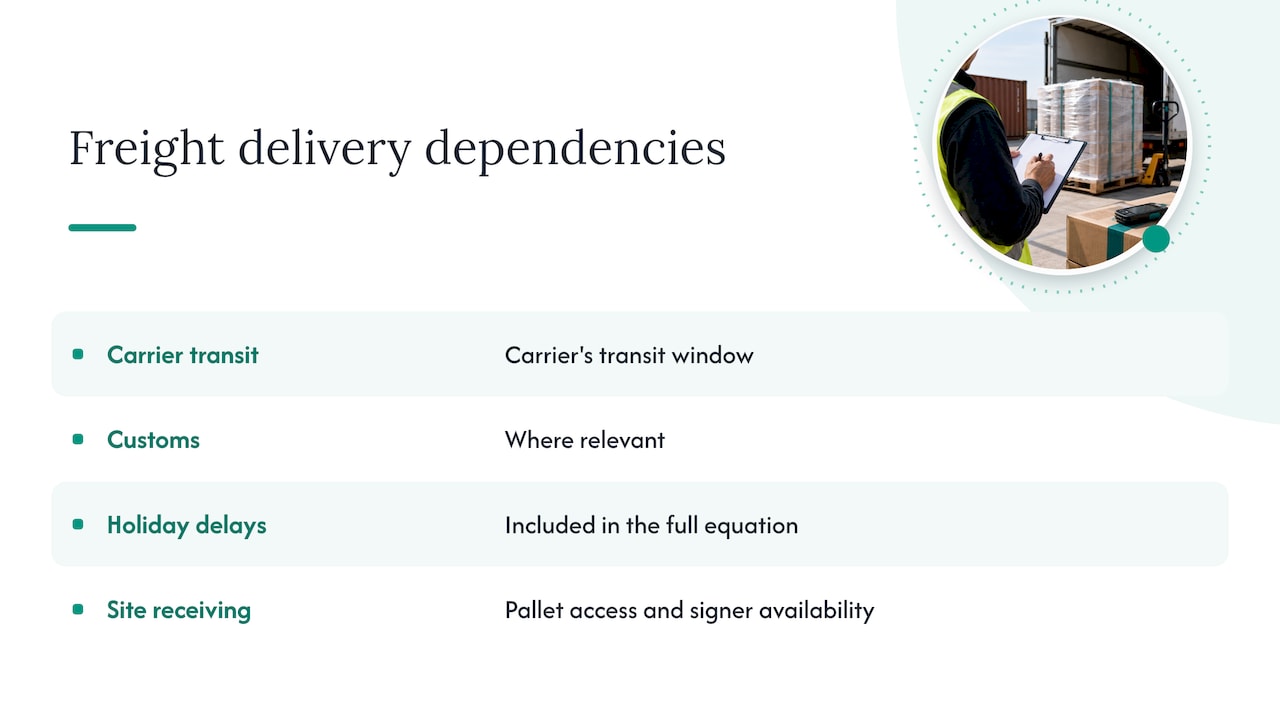
Freight time is the part many project schedules forget. Procurement specialists point out that the full equation includes time in transit, customs where relevant, holiday delays and approvals, and that overlooking it can leave a project weeks behind with costly remobilization of crews. For a domestic film order the biggest variables are the carrier’s transit window, whether the site can receive pallets or cartons, and whether anyone is there to sign for them.
Lead time is not installation time
Searchers often mix the two, so separate them in your schedule.
- Lead time covers everything up to the moment material is on site.
- Installation time covers the physical application of film once crews have it.
This distinction is where film earns its place on tight schedules. Traditional renovation finishes, such as demolition and replacement of wall panels, cabinet fronts or doors, generally require trades to be sequenced one after another, with drying, curing or fabrication in between. Film is applied to the existing surface. Bodaq film is stretchable and uses an air-channeled adhesive, which is designed to make application cleaner and simpler on walls, furniture, doors and other surfaces. The practical result for a planner is that the installation window can be short and the area can often return to use quickly. For a deeper look at the schedule effect in offices, see how specifiers renovate offices with film in hours, not weeks.
That is why the best way to protect a deadline is to make the pre-delivery stage tight and then treat installation as a short, well-defined event.
What adds weeks you did not plan for
Approvals that arrive late
If the manufacturer-quoted production time is the only number in your schedule, you are missing the approvals loop. A sign-off from an owner, a brand standards review or a landlord’s consent letter can each take longer than the freight. Put them on the schedule as tasks with owners and dates. A task-management tool helps here: breaking prerequisites into tracked tasks keeps the things that must be finished before an order is released visible to everyone, not buried in an email thread.
Substrate surprises
Film is only as good as the surface under it. If a wall needs patching, a door has a failing finish or a cabinet face has residue, the prep work becomes a gating item, and the delivery date is irrelevant if the surface is not ready. Our guide to matching film grade to the substrate helps you identify what each surface type needs before crews arrive.
Neighboring trades
Film usually follows paint, millwork and electrical, and precedes furniture and signage. When those trades slip, film slips with them. A clear picture of schedule buffers and risks beyond the quoted production time is useful when you place film behind finish trades, because the film start date is only as firm as the work that precedes it.
Holidays and peak seasons
Carrier capacity tightens around major holidays, and so do receiving hours at hotels, schools and offices. If your install window lands near one, move the order earlier rather than hoping freight will absorb it.
Reorders
A second order for a shortfall has its own processing and freight time, and it can land after crews have demobilized. Order a modest overage on your measured quantity, and keep leftover film for future repairs.
How to plan orders so the install stays short
A simple routine keeps most film projects on time.
- Lock the surface list. Walk the site and list every surface, its material and its condition. Photograph each one.
- Shortlist and sample. Choose two or three candidates per surface type and put samples on the actual substrate. Collect written approval from the person who has the final say.
- Calculate quantity with allowance. Add trim and pattern-match allowance per surface, and round up to whole rolls.
- Request the quote with ship timing. Ask for the estimated ship date for your quantity, collection and color, and have it in writing.
- Work backward from the install date. Subtract freight time, then a buffer, then the supplier’s processing time. The result is the date by which the purchase order and approvals must be complete.
- Confirm receiving. Name who accepts the delivery, which door, what hours, and where the cartons are stored until crews arrive.
- Stage the install. Pre-assign areas by phase so crews always have something to work on.
Step four is where Bodaq can take work off your plate: the sample program lets you settle the selection before the order, and our team handles quotes and orders through the online order form, so the estimate and the quantity are on one document.
Phasing installation in occupied spaces
For hotels, offices, clinics and retail, the question is not only how long the work takes but how little of the space it removes from use. Window film specialists recommend phasing around the operating pattern of the business, assigning identifiers to each area by phase with clear boundaries, recording in writing who controls access and approvals, and including a pre-measured fallback phase so crews stay productive when the main area is occupied. The same logic applies to wall, door and furniture film.
A practical phasing example for a 40-room hotel corridor refresh:
- Phase one: vacant rooms and back-of-house areas, to build momentum and confirm the pattern and finish with the owner.
- Phase two: corridors and elevator lobbies during low-traffic hours.
- Fallback phase: pre-measured doors and trim in any area, so crews can pivot if a room is occupied.
Because the film goes over the existing surface, there is no demolition debris and no waiting for curing, which keeps each phase compact. General contractors will find more on the scheduling advantage in architectural film benefits for general contractors.
Who should plan for what
Homeowners: your lead time is mostly selection and freight. Order samples first, choose, and place the order when your installer or your own weekend is fixed. Our cost guide helps you budget before you order.
Designers and architects: put the approval chain on the schedule and specify film grade and substrate clearly. The specification guide lists what to write and verify so there are no mid-project substitutions that reset the clock.
Property and facility managers: schedule the install window first, then work backward. Include receiving, storage and access approvals.
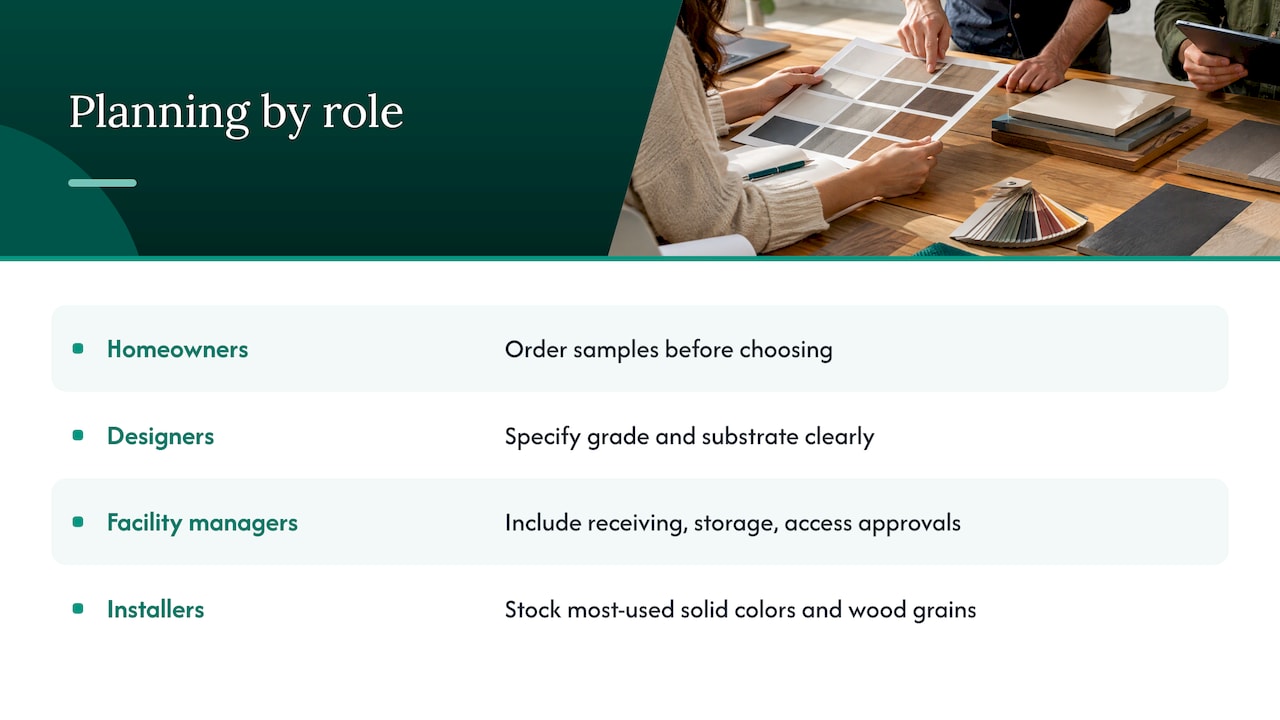
Installers and dealers: keep your own stock of the most-used solid colors and wood grains so small repairs do not wait on freight. Bodaq offers dealer kits and certified installer training for this purpose.
Our perspective
Most lead-time trouble we see described in project planning has nothing to do with how fast film can be made. It comes from a start date that was never defined: no one signed off the sample, the quantity changed, nobody was named to receive the boxes.
We build our approach around making the decisions early and the application brief. A stretchable, self-adhesive film with air-channeled adhesive is designed to go onto an existing surface without demolition, so the work on site can be a short event instead of a multi-trade sequence. A catalog of more than 450 textures and colors, plus samples, means the choice can be made on the real wall before the order is placed.
Our advice is simple: treat the order as a milestone, not a hope. Lock the surface list, approve in writing, confirm the ship estimate for your quantity, and schedule crews against delivery. Do that, and film can be one of the most predictable finishes on the job.
Bodaq
Ready to put a date on it
If you have a surface list and a target install window, the quickest way to turn it into a schedule is to get your selection and quantity in front of us. Browse the collections, request samples for your shortlist and submit your order or quote request, then confirm the ship estimate against your install date.

Start with the Bodaq interior film collections, or go to the Bodaq U.S. site to request samples and a quote.
FAQ
How long does architectural film take to arrive after an order?
It depends on order size, stock position, your payment and approval timing, and the carrier’s transit window. The reliable approach is to request a written ship estimate with your quote, for your specific collections, colors and quantity, and then add a buffer for freight and receiving.
Does lead time include installation?
No. Lead time ends when the material is on site. Installation is a separate task with its own duration, which you schedule after delivery. Film is applied over the existing surface, so the installation segment is typically short compared with replacing materials.
When does the lead-time clock start?
For manufacturers, it generally starts when they have the purchase order, any deposit and required approvals, not on the day you first inquire. Procurement guidance describes it this way, so get sample and quantity approvals done before you submit the order.
How can I avoid delays on a tight renovation?
Finish selection and sample approval early, submit one complete order with a small overage, confirm who receives the delivery, and phase installation around the space’s operating pattern. Name a fallback area so crews always have somewhere to work.
Should I order extra film?
Yes, a modest allowance beyond your measured quantity covers trimming, pattern matching and future repairs, and it avoids a second shipment with its own lead time.
Sources
- Lead Times in Hospitality FF&E Procurement, AK Design Group
- Common Interior Design Terms and What They Mean, Sygrove
- Phasing a Window Film Installation in an Occupied Business, Precision Film Systems
- Construction task management: a practical guide for builders, Buildberry
- New Build Painting Schedule: A Builder’s Timeline Guide, Sigma Painting