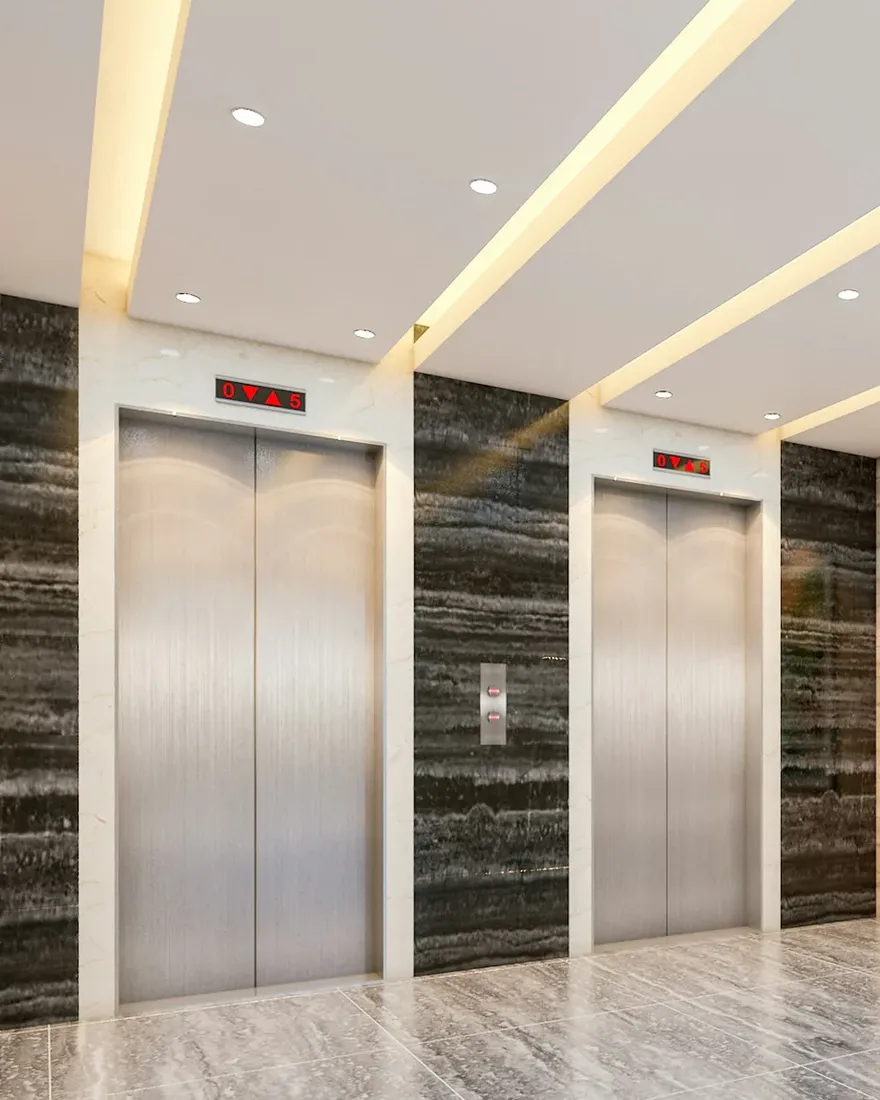
Brushed stainless steel was the standard elevator door finish for decades. It is tough, but years of luggage carts, keys and hands leave their mark: scratches that catch the light, fingerprints, dents near the floor, and a grain that looks dated next to a renovated lobby. Replacing the door panels means new parts, an elevator contractor and an elevator out of service. Architectural interior film updates the doors you already have, in place.
This guide is for property managers, building owners and designers. It covers your options, where film fits, which finishes suit elevator doors, what to check first, and how the work runs.
Three ways to update stainless steel elevator doors
- Replace the door panels. The right call when doors are bent or damaged, or when the elevator is being modernized anyway. It is also the most disruptive route.
- Restore the stainless. Polishing and re-graining can soften light scratches, but the result is still stainless steel, with the same look and the same fingerprints.
- Wrap the doors with architectural film. A new surface goes directly over the existing steel. You can keep a metal look, or change to wood, stone or a color that matches the lobby.
Why film works on elevator doors
- It goes over the metal you have. Bodaq film applies directly over existing surfaces with minimal prep. The panels stay where they are, and there is no demolition.
- It is fast. Elevators can often be refinished in a day, and the work happens right in the lobby and the cab. Doors can be booked into a quiet window, such as overnight.
- It is light. Bodaq film adds almost no weight, and Bodaq states it complies with elevator weight regulations in Canada and the US.
- It matches. The same film can go on the cab walls, the door frames and the lobby walls, so the whole elevator area reads as one design.
- It costs less. On average, refinishing with Bodaq film costs 50% less than a traditional renovation and is up to 50% faster.
Finishes that suit elevator doors
Bodaq has more than 450 finishes. For elevator doors, four directions cover most buildings:
- Keep it metal, just new. Metal finishes such as RM005 Brushed Silver or RM004 Brushed Steel give a clean brushed look without the old scratches. VM901 Chrome Velvet Metal has a softer sheen.
- Warm it up. Wood finishes such as SPW52 Honey Walnut, one of Bodaq’s best sellers, suit hotel and residential lobbies.
- Brighten it. A white stone or marble such as PM017 Bianco lifts a dark lobby.
- Hide the scuffs. Solid colors such as S264 Pebble Grey hide scuffs better than white, and a deep color such as S265 Obsidian Blue makes the doors a feature.
Look at samples under the lobby’s and the cab’s own lighting. A finish that looks warm under one light can look flat under cooler LED strips.
What to check before you commit
- Fire rating. Bodaq film is rated Class A under ASTM E84. Elevator work is governed by codes such as ASME A17.1 and CSA B44, so collect the documents your inspector and elevator contractor need before work starts. Our guide to elevator interior code compliance covers this.
- Hall doors and car doors. Hall doors face the lobby on each floor. Car doors travel with the cab. Decide whether you are doing every floor or only the main lobby, since that sets the scope and the schedule.
- Your elevator contractor. Coordinate with the company that services the elevator, so the doors are checked and the work fits their schedule.
- Dents. Film follows the surface underneath, so deep dents are filled and sanded smooth first.
- Wear and cleaning. Bodaq film is made for high-traffic commercial spaces and resists scratches, stains and daily wear. It is moisture-resistant and easy to clean with a mild detergent, and it is designed for more than 10 years of use.
How the work runs
- Scope. Send photos of the doors, the number of floors and elevators, and the look you want.
- Samples. Compare finishes in the lobby’s own light.
- Schedule. Book a low-traffic window and do one elevator at a time, so the building keeps service.
- Prep. The steel is cleaned, dents are filled with putty and lightly sanded, and primer goes on the edges and corners for better adhesion.
- Apply. The film is measured, cut and applied with a squeegee, working the air out as it goes.
- Back in service. The elevator returns to service once the work is done and checked.
A certified Bodaq installer can do the work for you, from a network across the USA and Canada. For the whole cab, read elevator wrap installation. For budgets, see elevator wrap costs.
FAQ
Can you put film on stainless steel elevator doors?
Yes. Architectural film goes directly over smooth, sound surfaces, including stainless steel, after cleaning and prep. The doors stay in place.
Can I keep a metal look?
Yes. Brushed metal finishes such as RM005 Brushed Silver and RM004 Brushed Steel give the doors a fresh metal surface without the old scratches.
How long does it take?
Elevators can often be refinished in a day. Doors can be scheduled overnight or in another quiet window, one elevator at a time.
Is elevator door film fire rated?
Bodaq film is rated Class A under ASTM E84. Ask for the documentation your inspector needs before work starts.
How long does it last?
Bodaq film is designed for more than 10 years of use in high-traffic commercial spaces.
Need a direct source of Bodaq film? Here we are.
Want to see the finishes on your own doors first? Contact Bodaq for samples, or send photos of your elevator doors for a quote. For buildings and portfolios with several elevators, Bodaq can scope, supply, install and manage the whole project.