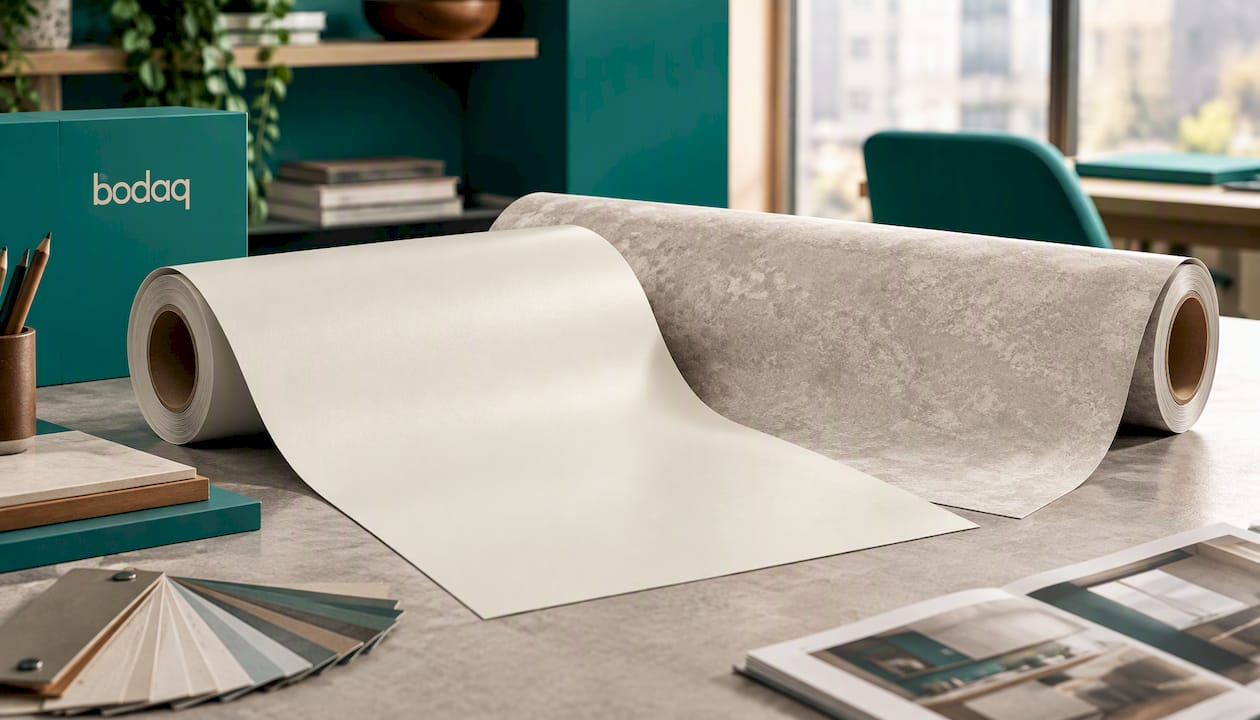
A full Bodaq architectural film roll is 48 inches wide and 164 feet long, which works out to 656 square feet of film before trimming and waste. It is about 0.2 mm (8 mil) thick and weighs roughly 65 to 66 lb. Those numbers decide how many doors, wall drops or millwork runs you can pull from one roll, and how you plan freight and storage.
This guide gives you the exact dimensions, shows the math for real jobs, and explains what to check before you order.
TL;DR
- Every Bodaq finish is specified on a 48 in wide, 164 ft long roll, thickness 0.2 mm (8 mil).
- One roll weighs roughly 65 to 66 lb, and the exact figure varies slightly by finish, so check the product page of the SKU you order.
- A full roll gives you 656 sq ft of gross film. Plan for trim allowance and pattern matching on top of your measured area.
- Roll size is only half the story: installation temperature (54 to 100 °F) and a 3 to 7 day cure period belong in the schedule.
Table of Contents
- The standard Bodaq roll: dimensions at a glance
- Why 48 inches is a practical width
- What 164 feet really covers
- Thickness and weight: what they tell you
- Planning around the roll: temperature and cure time
- A note from our side of the roll
- How to choose how many rolls to order
- Roll size and the type of project
- Ordering Bodaq film
- Checklist before you place an order
- FAQ
- Sources
The standard Bodaq roll: dimensions at a glance
Bodaq’s US performance documentation lists the roll size as 48 in × 164 ft at approximately 65 lb, with a film thickness of 0.2 mm (8 mil). The catalogue page for Cardoso NS710 shows the same width and length, with a listed weight of 66 lb. The one-pound gap is the point: weight can shift slightly from finish to finish, so the product page of the exact SKU should govern ordering and freight planning.
| Spec | Value |
|---|---|
| Width | 48 in (about 122 cm) |
| Length | 164 ft (about 50 m) |
| Gross area per roll | 656 sq ft |
| Thickness | 0.2 mm (8 mil) |
| Weight | approx. 65 to 66 lb, varies by finish |
| Installation temperature | 12 to 38 °C (54 to 100 °F) |
The metric conversions are simple arithmetic from the published imperial figures. If your architect’s drawings are in millimeters, the width is roughly 1,220 mm and the length roughly 50 m.
Why 48 inches is a practical width
A 4 ft width is no accident. It matches the module of sheet goods, so a film panel lines up naturally with how most interior surfaces are built and measured. A standard 36 in door slab fits inside the width with room to spare. A cabinet side, a reception-desk front or an elevator wall panel often fits in a single drop, which means fewer seams for the eye to find.
Wider surfaces are different. A wall that is 8 ft high is two widths tall if you run the film horizontally, or you can hang vertical drops that each cover 4 ft of wall width and run floor to ceiling. Vertical drops are the usual approach on walls, because a seam line running the full height reads as a deliberate panel joint, especially with stone, metal or solid colors.
What 164 feet really covers
The gross area of 656 sq ft is a ceiling, not a promise. In practice you lose film to three things: trim allowance on each cut, pattern matching, and the offcuts that are too small to use. Here are three worked examples, illustrative math you can adapt to your own measurements.
Example 1: interior doors
A standard door face is about 80 in tall and 36 in wide. Add a couple of inches at each end for handling and trimming and you cut each piece at roughly 84 in. A 164 ft roll is 1,968 in long, so 1,968 ÷ 84 gives 23 door faces per roll, with a few inches left over. Because the door is narrower than the 48 in width, you have a sliver of leftover film on every piece. That is worth keeping for door edges, kick plates or small returns.
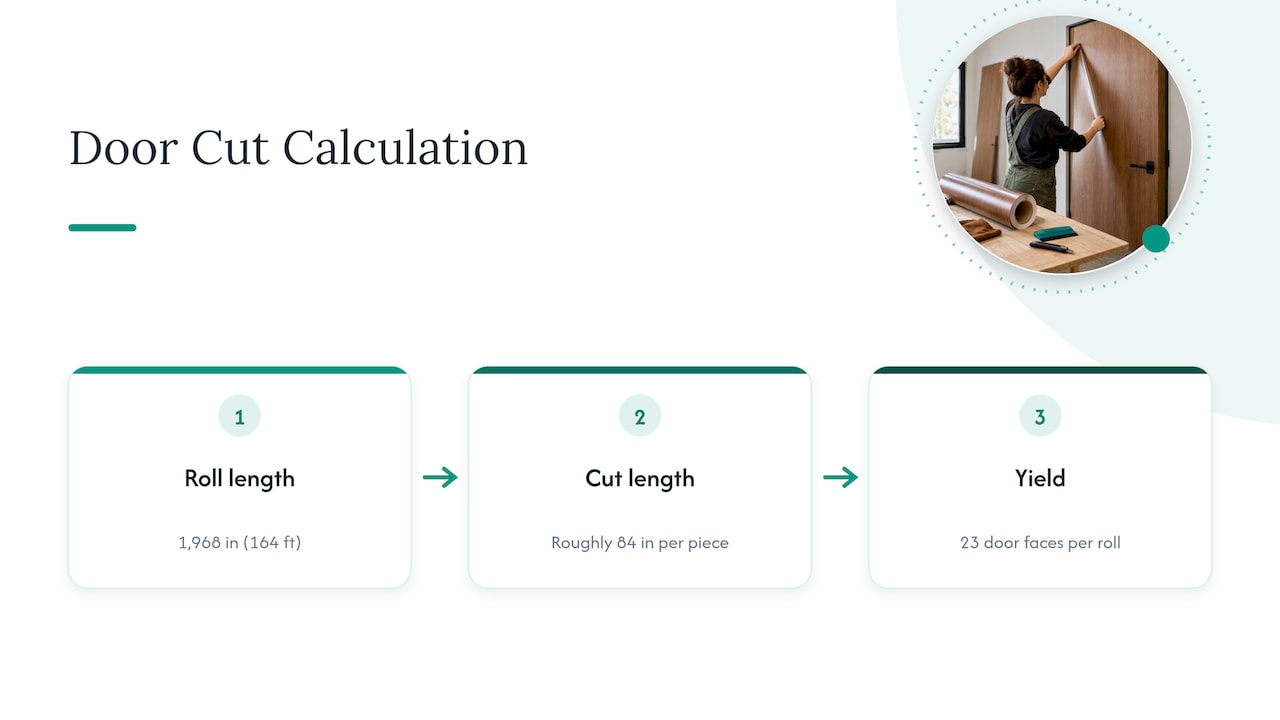
A two-sided door counts twice. A hotel corridor with 20 guest room doors finished on the corridor side only fits comfortably on one roll. Finishing both faces of 20 doors takes 40 pieces, which is two rolls.
Example 2: an accent wall
Take a wall that is 8 ft high and 20 ft wide. With vertical drops cut at about 8 ft 4 in, you need five drops, each 4 ft wide, for 41 ft 8 in of film. That is a quarter of a roll. If your pattern is directional, like a wood grain, all drops must run the same way, and a repeat that has to be matched at the seams adds a few more inches per drop.
One roll gives you about 19 drops at that cut length (1,968 ÷ 100 in), which is enough for around 76 ft of wall run at 8 ft ceiling height. That is a generous accent wall or a long corridor, but not a whole floor of offices.
Example 3: a mixed renovation
Most real projects blend surfaces: doors, a reception front, elevator cab walls, a few wall panels. The reliable method is to build a cut list rather than divide square footage by 656:
- Measure every surface and record height and width.
- Note which surfaces are narrower than 48 in and which need seams.
- Add a 2 in allowance on every side you will trim.
- Group pieces by pattern direction, since a directional finish cannot be rotated.
- Lay the pieces against the 1,968 in length and count the rolls.
Order a little over what the list says. A finish that is in production today may be on a different batch next season, and a mid-project reorder can introduce a slight color shift between lots.
Thickness and weight: what they tell you
The 0.2 mm (8 mil) thickness is part of why the film can wrap curves, return edges and sit tight around door profiles. The same performance data reports 3H pencil hardness, 220% transverse elongation and 80% machine elongation, and stain testing with no change after 24 hours of contact for the listed substances. Elongation is what we mean by stretchable: the film gives enough to follow a contour, and it recovers its look once it settles.
Weight matters for logistics rather than design. At about 65 lb, a roll is a two-person lift in its carton, not a forklift-only item, but it is long. Plan a staging area where you can cut pieces to length without folding the film, and store rolls flat or upright as the product page instructs for the finish in question.
Planning around the roll: temperature and cure time
A roll that is perfectly sized still fails if the room is wrong. Bodaq’s published data gives an application range of 12 to 38 °C (54 to 100 °F). A building with the HVAC off in January, or a hotel floor with the windows open in August, may fall outside it. Condition the space, and the film itself, before you start.
Then there is the cure. The adhesive takes 3 to 7 days to reach full strength. Fast installation does not mean immediate full-service readiness: scheduling heavy use or aggressive cleaning on day one can undermine an otherwise clean job. For a hotel renovating rooms in phases, build those days into the room-release schedule and let the surfaces sit before they return to service. Our guide to installing architectural film walks through the steps, including the post-heat stage.
A note from our side of the roll
We see the same mistakes again and again, and almost none of them are about the film itself.
The first is ordering by square footage alone. Gross area looks neat on a spreadsheet, but doors, panels and columns are cut pieces, not an open field. A cut list will always beat a calculator.
The second is ignoring pattern direction. Wood grain, brushed metal and fabric all have a direction, and the installer needs the freedom to keep it consistent from the first door to the last. That freedom costs film, and it is worth every inch.
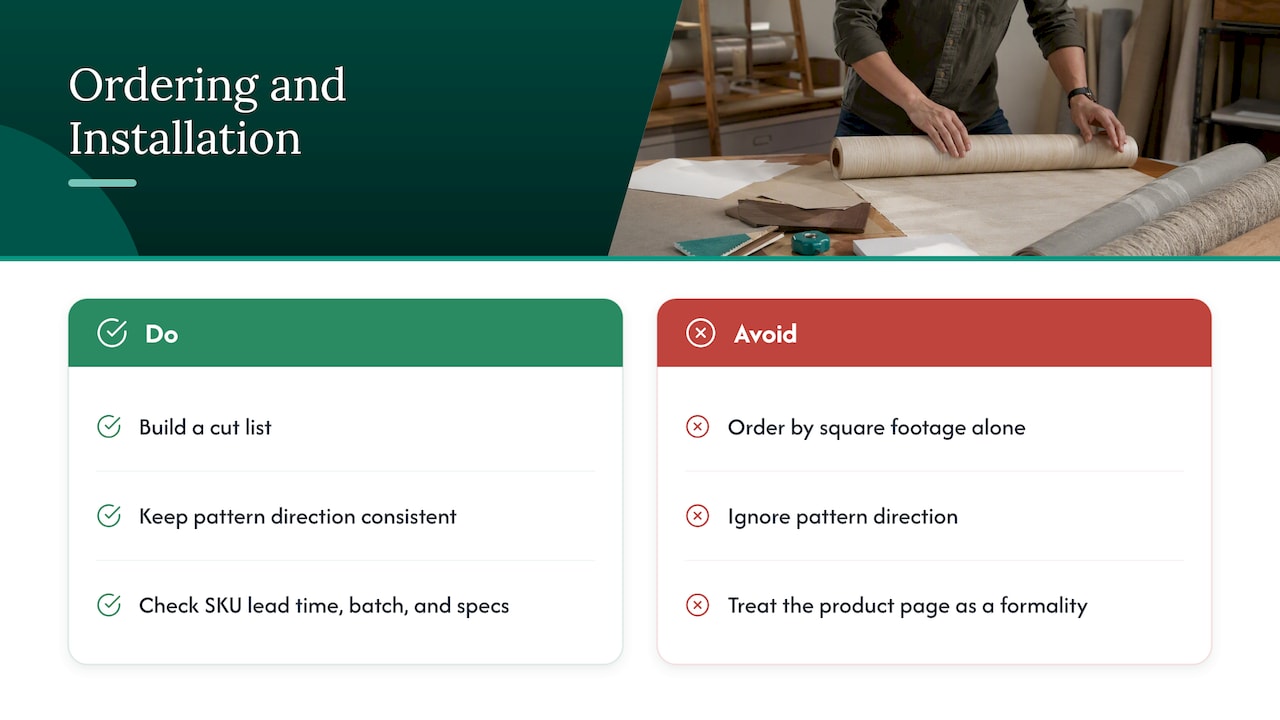
The third is treating the product page as a formality. A finish that weighs 66 lb rather than 65 will not wreck your freight quote, but the lead time, the batch and the specification for that SKU all live on its page. We keep those pages accurate so that specifiers can order with confidence.
The film’s strength is that it goes over the surface you already have, with no tear-out and no dust. A well-sized order keeps that promise: fewer leftovers, fewer surprises, and a job that finishes when the schedule says it will.
— Bodaq
How to choose how many rolls to order
Use this short decision path before you request pricing.
- Under about 30 sq ft of work, like a single door or a small panel: a sample or a small project order may be enough. Request samples to confirm color and texture in your own light first.
- A handful of doors or one accent wall: one roll is usually plenty. Check that the cut list fits inside 164 ft.
- Corridors, lobbies, guest room floors: count by piece, then add a buffer for pattern matching and mistakes. Two rolls of the same finish, ordered together, keep the lot consistent.
- Mixed finishes: each pattern needs its own roll count. Do not assume you can combine leftovers across finishes.
If you are specifying for a commercial project, it is worth reading how film meets code. Our article on ASTM E84 wall finishes under IBC Chapter 8 explains the fire-rating side so the paperwork matches the order. For choosing the right grade for the surface, see matching film to substrate.
Roll size and the type of project
Different buyers use the same roll differently.
Designers and architects care about seams and repeats. A 48 in width means you can plan drops on the same module as your drawings. Our wall finishing material overview compares film with other options.
General contractors care about speed and waste. A pre-measured cut list shortens installation and cuts disposal. We cover the schedule benefits in film for general contractors.
Property and facility managers care about downtime. Offices and common areas can be resurfaced in hours rather than weeks, as described in our guide to office renovation with film.
Homeowners usually need far less than a full roll. If you are refreshing a kitchen or a hallway, our page on reinventing your home with architectural film shows what is realistic.
Ordering Bodaq film
Bodaq offers more than 450 textures and colors across Wood, Metal, Stone & Marble, Solid Colors, and Fabric & Leather collections. You can browse the full range on the Bodaq Interior Film collections page, request samples to judge the finish in your light, and then order rolls or ask for a quote. If you already know your surface, two high-performance finishes are good places to start: Easy Clean ECF01 for solid color surfaces and Rustic Stone EXF52 for a stone look. We also supply installation tools and offer training for professional installers, so the person who cuts the roll knows the film.
Checklist before you place an order
- Confirm the finish and its SKU, and read that product page for width, length and weight.
- Build a cut list with trim allowance, and mark pattern direction on every piece.
- Count rolls from the cut list, not from total area, and add a buffer.
- Order every roll for one area at the same time to keep lots together.
- Check the site’s temperature will sit between 54 and 100 °F during installation.
- Schedule 3 to 7 days for the adhesive to reach full strength before heavy use or cleaning.
- Verify code requirements for the project. The technical bulletins are a good place to find the documents.
FAQ
What is the standard size of an architectural film roll?
A Bodaq roll is 48 inches wide and 164 feet long, which is roughly 122 cm by 50 m. That gives 656 square feet of gross film. The exact weight is about 65 to 66 lb, depending on the finish.
How many doors can one roll cover?
For a standard 80 in by 36 in door face, cutting each piece at about 84 in, a 164 ft roll yields around 23 faces. If you finish both sides of every door, that is about 11 doors per roll. Doors with glass lites, wide frames or directional patterns will cut the number down.
How thick is architectural film?
Bodaq’s film is 0.2 mm, or 8 mil, on average, according to its performance documentation. That thickness allows it to stretch around contours while still giving a solid, finished look on doors, walls and millwork.
Can I buy less than a full roll?
Samples are available so you can check color and texture before you commit, and the best route for smaller quantities is to ask our team through the Bodaq Interior Film site. The availability of cut lengths can differ by finish, so confirm it on the product page.
Does the roll size change the installation temperature?
No. The installation range of 54 to 100 °F applies regardless of how much film you use. Bring the space, the surface and the film into that range before you begin, and leave 3 to 7 days for the adhesive to reach full strength.