The best healthcare wall finish is the one that survives your cleaning protocol, resists moisture, and can be installed without shutting down a unit. In U.S. facilities that usually means vinyl wallcovering, paint, rigid panels or, increasingly for renovations, a stretchable architectural film. The right pick depends on the room, the disinfectants you use and how much downtime you can afford.
Below, we walk through the main finish types, the cleaning and infection-prevention questions to settle before you buy, how to match finishes to room types, and how to renovate occupied spaces without disruption.
TL;DR
- Vinyl wallcovering and paint are the two most common wall surfaces in U.S. healthcare, but aesthetics often drive the choice more than maintenance reality.
- No regulation tests finishes for disinfectant compatibility, so you need manufacturer testing and validation data in hand before purchase.
- Facility managers surveyed in one Texas study ranked ease of maintenance above initial cost; a cheap finish that degrades is the expensive one.
- Seams, gaps and porous substrates are where problems start, so look at the whole system, including the adhesive and the wall behind it.
- For occupied spaces, a self-adhesive film can refresh walls with less dust, odor and downtime, provided it is validated for your protocols.
Table of Contents
- What U.S. healthcare facilities actually put on their walls
- Cleaning, disinfection and infection prevention come first
- Which finish properties matter most
- Matching finishes to rooms and levels of use
- Renovating occupied spaces without losing beds
- Where architectural film fits
- Our perspective: treat the wall as a system, not a swatch
- Choosing a film for a healthcare project
- A short checklist before you specify
- FAQ
- Sources
What U.S. healthcare facilities actually put on their walls
Two materials dominate. Vinyl wallcovering and paint are the two most prevalent wall surfaces in U.S. healthcare facilities, and the same source notes that aesthetics often control selection over maintenance realities. That gap between what looks good on a sample board and what holds up on a Tuesday night in the emergency department is the main reason finishes fail early.
A 2012 survey of facility managers at metropolitan, for-profit Texas hospitals found Type II vinyl was the most preferred wall finish in emergency, surgery and inpatient units. Water-based latex paint ranked second, rigid fiberglass panels third and solvent or oil-based paint fourth. It is a regional, older snapshot, but it shows how practitioners think: durable, cleanable and familiar beat novel.
Here is how the main options differ in practice.
| Finish | Where it shines | Watch for |
|---|---|---|
| Vinyl wallcovering | Corridors, patient rooms, waiting areas; wide range of patterns | Seams and edges; adhesive must carry a biocide; moisture behind the covering |
| Paint (latex, semi-gloss or gloss) | Fast, low upfront cost, easy touch-ups | Repainting cycles, odor and ventilation during work, scuffs on high-traffic walls |
| Rigid panels (FRP and similar) | Wet or heavily cleaned zones, soiled utility, labs | Joints and trim, plain look, panel installation is invasive |
| Impact-protection systems | Corridors with beds, carts and equipment | Cost, a clinical look if used everywhere |
| Architectural interior film | Renovations of existing walls, doors, millwork and casework; a unified look across surfaces | Needs a sound substrate; ask for cleaning and disinfectant validation for your protocols |
No single row wins everywhere. Specifiers who get the best results mix them: a tough panel or protection rail at cart height, a washable decorative finish above, and a consistent color story that ties it together.
Cleaning, disinfection and infection prevention come first
A wall finish is not a critical surface in the way a bed rail or an instrument tray is, but it is part of the environment your cleaning team maintains every day. The CDC includes walls among noncritical general housekeeping surfaces and calls for standardized, setting-specific cleaning and disinfection protocols. In plain terms: decide how the room will be cleaned, then choose a finish that tolerates it.
Build the selection team early
The same CDC guidance recommends that facilities bring together environmental services management, infection prevention and control, materials management and other relevant staff to choose cleaning and disinfection products and technologies. They weigh manufacturer instructions for use, contact time, health risks, effectiveness on the surface, cleaning efficiency, training needs and the effects of repeated exposure. Add your designer or architect to that list before finishes are locked in, not after.
The ASHE and FGI monograph on the environment of care makes the same point from the design side: infection-prevention measures need a multidisciplinary approach involving infection preventionists, architects, engineers, epidemiologists and other healthcare personnel.
Disinfectant compatibility is your responsibility to verify
This is the point most often missed. According to the Healthcare Surfaces Institute, there are no regulatory testing requirements for evaluating surface disinfection compatibility, so you should review instructions for use and obtain manufacturer testing and validation data before purchasing. The Institute’s Linda Lybert also cautions against asking a manufacturer to put your facility’s disinfectant list on company letterhead as “approved.” Products need to be tested and validated, with documentation.
A practical request to any supplier, film included, looks like this:
- Send us the test method and results for the disinfectants on our current list, by product name and contact time.
- Tell us how many cleaning cycles the data represents.
- Tell us what happens after repeated UV-C or vapor-based disinfection, if we use it.
- Provide the written cleaning and maintenance instructions you will stand behind.
The last two matter. An ISSA article on selecting surface materials notes that materials should be compatible with no-touch disinfection technologies such as UV-C or vapor systems, and reports that repeated UV exposure discolored and cracked some plastic furnishings. The same piece warns that porous composite materials, including certain decorative wall panels, can absorb disinfectants and degrade within months, which can lead to microbial growth beneath the surface and costly replacement.
Look at the adhesive and what is behind it
A finish is a system. For wallcoverings, the HFM magazine article on surface selection states that adhesives in healthcare must contain a biocide component designed to prevent bacterial and mildew or fungal growth, both in the adhesive and behind the covering if moisture gets there. That is a good question for any self-adhesive product too: what is in the adhesive layer, and how does the system behave if the wall gets wet?
Which finish properties matter most
Research from the field points to a consistent short list. We have organized it as the questions to ask a supplier, rather than a ranking, because the weighting changes by room.
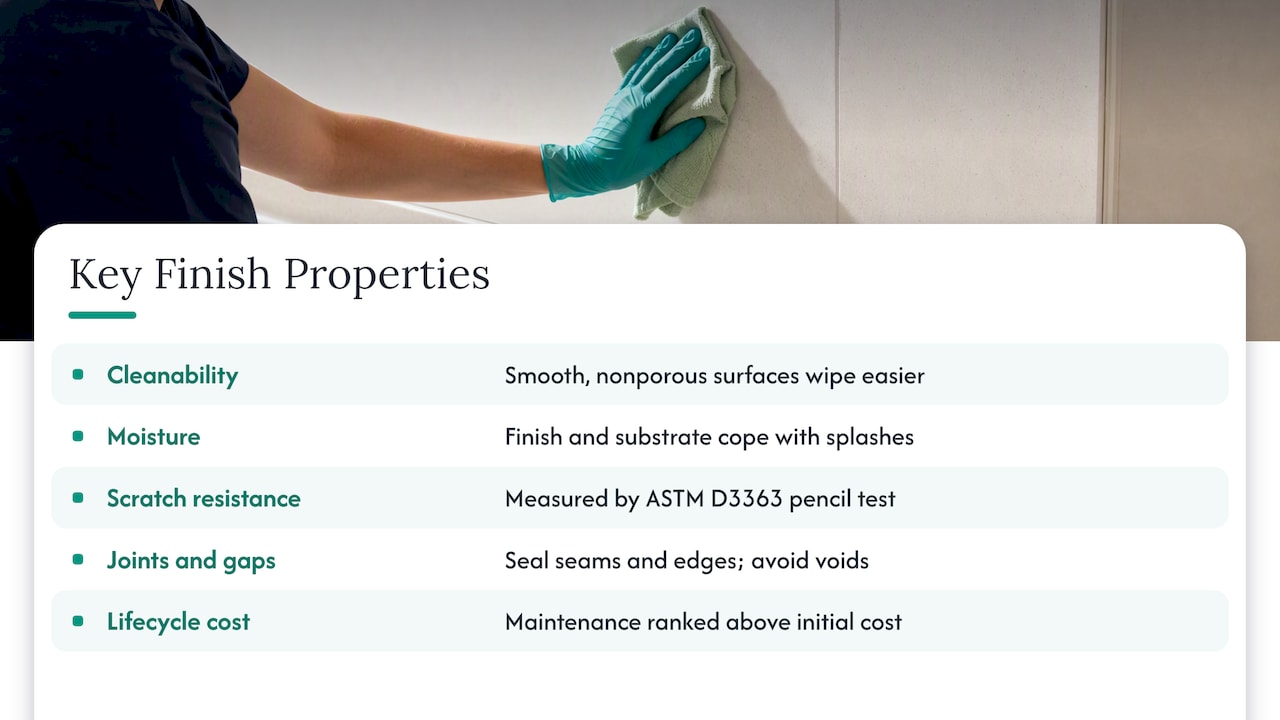
Cleanability. Smooth, nonporous, low-texture surfaces are easier to wipe and show less residue. Semi-gloss and gloss paint finishes, for example, are easier to clean and hide scratches and dings better than flat ones, a point made in a guide to painting healthcare facilities by contractors who work in them. Heavy emboss and deep texture can look wonderful in a lobby but are harder to clean in a procedure room.
Moisture tolerance. Walls near sinks, showers, soiled utility and ice machines need a finish and a substrate that cope with splashes and humidity, and edges that do not let water creep behind.
Scratch and scuff resistance. Corridors take constant abuse from carts, wheelchairs and bed rails. Scratch resistance is measurable: our page on scratch-resistant wall finishes tested to ASTM D3363 explains what that pencil-hardness test does and does not tell you.
Few joints and gaps. Surfaces should be accessible and free of voids and joints where bacteria can breed. Ask how seams are treated, how edges are sealed and whether the trim creates ledges that collect dust.
Lifecycle cost. Here is the finding that should change budgeting conversations. In the Texas facility-manager survey, ease of maintenance was ranked a greater concern than initial cost, and materials chosen solely for looks may have a short life if they are not appropriately cared for. Price a wall over its whole service life, including repainting, patching, labor and the cost of taking a room out of service.
Matching finishes to rooms and levels of use
CDC guidance calls for cleaning and disinfection protocols tailored to the setting, accounting for room layout, equipment and patient risk. Use the same logic for finishes. A simple way to organize a project is by zone.
High-contact, high-impact zones
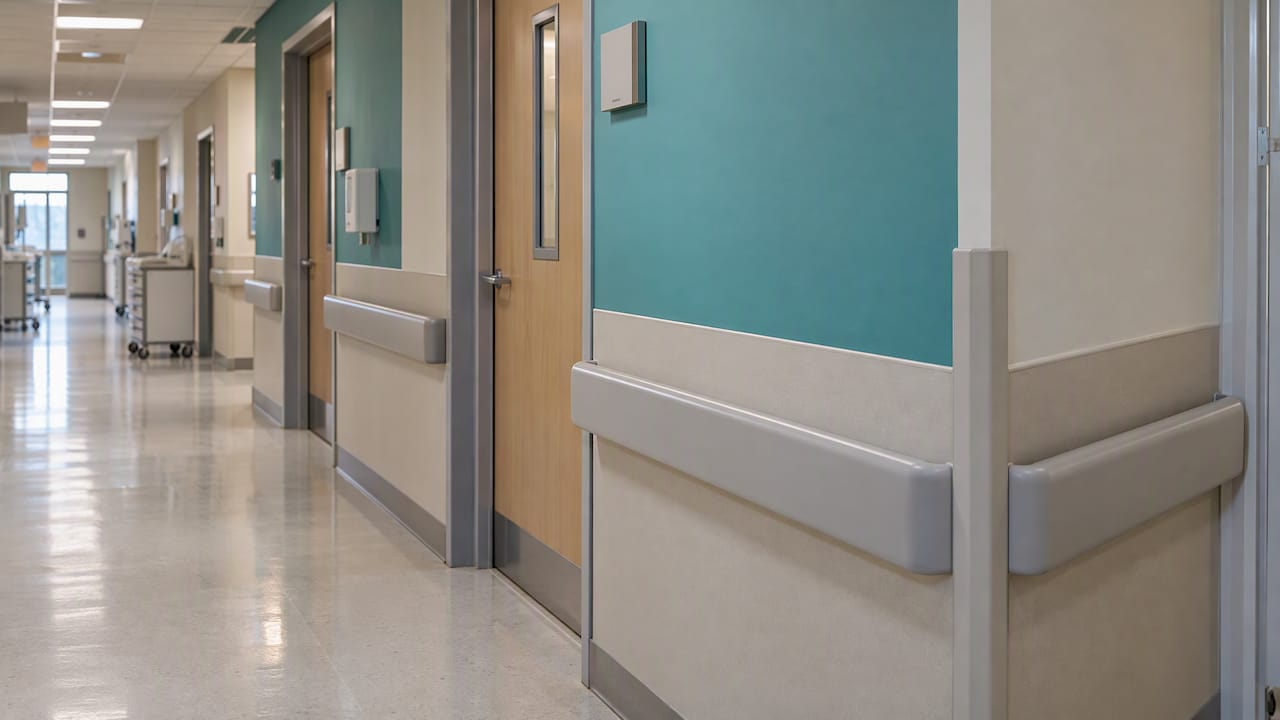
Corridors, emergency department hallways, imaging suites and elevator lobbies see the most mechanical abuse. Combine a rigid protective layer at bed and cart height with a durable decorative finish above. Choose scratch-tested materials and plan for edge protection at corners.
Patient rooms and treatment rooms
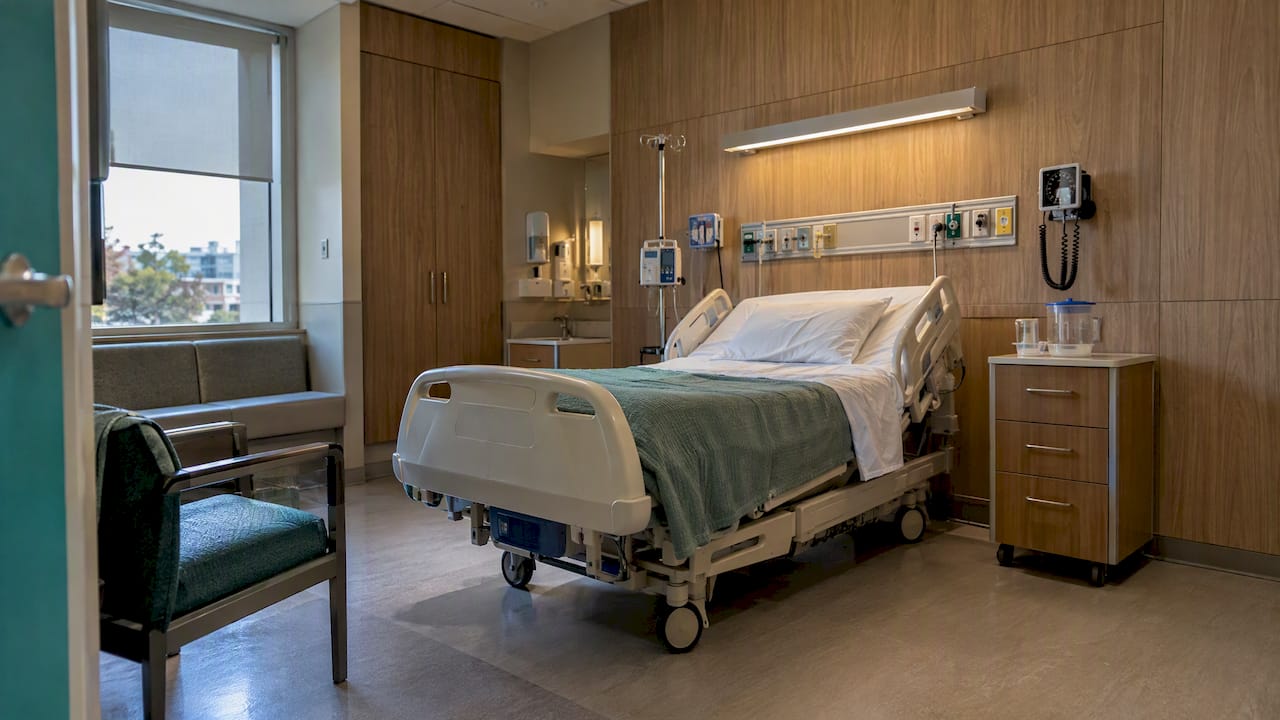
These rooms are cleaned on a defined schedule, often with strong disinfectants, and also shape how a patient feels. Warm woodgrains, soft neutrals and calm, low-contrast color palettes support a less institutional atmosphere, while the finish still has to be wipeable and validated for your products. Keep patterns restrained in rooms where staff must spot changes in skin tone or spills.
Wet and clinical-support areas
Soiled utility, decontamination, sterile processing and labs are where rigid, joint-minimized systems or specialized coatings tend to be specified. Do not assume a decorative finish belongs here without documented moisture and chemical performance.
Public and waiting areas
Lobbies, waiting rooms, cafeterias and family lounges are where finish choice has the biggest effect on perception. They are also the easiest areas to refresh in phases, because they can often be worked after hours without closing clinical space. Our overview of hospital wall finish options for specifiers goes deeper on seven materials and where film fits.
Renovating occupied spaces without losing beds
Downtime is often the biggest hidden cost. Taking a patient room offline for painting or panel installation means lost capacity, dust control and odor mitigation. Two points keep these projects on track.
First, plan the infection-control risk assessment before you touch a wall. The FGI Guidelines require an ICRA approach in states that adopt or adapt them, and the Joint Commission applies it in states without their own healthcare design codes. The 2001 FGI Guidelines already described it as a risk-definition and risk-reduction tool for construction projects that encourages cooperation between agencies and providers. Confirm which version and state requirements apply to your facility with your authority having jurisdiction.
Second, choose methods that generate less dust, odor and noise. Sanding, wet-trade work and heavy panel cutting create the most disruption. A self-adhesive film applied over a sound existing surface avoids demolition, and many fit-outs can be phased room by room. We cover the two-day approach in our commercial interior refresh guide, and our hospitality renovation guide shows how operators with occupied buildings think about the same trade-offs.
Where architectural film fits
Architectural interior film is a thin, self-adhesive, stretchable decorative surface applied directly over existing walls, doors, columns, millwork and casework. It is not a replacement for protective panels in the harshest zones. It is a strong answer where the existing substrate is sound and you want a new look, a consistent color story across mixed surfaces, and minimal disruption.
The practical benefits, as we see them:
- One material across many surfaces. Walls, door faces, nurse station fronts and casework can share the same woodgrain, stone or solid color, so the space reads as designed rather than patched.
- Less mess. The film is stretchable and uses an air-channeled adhesive, which supports cleaner, simpler installation and less waste than many conventional methods.
- Range. Our catalog runs to more than 450 textures and colors, from wood and metal to stone, fabric and solid colors.
- Durability for busy spaces. Our products are positioned for high-traffic environments and tested for scratch resistance.
What we will not do is claim blanket approval for every disinfectant. Ask us for the documentation relevant to your cleaning protocol, and use the request list above with every supplier you evaluate. For more on our approach to safety and sustainability in clinical settings, see our healthcare design guide.
Our perspective: treat the wall as a system, not a swatch
We see the same pattern in project after project. A design team falls for a finish in the showroom, the maintenance team inherits it, and a year later someone discovers that the cleaning chemical on the cart does not agree with the surface. The fix is not a better swatch. It is a better conversation, held earlier, between design, infection prevention and environmental services.
That is why we put cleanability, substrate condition and installation impact on the same page as color and texture. Film earns its place when you are refreshing, not rebuilding: when a wall is sound but tired, when the budget cannot absorb a gut renovation, or when a unit cannot close for weeks. In those cases, a stretchable, self-adhesive finish gives you the sculptural warmth of wood or the calm of a deep solid color without turning a corridor into a construction site. And when a zone demands a rigid panel or impact system, we would rather you specify that and use film where it fits.
— Bodaq
Choosing a film for a healthcare project
Start with the surfaces you have, then narrow by room type. Our Easy Clean high-performance collection is a good place to begin for solid colors in demanding spaces, and our Refined White premium collection suits clean, bright clinical looks. If you want warmth in patient rooms and lounges, browse the wood, stone and fabric families in the full Bodaq film collections.
Request samples and apply them to your own wall type. Then run your own cleaning routine on them for a few weeks before committing.
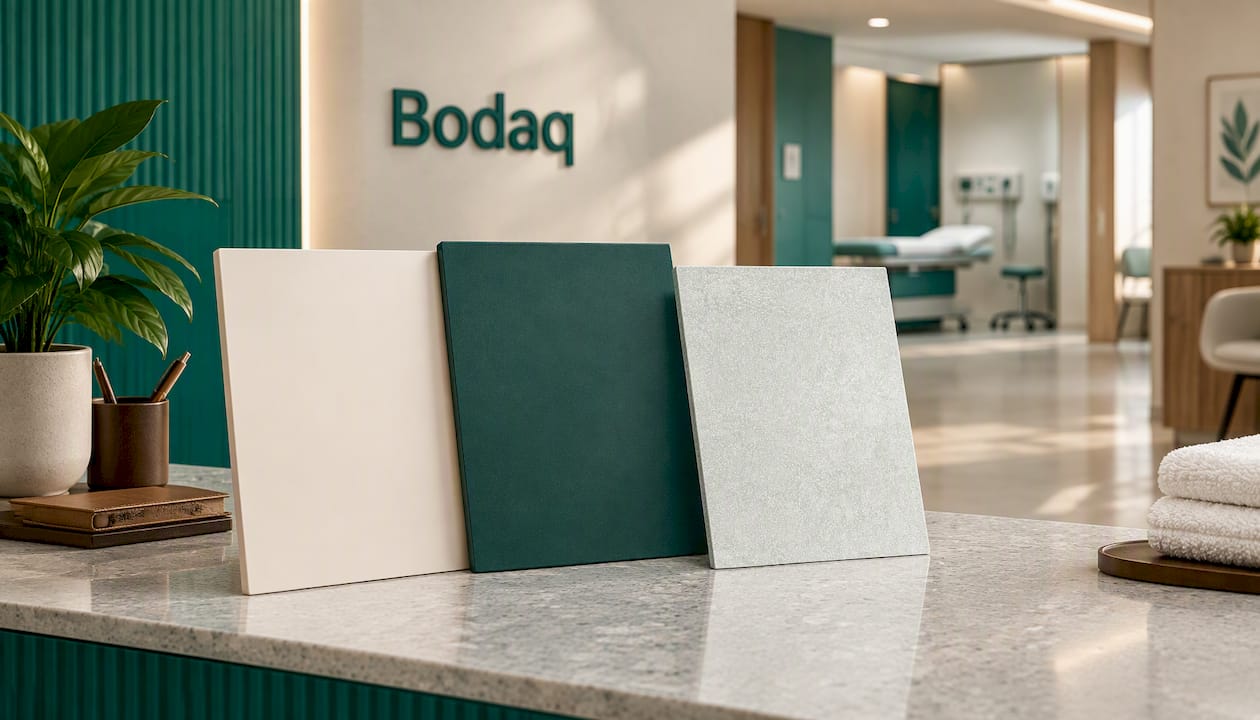
Ready to test a finish in your facility? Explore Bodaq Interior Film and request samples to put through your own cleaning protocol.
A short checklist before you specify
- Confirm the substrate is sound, dry and free of mold or damage.
- List every cleaner and disinfectant, plus any UV-C or vapor systems used in the room.
- Obtain written testing and validation data, not a letter listing approved products.
- Check adhesive and system details, including moisture behavior behind the finish.
- Review seams, edges and trim for places where dirt or moisture can collect.
- Agree the construction risk assessment and phasing with infection prevention before work begins.
- Compare lifecycle cost, not purchase price, including how long the room is out of service.
FAQ
What is the most common wall finish in hospitals?
Vinyl wallcovering and paint are the two most prevalent wall surfaces in U.S. healthcare facilities. A Texas survey of facility managers found Type II vinyl preferred in emergency, surgery and inpatient units, with latex paint second. Rigid fiberglass panels and other systems are used where moisture or impact demands more.
Are there regulations that test wall finishes for disinfectant compatibility?
No. The Healthcare Surfaces Institute notes there are no regulatory testing requirements for surface disinfection compatibility. That means the burden falls on you to collect instructions for use and manufacturer testing and validation data before you buy.
Can architectural film be used in healthcare facilities?
It can be a good fit for renovating sound walls, doors and casework in patient rooms, corridors and public areas, especially when downtime matters. Confirm cleaning and disinfectant validation for your protocols, and use rigid protection where impact or wet conditions call for it.
Is paint or wallcovering better for a hospital renovation?
It depends on the zone and the maintenance plan. Paint is quick and inexpensive up front, while vinyl and film can reduce repainting and offer richer texture. Facility managers in one survey ranked ease of maintenance above initial cost, so compare the cost over the life of the finish.
Sources
- Wall Finish Selection in Hospital Design: A Survey of Facility Managers
- A multidisciplinary, multimodal approach for surface selection (HFM)
- CDC: Infection control guidance for healthcare surfaces
- ISSA: Evaluation of cleaning and disinfection when selecting surface materials
- Healthcare Surfaces Institute: Surface Disinfection Compatibility Part 2
- ASHE and FGI monograph: The Environment of Care and Health Care-Associated Infections
- 2001 FGI Guidelines