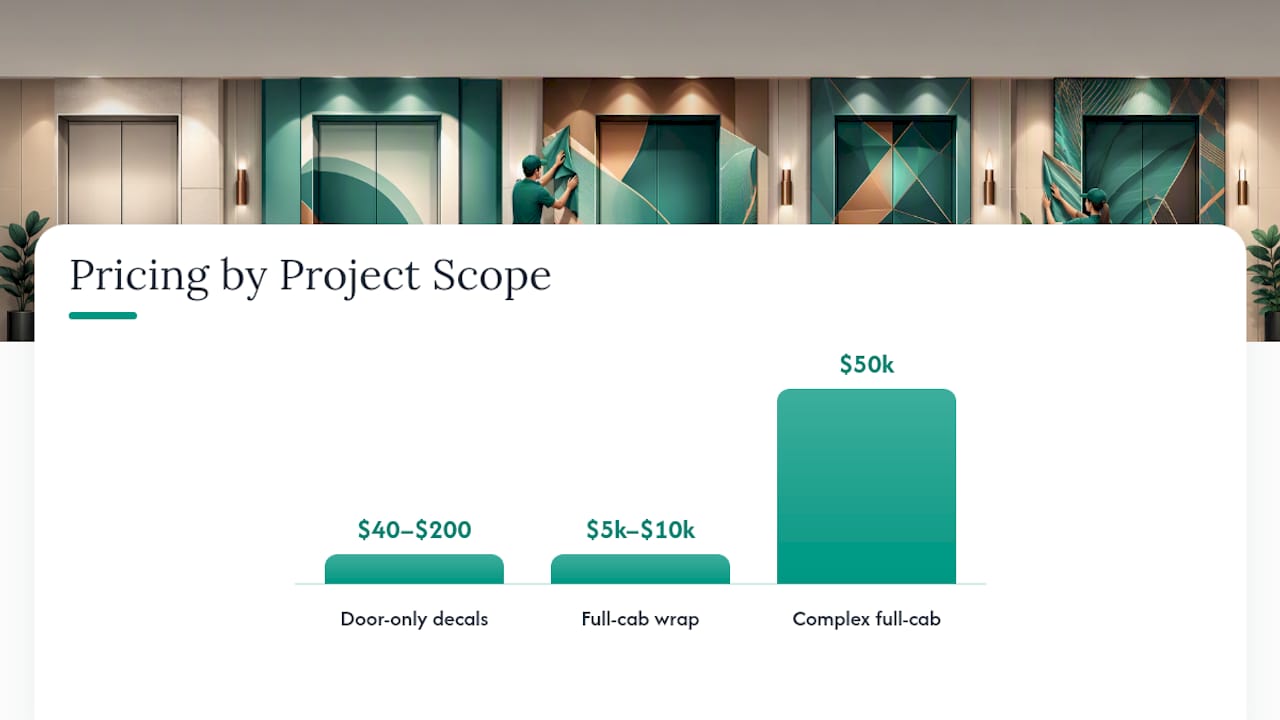
Budget roughly $40 to $200 per door for a simple printed vinyl decal, $5,000 to $10,000 per cab for a standard architectural-film refresh, and well beyond that for a complex full remodel with custom trim work. The gap between promotional wrap and architectural finish film explains most of that spread. Get a firm number only after a site assessment, since surface condition and design complexity move the price more than almost anything else. Options like premium architectural finish collections show where mid-tier architectural finishes typically land.
TL;DR:
- The cost of elevator wraps varies significantly based on scope, with door decals starting at $40 to $200, and full cab renovations reaching $50,000 or more for complex projects.
- Surface condition, material choice, design complexity, and labor conditions primarily influence price differences between projects, with surface prep being a major factor.
- Architectural film offers long-term durability and 5 to 10-year warranties, making it more cost-effective for permanent spaces, while printed vinyl suits short-term campaigns and quick changes.
- Installation duration ranges from a few hours for a door decal to several days or weeks for multi-cab rollouts, with detailed site photos helping prevent costly changes.
- Prices typically lower per elevator in multi-cab projects due to spreading setup, travel, and design costs across multiple units, especially when negotiating bulk discounts.
Table of Contents
- How Much Do Elevator Wraps Cost by Project Scope?
- What Drives the Price Up or Down?
- Architectural Film vs. Printed Vinyl: Which Costs Less Long Term?
- How Long Does Elevator Wrap Installation Take?
- What Do Real Elevator Wrap Budgets Look Like?
- Why Bodaq Changes the Installation Cost Equation
- Do Elevator Wrap Prices Vary by Region or Vendor Type?
- A Publisher’s View on Long-Term Value
- Ready to Get an Accurate Elevator Wrap Quote?
- Sources
- FAQ
How Much Do Elevator Wraps Cost by Project Scope?
Pricing scales with how much surface you’re covering and what material you choose, so it helps to think in three tiers rather than one blended number.
Door-only decals are the entry point. Pre-cut printed vinyl for a single elevator door typically runs $40 to $200, depending on the material grade and whether the vendor pre-cuts the panel to your exact door dimensions. This tier suits short campaigns, seasonal branding, or a quick refresh on a property with a tight budget.
Full-cab jobs cost considerably more because they wrap walls, ceiling panels, and often handrails and trim. A basic vinyl cab wrap sits at the lower end of that range. A partial architectural-film install, where you’re upgrading interior walls but leaving the ceiling and fixtures alone, lands in the middle. A complex full-cab architectural finish with seam matching, textured panels, and custom trim work pushes toward the $50,000 per cab territory that ResurfaceWraps documents for the most demanding remodels.
Multi-cab rollouts change the math again. A building with four or more elevators often negotiates a lower per-cab rate than a single-unit job, since the installer spreads travel, setup, and design costs across more units.
Beyond material and labor, expect a few predictable add-ons:
- Sales tax, which varies by state and municipality
- Installer travel fees for buildings outside a vendor’s normal service radius
- A one-time design or proofing fee for custom patterns or logo integration
- Rush fees if you need the job completed on a compressed timeline
What Drives the Price Up or Down?
Two buildings with identical cab dimensions can get wildly different quotes, and the reason almost always traces back to five factors.
Surface condition matters more than most owners expect. Dented panels, rust spots, or non-flat surfaces require filler, sanding, or metalwork before any film goes on, and that prep work adds labor hours fast. Installers increasingly ask for high-resolution photos before quoting precisely because it lets them price prep accurately instead of guessing.
Material selection sets your baseline. Architectural film costs more upfront than standard sign vinyl or temporary fabric wraps, but it’s built for years of daily use rather than a single campaign.
Design complexity adds cost through full-pattern seams, texture matching across panel joints, and detailed edge or trim work around control panels and handrails.
Labor conditions also swing the number: certified installer availability, union labor rules in some metro markets, and after-hours or weekend scheduling to avoid disrupting tenants all carry a premium.
Finally, permits, building management approval processes, disposal of old materials, and installer travel can add unplanned line items.
- Surface prep (filler, sanding, rust treatment)
- Material grade (architectural film vs. sign vinyl vs. fabric)
- Pattern and seam complexity
- Certified labor and scheduling requirements
- Permits, disposal, and travel
Pro Tip: Send your installer clear, well-lit photos of every wall panel, the ceiling, and any existing damage before you ask for a quote. It’s the single fastest way to avoid a change order once work begins.
Architectural Film vs. Printed Vinyl: Which Costs Less Long Term?
The material you choose determines whether you’re buying a multi-year finish or a short-term campaign wrap, and the cost difference reflects that.
Architectural interior film is built for permanence. Products in this category commonly carry warranties in the 5 to 10-year range, hold up to daily cleaning without peeling, and come in textured, stone, and solid finishes that read as a genuine surface upgrade rather than a sticker. Bodaq’s High-Performance Collection, including finishes like Wild Concrete EXF53 and Rustic Stone EXF52, illustrates the range available for this tier, and the Easy Clean ECF01 finish specifically targets high-traffic wear.
Printed vinyl and decals serve a different purpose entirely. They’re cheaper, faster to produce, and ideal for a limited-run ad campaign, a building rebrand you expect to change again soon, or a temporary cover during construction. PhotoTex-style fabric wraps offer a removable option for very short-term use.
The decision comes down to horizon:
- Choose architectural film for hospitality lobbies, class-A office cabs, or any space where the finish needs to last years
- Choose printed vinyl for campaigns, seasonal promotions, or buildings planning a renovation within a year or two
- Choose a dark, high-contrast option like Bodaq’s Onyx EXF51 when the goal is a luxury statement rather than a promotional message
How Long Does Elevator Wrap Installation Take?
Installation time depends almost entirely on scope and surface condition, but a typical job follows the same sequence.
- Measurement and photo documentation of the cab
- Surface prep, including cleaning, filler, or sanding on damaged panels
- Pre-cutting film or vinyl panels to exact dimensions off-site
- On-site adhesive application, working panel by panel
- Seam finishing and trim work around edges and controls
- Final cleanup and inspection
A single door decal often takes a few hours, and choosing the right finish can contribute to your home’s appeal, as explained in this article on how interior doors add value. A standard full-cab job runs about one day under normal conditions. Multi-cab rollouts across a building stretch from several days to a few weeks, depending on how many elevators go offline at once. Sending detailed photos and confirming building access ahead of time keeps that schedule from slipping.
What Do Real Elevator Wrap Budgets Look Like?
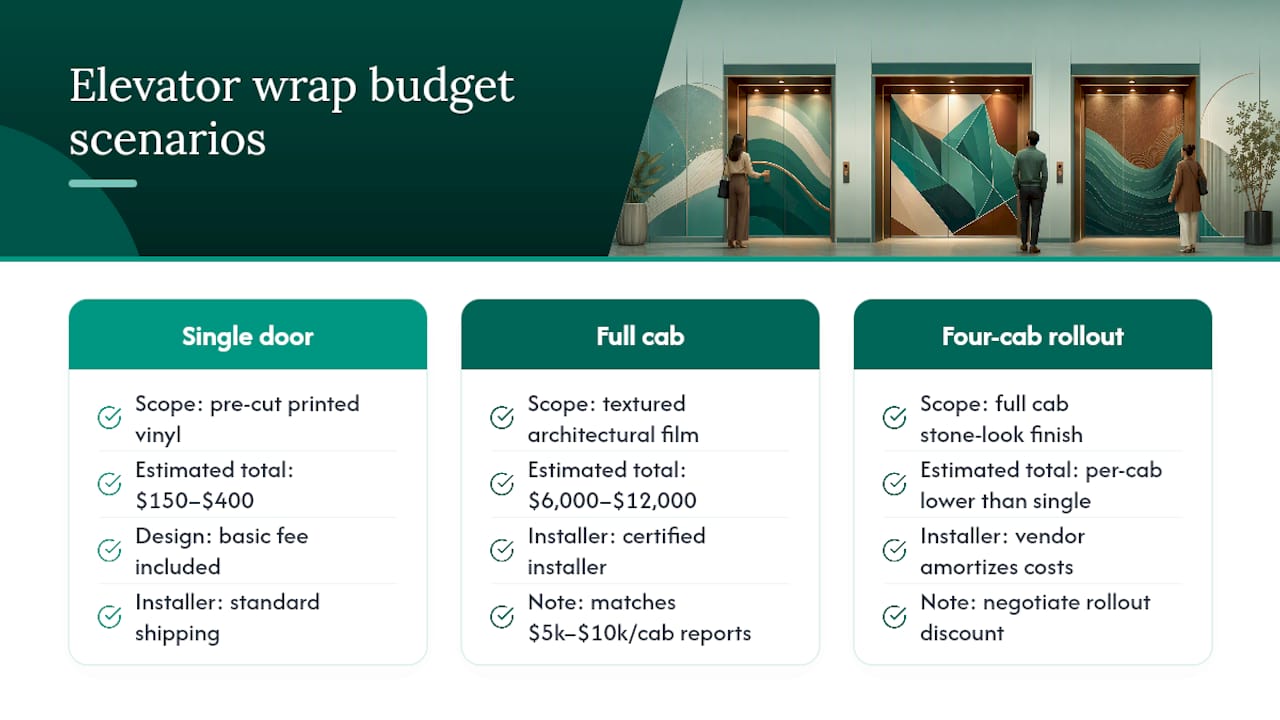
Three scenarios show how these numbers play out on an actual purchase order.
Example A: Single door decal. A retail building wants a seasonal logo decal on one elevator door. Scope: pre-cut printed vinyl, standard shipping, no design revisions. Estimated total: $150 to $400 including a basic design fee.
Example B: Hotel full-cab architectural-film refresh. A boutique hotel replaces dated laminate panels with a textured architectural film across walls and ceiling trim in one cab. Scope: full surface prep, custom pattern matching, certified installer. Estimated range: $6,000 to $12,000, consistent with the $5,000 to $10,000 per-cab figures ResurfaceWraps reports for comparable jobs.
Example C: Four-cab office rollout. A commercial office tower upgrades four elevators to a matching stone-look finish. Per-cab pricing typically drops below the single-unit rate once the vendor amortizes design and travel costs across all four units, making this the point to negotiate a rollout discount.
Common adders across all three scenarios: expedited design turnaround, out-of-market travel fees, applicable sales tax, and after-hours staging if the building can’t take an elevator offline during business hours.
Why Bodaq Changes the Installation Cost Equation
Bodaq’s stretchable, self-adhesive film conforms to curved panels and trim without the heat-forming or heavy adhesive prep that slower materials require, which cuts on-site labor hours and material waste on a typical cab job.
That efficiency matters because labor is usually the line item that inflates a quote past the estimate.
- A wide variety of textures and colors let specifiers upgrade the look of a cab without structural renovation
- Stretchable film reduces seam count on curved or wrapped panels
- Faster application shortens the window an elevator sits out of service
Request a sample or a site assessment before finalizing a budget. It’s the only way to convert these ranges into a number specific to your building.
Do Elevator Wrap Prices Vary by Region or Vendor Type?
Yes, and the variation is bigger than most first-time buyers expect. Labor rates in major metros like New York, Chicago, or San Francisco run higher than in smaller markets, partly because of union labor rules and partly because of building access logistics in high-rise properties. A New York-focused rundown of elevator wrap projects points to the same core cost drivers as anywhere else, size, elevator count, material, and design complexity, but notes that local scheduling constraints and building management requirements can add cost that a suburban property wouldn’t face.
Vendor type matters just as much as location. A national installer network with certified crews typically charges more per cab than a regional sign shop, but often carries stronger warranty backing and faster multi-city scheduling for rollout projects. A local vinyl and signage shop may beat that price on a single-cab job but lack the architectural-film specialization needed for a hospitality-grade finish.
There’s also a pricing category buyers sometimes confuse with wrap installation: elevator advertising. Media buy rates for advertising space inside elevator cabs are priced as periodic rental agreements, not one-time installation costs, and they follow an entirely separate budgeting process from the material and labor costs covered here. If a vendor quote references “elevator advertising rates,” confirm whether you’re buying a finish or renting ad space, because the two numbers aren’t comparable.
Get quotes from at least two vendor types (a regional installer and a manufacturer-certified specialist) before committing, especially on a multi-cab project where a small per-unit difference multiplies fast.
A Publisher’s View on Long-Term Value
Architectural film costs more upfront than a printed wrap, but it stretches that cost over years of daily wear instead of one campaign cycle, which usually makes it the better value for permanent spaces. Always confirm scope with a certified installer and a proper site assessment before you commit.
— Bodaq
Ready to Get an Accurate Elevator Wrap Quote?
A regional sign shop can quote you fast, and a national advertising vendor can rent you cab space, but neither gives you a finish built to last a decade without repeat replacement costs. Bodaq’s architectural film is the option built for property owners who want a permanent upgrade, not a recurring line item.
Start by browsing finishes suited to elevator interiors, like the concrete-textured Deep Wild Concrete EXF54 or the wear-resistant Easy Clean ECF01 collection, both built for high-traffic cabs. From there, request a sample panel and schedule a site assessment so a certified installer can turn these price ranges into a firm number for your building. You can also register for the architectural film webinar if you want a deeper look at specification and installation before you request a quote.
Sources
- Custom Printed Vinyl Elevator Wraps. Doors, Trim, & Cab Wraps
- Elevator and office lobby advertising (rate guide)
FAQ
How much does a vinyl wrap usually cost?
A basic vinyl elevator door decal typically runs $40 to $200 per door, while a full-cab printed vinyl wrap costs more depending on square footage and design complexity.
What is an elevator wrap?
An elevator wrap is a vinyl or film covering applied to a cab’s walls, doors, or ceiling panels to change its appearance without replacing the underlying structure. It ranges from temporary printed vinyl for branding to permanent architectural film built as a long-term interior finish.
How much does wrapping a vehicle like a Tesla cost?
Vehicle wraps follow a different pricing structure than elevator wraps because they involve curved automotive panels and different material specs, so that cost isn’t a reliable benchmark for a commercial elevator project.
How do I price out a vinyl wrap job?
Start with cab dimensions and door count, then factor in material choice, surface condition, and design complexity, since prep work on damaged or non-flat panels is the most common reason quotes come in higher than expected. Sending detailed photos before requesting a quote is the fastest way to get an accurate number.
Is architectural film worth the higher cost compared to printed vinyl?
For spaces meant to last years, like hotel lobbies or class-A office cabs, architectural film’s 5 to 10-year warranty range typically outperforms printed vinyl on lifecycle cost, even though the upfront price is higher.