
Heat-activated architectural film is the practical way to wrap compound curves, deep moldings, and sculptural details that flat panels simply cannot follow. When applied within the recommended temperature window, the film’s elasticity lets it conform to tight radii without cracking or lifting, and channelled adhesive lets large panels be squeegeed into place with minimal blister risk. Some collections handle this job differently depending on the surface and finish needed.
TL;DR:
- Heat-stretch film performs best at temperatures between 12 and 38 degrees Celsius (54 to 100 degrees Fahrenheit) to ensure proper stretching without scorching.
- Full adhesive strength develops over three to seven days, so heavy cleaning or stress should be avoided during the initial curing period.
- Rely on progressive heating and small sections when conforming film to deep moldings or compound curves for optimal results.
- Using a sample before full installation helps verify pattern scale and texture match, especially on complex curved surfaces.
- Most post-installation bubbles originate from trapped air or dust, which can often be fixed with a needle vent and re-squeegeeing, but contamination may require lifting and cleaning.
Table of Contents
- What makes heat-stretch architectural film different
- When to choose heat-stretch film and where it has limits
- Tools and prep you need for heat-stretch installations
- Step-by-step installation over curves and moldings
- Fixing bubbles, wrinkles, and edge lift
- Matching our collections to your project
- What installers and specifiers should weigh before starting
- How to get started with samples, quotes, and installation guides
- FAQ
- Sources
What makes heat-stretch architectural film different
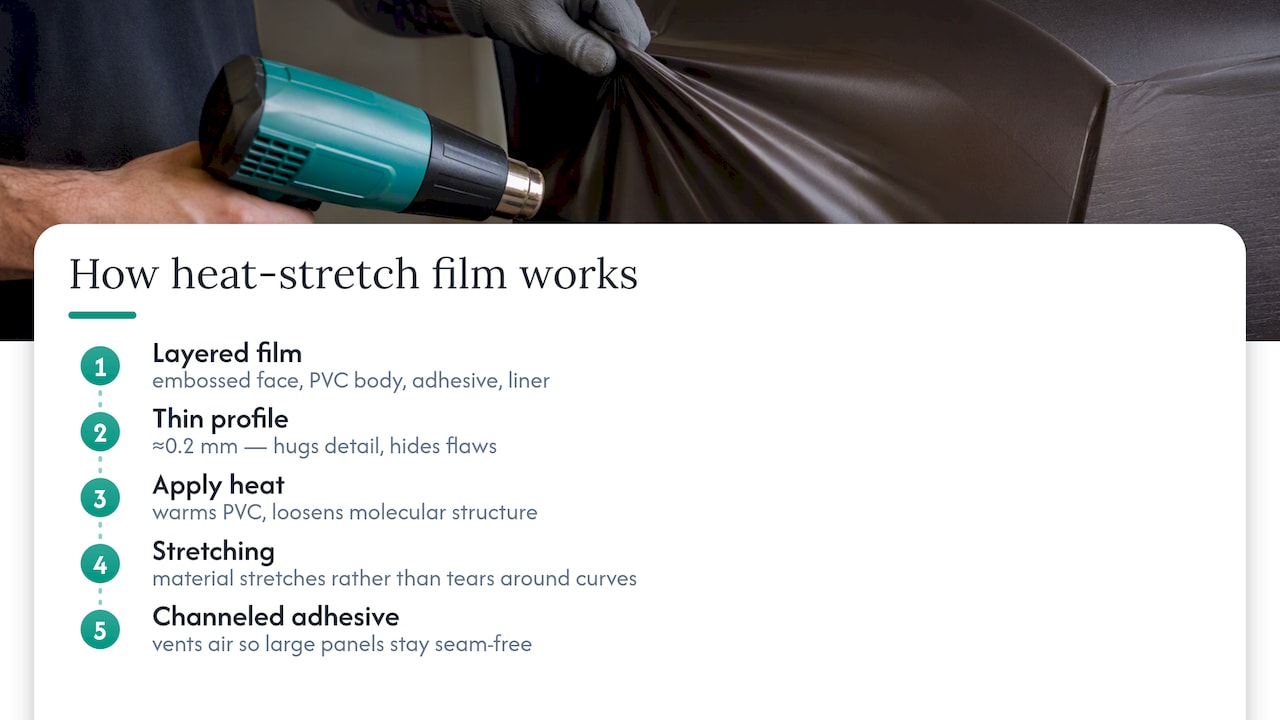
Our film builds up in four layers: an embossed decorative face, a flexible PVC body, a pressure-sensitive acrylic adhesive, and a release liner that peels away at installation. Most rolls run approximately 0.2 mm thick, a dimension that keeps the material thin enough to hug detail work while still hiding minor substrate imperfections, and architectural rolls usually come in widths suitable for efficient panel coverage.
Heat is what turns a flat, stiff sheet into a moldable surface. Warming the PVC loosens its molecular structure, so the material stretches rather than tears when you pull it around a curve or push it into a groove. The channelled adhesive built into our films gives trapped air a path to escape during squeegeeing, which means a single large panel can often be set without seams, even across an uneven wall.
When to choose heat-stretch film and where it has limits
Heat-stretch film earns its keep on curved walls, paneled doors, cabinetry fronts, elevator cab interiors, and any joinery with rounded edges or decorative grooves. These are exactly the shapes where rigid laminate or veneer require seams, miters, or custom tooling, and where a conforming film saves both labor and material.
The film performs best indoors, away from constant moisture or direct weather exposure, unless you are working with a collection specifically rated for exterior use. Before committing to a pattern, think about how its scale will read across the curvature: a large stone vein or wood grain can distort visibly when stretched around a tight radius, while a finer texture or solid color hides that distortion well. Planning seam placement along a natural break, like an inside corner or a molding reveal, keeps the finished surface looking intentional rather than patched.
Tools and prep you need for heat-stretch installations
A clean, dry, and properly primed substrate matters as much as the film itself. Low-energy surfaces like certain plastics or powder-coated metals may need a primer to hold adhesion over time, and any dust left on the surface becomes a trapped bubble later.
- A heat gun gives you controlled, directional heat for stretching and forming, while an infrared heater suits larger, flatter areas where even warming matters more than precision.
- Felt-edge squeegees, a sharp utility or snap-blade knife, a tape measure, and tack tape round out the core kit for alignment and trimming.
- An edge roller seats the film tightly along moldings and returns where a squeegee cannot reach.
- Work in a ventilated space, since heated PVC releases odor, and wear gloves when handling a heat gun near stretched material.
Step-by-step installation over curves and moldings
Before you unroll anything, confirm the room temperature and substrate surface sit within the recommended 12 to 38 degree Celsius (54 to 100 degree Fahrenheit) application window, dry-fit the panel against the shape, and cut with a few extra inches of allowance on every edge.
- Tack the film at the top edge, aligning the pattern so it reads correctly across the finished piece.
- Apply low, even heat to pre-shape the material, softening it just enough to drape loosely over the contour.
- Working in small sections, increase heat gradually while pulling the film taut and squeegeeing from the center outward to chase air toward the edges.
- On concave curves, stretch from the outside edges inward; on convex curves, work from the center outward so the film does not bunch.
- For deep grooves or moldings, heat the recess directly and press the film into the detail with a narrow squeegee or a wrapped edge tool before smoothing the surrounding field.
- Trim excess material along the edge with a sharp blade, then roll the perimeter firmly to lock the adhesive down.
Our step-by-step installation guide walks through pattern-specific variations in more detail, and a progressive heating approach, warming in stages rather than blasting one spot, remains the technique most installers rely on for vinyl film work.
Pro Tip: Keep the heat gun moving constantly; a few seconds of stationary heat can scorch the embossed texture before the film even starts to stretch.
Once the panel is set, avoid heavy contact or cleaning for the first day while the adhesive begins building strength.
Fixing bubbles, wrinkles, and edge lift
Most problems trace back to either trapped air or insufficient heat during forming. A small bubble that appears right after installation is usually trapped dust or air, not a failed bond, and a fine needle vent followed by firm squeegee pressure resolves it in seconds.
- Wrinkles usually mean the film cooled before it was fully stretched; reheating the area and re-squeegeeing while warm often corrects the shape.
- Edge lift along a seam or return often means the substrate needed a primer, or the edge simply needs another firm pass with a roller.
- A bubble that reappears after reheating, rather than one caused by fresh dust, usually signals a contaminated surface underneath and calls for lifting, cleaning, and reseating that section.
- Avoid flexing or leaning on a freshly stretched panel for the first day, since the bond is still building toward full strength.
Pro Tip: Reheat-and-reseat saves far more panels than installers expect, so resist the urge to cut and patch until you’ve tried warming the trouble spot one more time.
Manufacturer testing on our film shows 180-degree peel strength rising from about 7.83 N/mm after 30 minutes to roughly 10.29 N/mm after 24 hours, with full adhesive strength developing over 3 to 7 days. That timeline is worth respecting before subjecting a panel to heavy cleaning or impact.
Matching our collections to your project
Each of our three collections solves a slightly different installation challenge, and picking the right one up front saves rework later.
- Rustic Stone EXF52 suits projects that want a convincing stone look on curved reception desks, columns, or feature walls where a high-performance finish needs to hold up to daily contact.
- Easy Clean ECF01 fits high-touch surfaces like doors, counters, and healthcare or hospitality fixtures where wipeability and hygiene matter as much as appearance.
- Onyx EXF51 works well where a deeper emboss or an exterior-rated finish is called for; confirm whether your application is interior or exterior before ordering, since the two use cases call for different specifications.
Before committing a full roll to a curved or detailed surface, order a sample from our interior vinyl film collections and test it on-site. Holding the actual texture against your lighting and substrate tells you more about pattern scale and seam placement than any photo can, especially on a surface with pronounced curvature.
What installers and specifiers should weigh before starting
Heat-stretch film shortens a renovation timeline dramatically compared to demolition and replacement, and it generates far less waste in the process. We think that time and material savings matter most on large-scale or heavily curved projects, where sourcing custom millwork would otherwise take weeks.
Confident DIYers can handle flat panels and gentle curves, but compound curves, deep moldings, and large commercial runs benefit from a certified installer who has logged the hours needed to read heat and stretch consistently across a big surface.
— Bodaq
How to get started with samples, quotes, and installation guides
Getting from idea to finished surface starts with touching the actual material, not a screen. We make that first step simple whether you are refinishing a single door or specifying film across a commercial build-out.
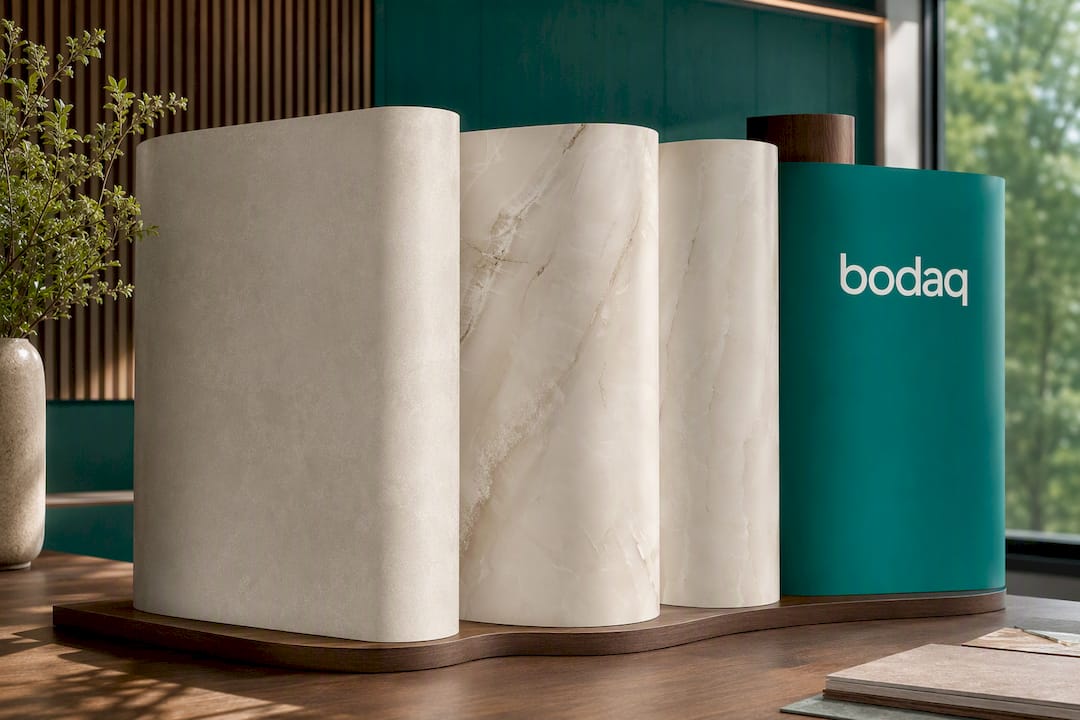
- Order a physical sample from our Bodaq Interior Film catalog before committing to a full roll.
- Read our where to buy and how to install guide for sourcing and setup details specific to your project.
- Ask about our dealer and certified installer program if you plan to order in volume or want professional hands on a complex job.
If you are weighing film against replacing an interior door outright, a resource like this comparison of interior door options lays out the trade-offs worth considering before you decide. When you are ready to move forward with film, request a quote through our collections page and we will help you match pattern, performance, and budget to the surface in front of you.
FAQ
What temperature should I use for heat-stretch film installation?
Manufacturer guidance recommends applying architectural film within a 12 to 38 degree Celsius (54 to 100 degree Fahrenheit) window for hand application. Staying inside that range keeps the PVC pliable enough to stretch without scorching the embossed texture.
How long does architectural film take to fully cure?
Adhesive bond strength builds quickly at first and reaches full rated strength over 3 to 7 days after installation. Avoid heavy cleaning or stress on the panel during that early window.
Can heat-stretch film be used on deep moldings and tight curves?
Yes, heating the film progressively and stretching it in small sections lets it conform to deep grooves, rounded edges, and compound curves that rigid materials cannot follow. Concave curves generally stretch best from the outside edges inward, while convex curves work better from the center outward.
Which Bodaq collection works best for a curved commercial surface?
Rustic Stone EXF52 suits stone-look finishes on curved millwork, Easy Clean ECF01 fits high-touch or hygiene-sensitive surfaces, and Onyx EXF51 covers deeper emboss or exterior-rated needs. Ordering a sample from our collections catalog lets you confirm texture and pattern scale against your actual substrate before committing.
What causes bubbles after a film installation and how do I fix them?
Most bubbles come from trapped dust or air rather than a failed bond, and a fine needle vent followed by firm squeegee pressure usually clears them. A bubble that returns after reheating often points to a contaminated surface that needs lifting, cleaning, and reseating.