High-pressure laminate (HPL), wood veneer, thermofoil and architectural film all give a surface a new look, but they work in very different ways. HPL, veneer and thermofoil are built into a panel or door in a shop. Architectural film is applied to the surface that is already there. If your priority is a fast, low-waste refresh of existing walls, doors, furniture and fixtures, with a large library of finishes and little disruption to the space, architectural film is the strongest fit, and Bodaq Interior Film is built for exactly that job.
TL;DR
- HPL is a rigid decorative sheet that has to be glued to a substrate such as particleboard. It is a fabrication material, so it suits new casework and counters built from scratch.
- Architectural film is a stretchable, self-adhesive layer applied directly to surfaces that are already in place, which suits renovations, fit-outs and occupied spaces.
- Veneer is real wood, and film is a repeatable printed pattern. Choose film when you want consistent, controllable looks across many rooms or units.
- Bodaq offers more than 450 textures and colors across wood, metal, stone and marble, solid colors, and fabric and leather collections.
- Match the material to the project: new build millwork, an existing space to refinish, or a run of identical units.
Table of Contents
- What each material actually is
- Side by side: HPL, veneer, thermofoil and film
- HPL vs architectural film
- Architectural film vs wood veneer
- Architectural film vs thermofoil
- Installation, downtime and waste
- Which one fits your project?
- Our perspective
- Ready to specify film?
- FAQ
- Sources
What each material actually is
The comparison gets easier once you see where each product sits in the building process.
HPL. According to the Composite Panel Association’s 2026 design portfolio, HPL is made by layering kraft paper and phenolic resin with a decorative printed paper, then fusing the stack under high heat and pressure. It is used in hospitality, office, healthcare, retail and education spaces for casework, cabinetry, countertops, fixtures and furniture. The sheets are thin, roughly 0.028 to 0.048 inches, and Woodworking Network’s designer guide notes they must be glued to a substrate, usually particleboard.
Thermally fused laminate (TFL). The same guide describes TFL as a European-developed alternative to HPL, with the decorative layer fused directly to particleboard or MDF.
Wood veneer. This is thin real wood sliced from logs and bonded to a panel. Species, cut and the way the leaves are matched together drive the look, and no two sheets are identical.
Thermofoil. A vinyl film heat-formed over a routed MDF door, wrapping the face and edges. It is a factory process, so it is chosen when doors are ordered, not applied to a door already hanging in a space.
Architectural film. A thin, stretchable, self-adhesive film that is applied to an existing surface. Bodaq Interior Film, made by Hyundai L&C, comes in more than 450 textures and colors and uses an air-channeled adhesive, which is designed to make installation cleaner and easier.
The practical takeaway: HPL, veneer and thermofoil are decisions about what you build. Film is a decision about what you do with what you already have.
Side by side: HPL, veneer, thermofoil and film
| HPL | Wood veneer | Thermofoil | Architectural film | |
|---|---|---|---|---|
| Form | Rigid sheet | Thin real wood leaves | Heat-formed vinyl skin | Stretchable self-adhesive film |
| Where it happens | Shop fabrication | Shop fabrication | Factory | On site, on existing surfaces |
| Needs a new substrate | Yes | Yes | Yes (MDF door) | No, goes over the existing surface |
| Look | Printed decor | Genuine grain, varies | Mostly solid or painted looks | Wood, metal, stone, solid, fabric and leather |
| Best fit | New casework and counters | Wood-forward spaces | New cabinet doors | Refinishing walls, doors, furniture, fixtures |
The row that matters most for renovators is the third one. When the existing surface only needs a new face, replacing it is the long way around.
HPL vs architectural film
HPL has a strong reputation, and it earns it. The PRO HPL technical leaflet describes an impervious surface that is easy to clean, and postforming grades that wrap over edges. It is a sound choice when you are fabricating a new countertop or a run of casework.
The difference for most of our readers is what happens before and after the surface is chosen.
Process. HPL is cut, glued and clamped to a substrate in a shop or on site. Film is applied to a surface that is already installed, so there is no demolition, no new substrate and little waste. Bodaq’s stretchability is what lets it conform around curves, edges and profiles that a rigid sheet cannot follow.
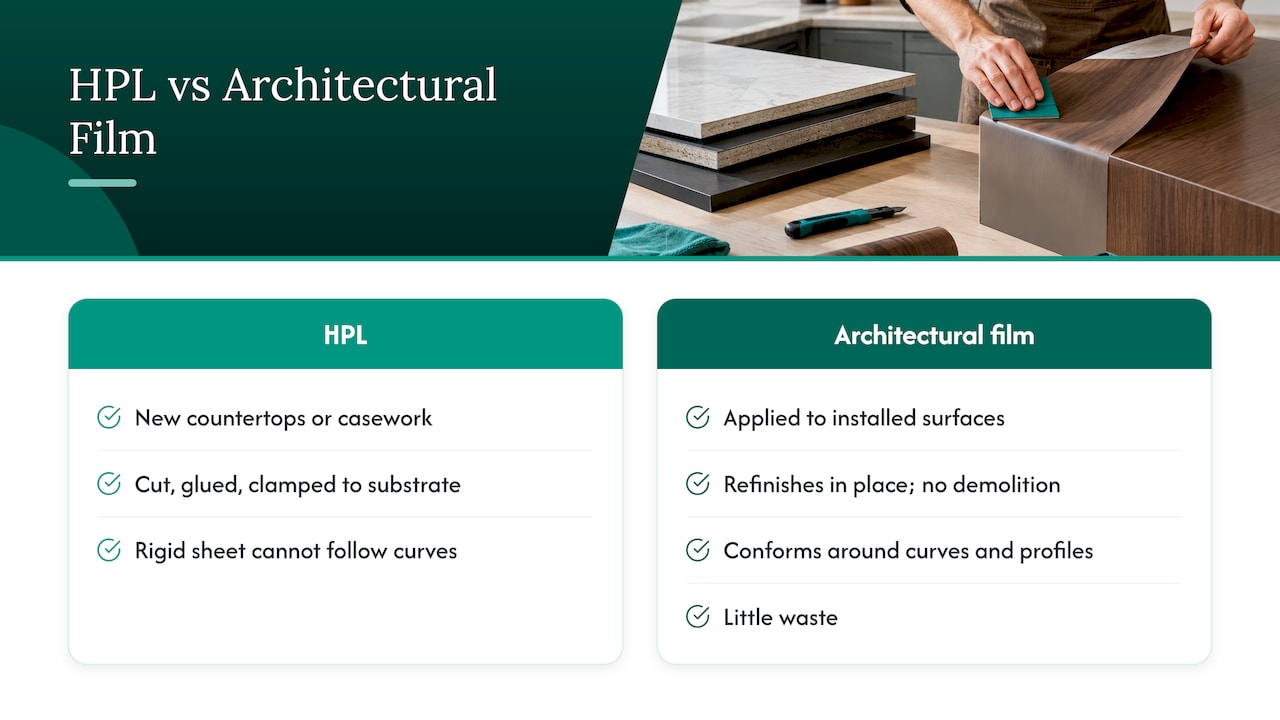
Disruption. A hotel corridor, a clinic reception or a retail floor cannot always close for weeks. Refinishing in place keeps rooms moving. Bodaq’s film is designed for rapid upgrades with less mess, which is why hospitality and commercial managers look at it first.
Variety. With 450-plus options in Bodaq’s catalog, a designer can move between warm oak, brushed metal, rustic stone, fabric and leather, and flat solid colors without changing the construction underneath. Browse the Bodaq collections to see the full range.
Durability. Bodaq film is certified for durability in high-traffic environments, and our guide to architectural film durability explains what to expect from it across different uses. For cleaning routines, see how to clean and maintain architectural film.
Where HPL is the build material. If you are constructing a brand-new counter from raw board, you need a facing material for that board. Film still has a role there, because it can finish the surfaces around it, such as doors, wall panels and existing furniture, so the whole space reads as one palette.
Architectural film vs wood veneer
Veneer is real wood. That is its appeal, and it is also why it is specified so carefully. A veneer schedule has to name species, cut, matching direction, substrate and finish system, and the grain is never identical from one sheet to the next.
The U.S. Forest Products Laboratory’s Wood Handbook explains that finishes which show the most natural character of wood tend to offer less durability, while tougher film-forming finishes such as urethane varnishes perform well on furniture, floors and interior woodwork. Real wood is a living material that needs a finish system chosen with care.
Film offers a different kind of value: a repeatable, manufactured pattern. If a hotel has 120 guest rooms and every headboard wall must match, a film delivers the same look in room 1 and room 120. Bodaq’s Wood Collection, for example Toasted Honey Oak LW120, gives you the warmth of oak on existing doors, panels and furniture without sourcing, matching and finishing real leaves.
Choose film over veneer when:
- you need identical looks across many rooms or units
- you want a wood tone on a surface that cannot take new veneer, such as an existing door or built-in
- the project timeline is short and the space is occupied
- you want one coordinated palette that mixes wood with metal, stone or solid colors
Choose veneer when the brief calls for authentic natural variation and you are building the piece new.
Architectural film vs thermofoil
Thermofoil is chosen at the cabinet-door order stage. The doors are routed from MDF, the vinyl skin is heat-formed over them, and what you get is a finished door. It is a good way to deliver a smooth, painted-look cabinet on a controlled budget in a new build.
Film answers a different question: what do you do with the doors, panels and carcasses already in the room? Instead of ordering replacements and waiting for lead time, you refinish what is there. Because Bodaq film stretches, it can follow door profiles and edges, and the catalog covers more than solid colors. You can move from a plain painted look to stone, metal, fabric or leather in the same system.
For kitchens and baths, our spec-ready guide to architectural film uses shows how to match film grade to substrate, and the moisture-resistant wall finish page covers the 48-hour adhesion test specifiers can use to qualify a wet-area surface.
Installation, downtime and waste
For property managers and hospitality teams, the schedule is often the real cost driver. Think about what each option demands from the space:
- HPL or veneer: measure, order, fabricate, deliver, glue, trim. Existing surfaces are usually removed first.
- Thermofoil: measure, order doors, wait for production, remove old doors, hang new ones.
- Architectural film: prepare the surface, cut to size, apply, trim. The surface stays where it is.
Two things protect an installation. The first is surface preparation, which is the single biggest factor in avoiding lifted edges. Our five-step surface prep guide walks through it. The second is the application method itself. Bodaq’s air-channeled adhesive lets trapped air escape as the film is smoothed down, and the installation guide covers the technique, including post-heating, for both pros and confident DIYers.
Because film is cut to fit the surface it covers, there is less offcut waste than with a rigid sheet that has to be sized and often trimmed. To estimate quantities before you order, read our guide to architectural film coverage.
Which one fits your project?
Use this as a quick decision guide.
Interior designers and architects. Specify film when the concept depends on a rich palette over existing or mixed substrates. Write it into the project properly: our architectural film specification checklist shows what to write and verify. Metal looks are covered in metallic architectural film.
Commercial property managers. Corridors, lobbies, elevator cabs, reception desks and tenant suites can be refreshed without gutting them. That keeps tenants in place and cuts debris.
Hospitality teams. Refinish guest-room doors, headboard walls and bar fronts room by room, so inventory stays available instead of closing a whole floor.
Homeowners. If your cabinet boxes and doors are sound but dated, a new face is the affordable route compared with replacing everything. A solid color like Easy Clean ECF01 or a stone pattern like Rustic Stone EXF52 can change a room’s character quickly.

Construction professionals. Film adds a finishing scope that does not need a millwork shop or long lead times. Certified installer training is available through Bodaq.
New casework from raw board. Pair HPL or veneer for the build with film on the surrounding surfaces to unify the finish.
Our perspective
Every surface conversation we have starts with the same question: does this need to be replaced, or does it just need a new face? Most of the time, the structure behind a tired finish is perfectly good. Replacing it adds demolition, lead time and waste that the design never needed.
That is why we built Bodaq Interior Film around stretchability and an air-channeled adhesive. Stretch lets the film follow edges and profiles. The adhesive is designed to make application cleaner and more forgiving, so a finish that used to be a shop job becomes something that can happen on site, in the space, on a schedule that respects the people using it.
The catalog matters just as much as the method. With more than 450 textures and colors, designers are not forced to compromise the concept to fit the material. Wood, metal, stone and marble, solid colors, fabric and leather: it all lives in one system, so a lobby, a guest room and a corridor can speak the same language.
Pair that with durability certified for high-traffic environments and eco-friendly standards, and film becomes a responsible, practical way to make an existing space feel new.
Bodaq
Ready to specify film?
Bodaq Interior Film brings wood, metal, stone and marble, solid color, and fabric and leather finishes to walls, doors, furniture and other surfaces in residential and commercial spaces. Explore the full range on the Bodaq Interior Film site, request samples to see textures in your own light, and talk to us about tools, dealer kits or installer certification.
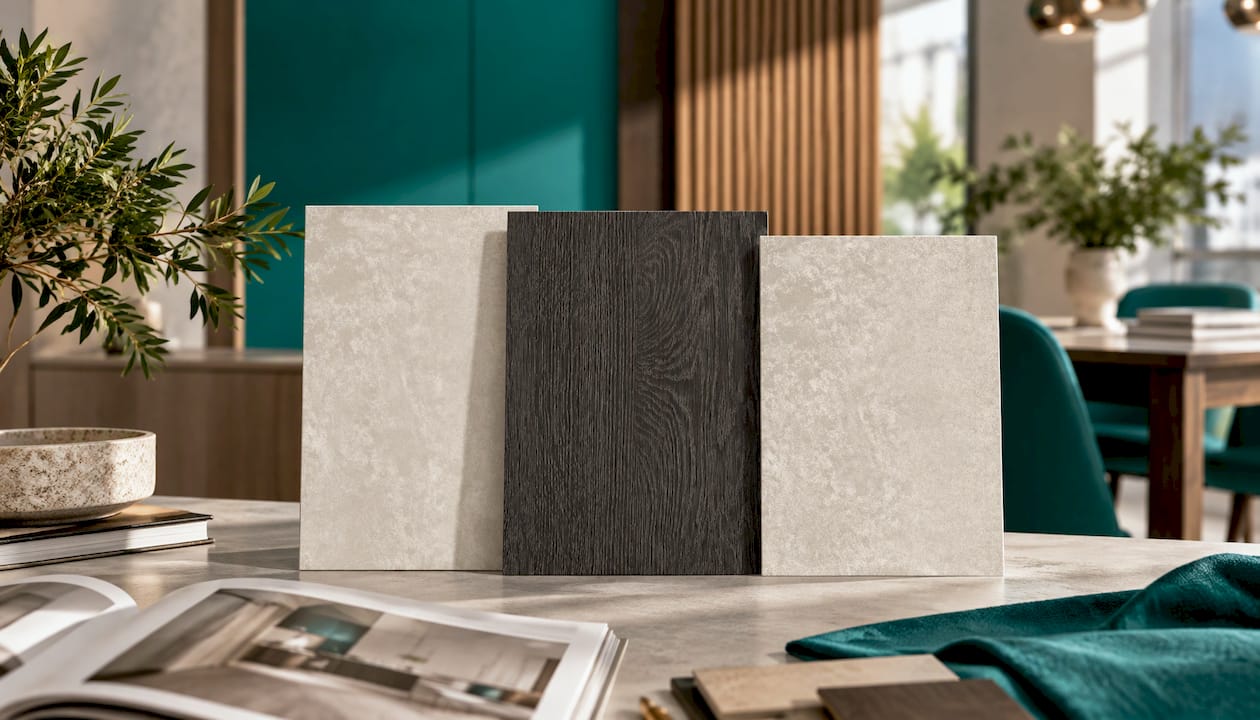
If you are comparing options for a specific project, start with the collection that matches your design direction and the surface you plan to cover. Our architectural film uses guide will help you match grade to substrate.
FAQ
Is architectural film the same as HPL?
No. HPL is a rigid sheet made of resin-impregnated paper layers fused under heat and pressure, and it must be glued to a substrate. Architectural film is a thin, stretchable, self-adhesive layer that goes straight onto an existing surface, so it works as a refinishing solution instead of a fabrication material.
What is the difference between HPL and veneer?
HPL carries a printed decorative paper, so the pattern repeats consistently. Veneer is thin real wood sliced from a log, so every sheet has its own grain. Both are bonded to a substrate like particleboard or MDF. If you want the look of wood with a repeatable pattern, film is another route.
Can film replace thermofoil cabinet doors?
It can refinish doors you already have. Bodaq’s film stretches around edges and profiles, and you can choose from solid colors as well as wood, stone, metal, fabric and leather looks. Surface preparation matters, so follow the prep steps before application.
Is architectural film suitable for commercial and hospitality spaces?
Bodaq positions its film for both residential and commercial use, with durability certified for high-traffic environments. Because it is applied on site over existing surfaces, it suits upgrades where closing a space for long is not an option.
How do I plan how much film I need?
Measure each surface, add allowance for trimming and pattern direction, and plan seams in advance. Our coverage planning guide shows how to do it.
Sources
- Composite Panel Association, 2026 Design Portfolio
- Woodworking Network, Surfaces and materials guide for designers
- PRO HPL, Characteristics and possibilities of use for decorative high pressure laminates
- Wood Handbook, Chapter 16: Finishing of Wood