A mall kiosk wrap is a film applied over the panels, counters and surrounds of a kiosk so it looks like a custom-built unit without a rebuild. The best result comes from an architectural interior film: a stretchable, self-adhesive material in wood, stone, metal, fabric or solid color that follows curves and edges and is installed in a matter of hours rather than weeks. That is why we recommend Bodaq Interior Film for kiosk refinishing: over 450 textures and colors, an air-channeled adhesive built for cleaner installation, and certified durability for high-traffic environments.
TL;DR
- A kiosk wrap has two jobs: a premium, brand-consistent finish and a fast install that keeps trading hours intact.
- Architectural film gives a material look (oak, travertine, brushed metal, leather) instead of a printed picture of one, and it stretches around curves and corners.
- Mall landlords often regulate kiosk finishes and graphics, so check your leasing criteria before you pick a pattern.
- Surface prep decides whether the film stays down: clean, degrease and dry every panel before you apply anything.
- Choose finishes by traffic zone: tougher, easy-clean surfaces where hands and bags touch, statement textures where eyes land.
Table of Contents
- What a mall kiosk wrap actually covers
- Check the mall’s kiosk rules first
- Choosing a finish for your kiosk
- Why a stretchable film suits a kiosk
- How to wrap a mall kiosk, step by step
- Keeping the wrap looking new
- What affects the cost
- Promo: refinish your kiosk with Bodaq
- Perspective
- FAQ
- Sources
What a mall kiosk wrap actually covers
A kiosk is a small box with a big job. It has to attract shoppers from several sides, hold product and equipment, and look good under bright mall lighting at eye level. Most kiosks are built from laminate, MDF, painted wood, metal or a mix, and after a few seasons of bumps, cleaning chemicals and handprints, those surfaces start to look tired.
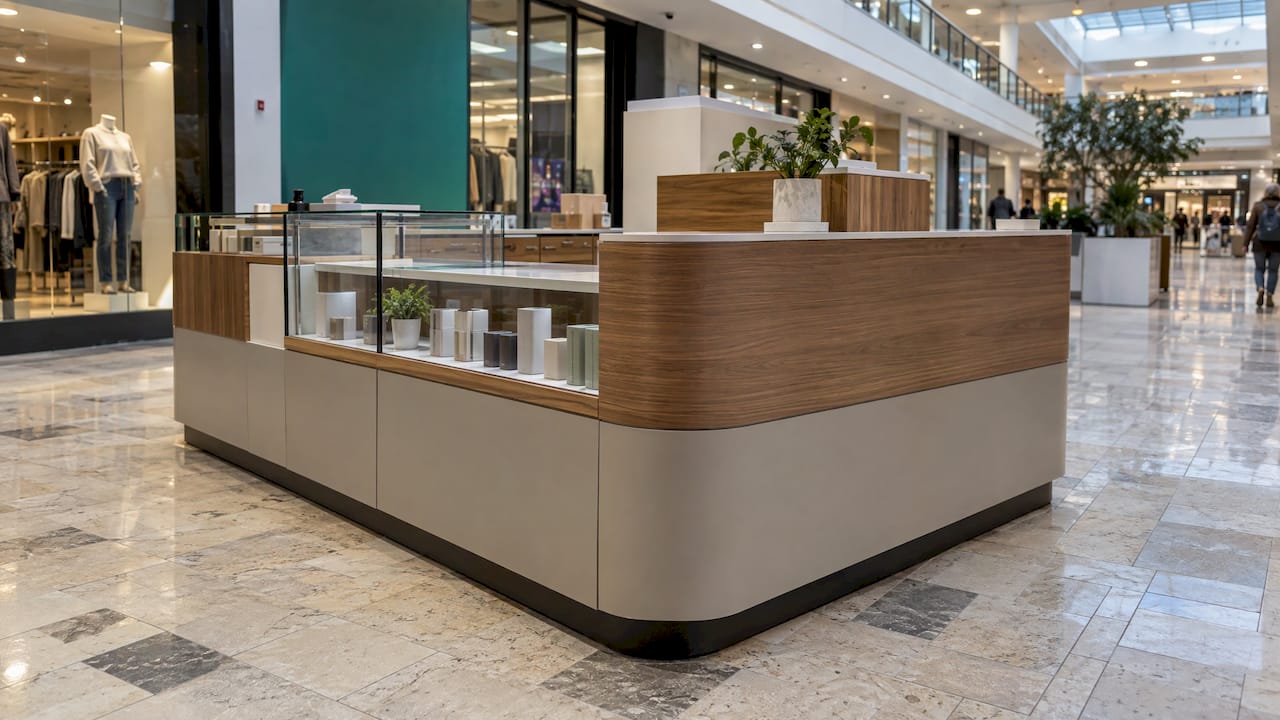
A wrap covers the visible faces: counter fronts, side panels, base plinths, pylons or header boards, display shelves and sometimes the gate. It does not replace the structure. It refinishes it.
Two very different products get called “wraps,” and the difference matters for your results:
- Printed graphic wraps carry a logo, photo or promotion. They are a signage product, designed to communicate a message and swapped when the message changes.
- Architectural interior film reproduces a real material, such as a warm oak grain or a honed stone, as a textured surface. It is designed to be the finish of the unit, not a message on it.
For most kiosk operators, the second is the smarter base layer. You get a premium look that reads as built, and you can still add your logo and promotions in the places where they matter.
Check the mall’s kiosk rules first
Before you choose a color, read your lease and the landlord’s design criteria. Malls treat kiosks as part of the shopping environment, and many have written standards.
One large U.S. mall operator’s kiosk design criteria, for example, caps indoor kiosk height at four feet plus a translucent shroud, and asks that 80 percent of exterior finishes be neutral, natural and authentic materials, with branding graphics and colors limited to 20 percent. Your landlord’s numbers will differ, but the pattern is common: finishes first, branding second.
This is where architectural film earns its place. A natural-looking wood, stone or metal wrap satisfies the “authentic material” spirit of rules like these, and your brand color or logo can sit in the smaller allowance. A fully printed, logo-heavy wrap may not get approved.
Submit your finish choice with the application. Having a physical sample in hand makes approvals easier, and Bodaq offers samples for exactly that purpose.
Choosing a finish for your kiosk
Think of the kiosk in zones, the way a designer approaches a room. Each zone has a job and a level of wear.
The hero face: where eyes land
The front counter and header are what shoppers see from thirty feet away. This is where texture does the work. A deep wood grain reads as warm and handmade, which suits jewelry, tea, candles, skincare and gifts. Stone and marble look read as upscale, which suits watches, fragrance and tech accessories.
From the catalog, good starting points include Natural Oak LW108 for an approachable, light grain, Smoked Charcoal Oak LW113 for a moodier, high-contrast look, and Travertine NS202 for a soft, sculptural stone tone.
The touch zones: where hands and bags land
Counter edges, lower panels and anywhere customers lean get the most contact. Here, you want a finish that cleans easily and holds up. Easy Clean ECF01 from the High-Performance Collection is designed for that kind of repeated wiping. Solid colors such as Silver Mist S263 are a clean, neutral backdrop that lets your product stand out.
The accent details: texture that invites touch
Fabric and leather looks add a tactile layer to shelves, inserts and trim. Woven Linen SF803 and Silver-Ash Linen NF906 bring a woven, boutique feel, while Soft Leather Light SL401 adds a quiet, upholstered note. Metal looks are another option for trim and pylons, and you can browse the full range in the Bodaq collections.

A simple pairing formula
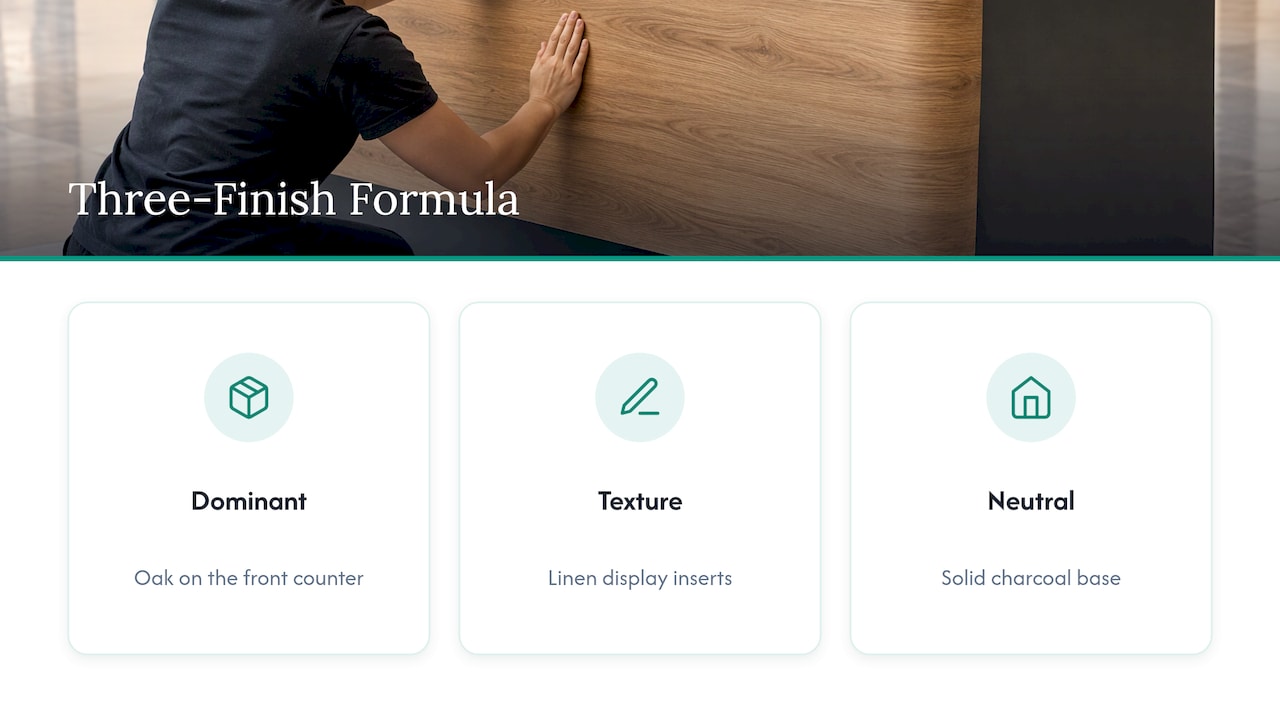
A reliable approach is one dominant material, one supporting texture and one neutral. For example: oak on the front counter, a solid charcoal on the base, and a linen accent on the display inserts. Three finishes read as intentional. Six read as a sample board.
Why a stretchable film suits a kiosk
Kiosks are rarely flat. They have rounded corners, radiused counters, reveals and recesses. That geometry is where ordinary wraps struggle.
Installers who work with vinyl point out the difference between film types. According to a regional technical specialist quoted in Sign Builder Illustrated, calendared material tends to pull back on bumpers, big corners and deep recesses, while cast material has a memory that can be reset with post-heating. The takeaway for a kiosk: the more complex the shape, the more the film’s stretch and conformability matter.
Bodaq’s film is designed to be stretchable and self-adhesive, with an air-channeled adhesive that makes installation cleaner and reduces waste. On a kiosk, that means fewer relief cuts on curves, fewer trapped bubbles on long panels, and less offcut ending up in the bin.
How to wrap a mall kiosk, step by step
Most kiosks can be refinished in a short window, which is the point for operators who cannot afford to lose selling days. Here is the routine and where it tends to go wrong.
1. Measure every face and plan the grain
Measure each panel height and width, then add a margin on every side for trimming and wrapping edges. Decide where the pattern direction runs: wood grain should run the same way across the unit, usually horizontally on counters and vertically on tall pylons. Where it goes wrong: ordering exact dimensions with no margin, or ignoring grain direction until a panel is already on.
If you are ordering for several kiosks, record the roll or batch details so a later reorder matches.
2. Prepare the surface
This is the step that decides how long your wrap lasts. Film needs a clean, dry, sound surface. Installers quoted in Sign Builder Illustrated carry spray bottles of 70 percent isopropyl alcohol and baby soap, and the same guidance notes that not cleaning the surface, or using the wrong detergent, impedes adhesion.
In practice:
- Remove hardware, handles, signage and locks where you can.
- Wash off grease, cleaning residue and fingerprints, then wipe with alcohol and let it dry completely.
- Fill and sand dents, chips and peeling edges so they do not telegraph through.
- Test a hidden area first if the existing finish is glossy or freshly painted.
Where it goes wrong: wrapping over dust, polish residue or an unsealed, flaking finish. The film is only as stable as the surface under it.
3. Work in sections, with the right tools
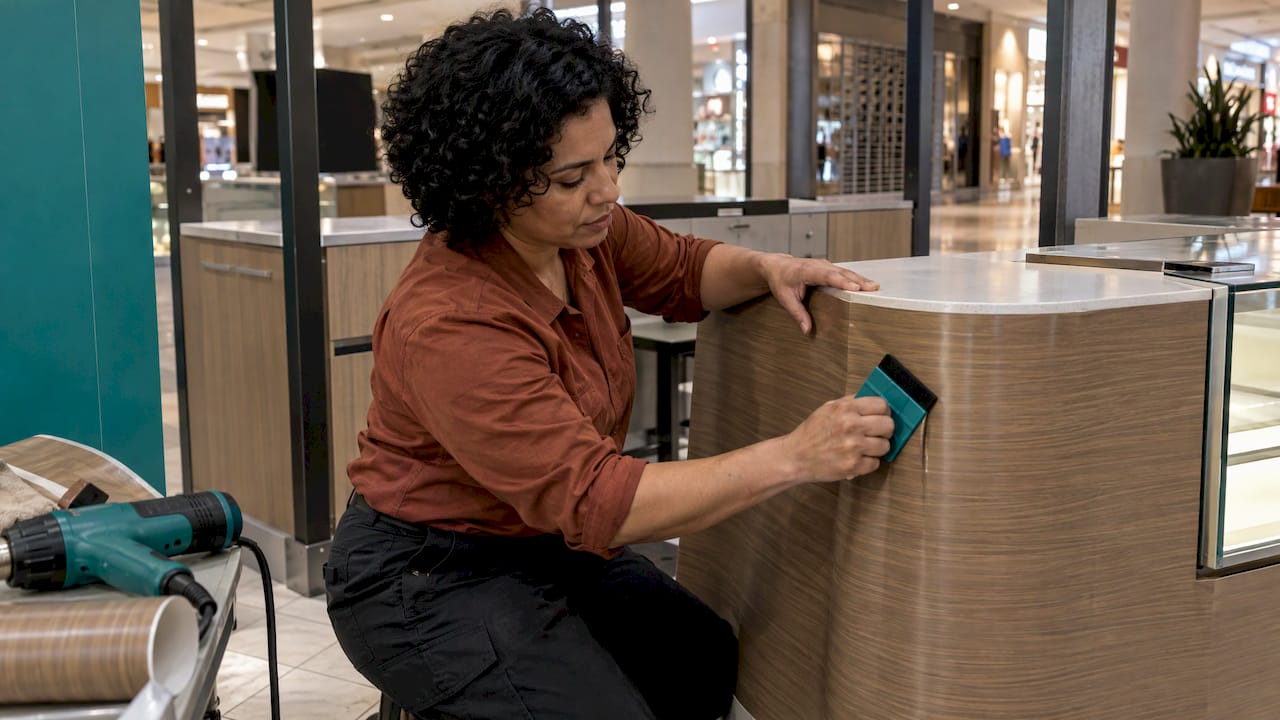
Bodaq offers installation tools and dealer kits, and a good squeegee and cutting setup make a visible difference on long counters. Apply the film from one edge, letting the air channels release air as you press.
Pressure matters. The same technical specialist notes that squeegeeing too lightly on air-egress film leaves air in the channels. Firm, overlapping strokes push it out.
4. Wrap curves, corners and edges
Heat gently and stretch the film around the radius rather than forcing it flat. Tuck edges around the panel so no raw edge faces the customer, and keep seams on the least visible side. Where it goes wrong: overstretching so the grain distorts, or leaving a seam on the hero face.
5. Finish, trim and reassemble
Trim with a sharp blade, refit hardware, and press down every edge once more. Leave the unit a short time before heavy cleaning so the adhesive can settle; follow the product’s technical guidance for specifics, available in the technical bulletins.
Scheduling around trading hours
Because the film is self-adhesive and needs no drying time for paint or glue, the work fits a short closure or overnight window. Plan the prep and removal of fittings the day before, so the install itself is the only task left when the gate closes. Hospitality and retail operators who cannot afford downtime are exactly the audience this approach is built for.
Keeping the wrap looking new
A wrap on a kiosk lives a hard life: constant contact, cleaning sprays and the occasional cart collision. A few habits keep it sharp.
- Clean with mild soap and water and a soft cloth, as part of the daily open and close routine.
- Avoid abrasive pads and harsh solvents on the surface; follow the cleaning guidance in the product technical bulletins.
- Check edges and seams weekly. A lifting corner pressed down early stays down.
- Keep spare film. Order a little extra with your original roll so a damaged panel can be re-wrapped in a matching finish, not patched.
If a panel is damaged, you re-wrap that panel rather than rebuilding the unit. Refreshing the look for a new season or a rebrand works the same way: a new finish over the existing structure, without a full rebuild.
What affects the cost
No two kiosks cost the same to wrap, and we do not publish a one-size-fits-all price here. What moves the budget:
- Surface area: the total square footage of all faces, including plinths and pylons.
- Shape complexity: curves and recesses take more installer time than flat panels.
- Finish choice: different collections and textures are quoted differently.
- Condition of the substrate: repairs and sanding before the wrap add labor.
- Who installs: your own team, or a trained professional installer.
For context on how budgeting works across the signage world generally, one signage guide notes that costs range from under $100 for a basic vinyl banner to $1,000 to $10,000 or more for a fully illuminated storefront sign, with design, permits and installation all factored in. A kiosk refinish sits in its own category, so request a quote based on your measurements and chosen finishes.
Promo: refinish your kiosk with Bodaq
If you are planning a kiosk refresh, start with the film. Bodaq Interior Film by Hyundai L&C comes in five collections (wood, metal, stone and marble, solid colors, and fabric and leather) across more than 450 textures and colors, and the catalog is built for walls, furniture, doors and other surfaces in commercial spaces. You can request samples to check a finish under your mall’s lighting and share it with the leasing office.
Browse the full collections, download the PDF catalog, or visit Bodaq to order or send a sales inquiry. If you are an installer or reseller, ask about the dealer program, installation tools and certified training.
Perspective
Kiosks are one of the hardest design problems in retail. You have a few dozen square feet, shoppers who decide in seconds, and a landlord who wants the unit to look like it belongs. A printed graphic can shout, but a finish can persuade.
That is why we build Bodaq around real-material looks: oak, stone, metal, fabric and leather, in more than 450 textures and colors. The film is stretchable and self-adhesive, and its air-channeled adhesive is designed to make installation cleaner and to minimize waste. For an operator, that translates into a short, low-disruption refit and a unit that looks custom.
We also see the kiosk as a brand tool. A consistent finish across several locations makes every unit feel like part of one family, and when the brand evolves, the finish can evolve with it. Our eco-friendly standards and certified durability for high-traffic environments are part of why designers, property managers and hospitality teams choose the film for spaces that work hard every day.
Bodaq
FAQ
How long does a mall kiosk wrap take to install?
It depends on the size of the kiosk and the number of curves, but a typical refinish fits into a short closure or an overnight window. Prep, including cleaning and removing hardware, is what takes the most planning, so do as much of it as possible before the install window starts. Bodaq’s self-adhesive, stretchable film is designed to make the application itself quick and clean.
Can I wrap over laminate, wood or metal panels?
Architectural film is made for refinishing walls, furniture, doors and other surfaces, and kiosk panels in laminate, painted wood and metal are typical candidates. The surface must be clean, dry and structurally sound, with chips and dents filled first. Review the technical bulletins for substrate guidance.
Will my mall approve the wrap?
Landlords set their own kiosk design rules, and some ask for mostly natural-looking finishes with limited branding graphics. A material-look film such as oak or stone is a strong fit for that kind of requirement. Submit samples with your design application so the leasing office can see the finish in person.
How do I clean a wrapped kiosk?
Wipe with a soft cloth and mild soap and water as part of your regular routine, and avoid abrasive pads. For high-touch areas, Easy Clean ECF01 is a finish designed for easy maintenance.
Can I change the look later?
Yes. Because the film is applied over the existing structure, a new season, a rebrand or a damaged panel means re-wrapping the surface, not rebuilding the kiosk.
Sources
- Things Every Graphics Installer Needs to Know, Sign Builder Illustrated
- Kiosk Criteria Manual: Retail / Dry Tenants (Indoor Kiosks Only)
- Signage for Businesses: Types, Materials, Design, Compliance, Image National