
For pros and homeowners chasing a realistic stone look without the cost or weight of quarried slab, Some marble and stone-effect films worth shortlisting include options like Rustic Stone EXF52, Onyx EXF51, and Terranova MonoBlanc BLC04. Each combines convincing texture with stretchable, self-adhesive installation and finishes rated for daily wear on walls, doors, and millwork. Order swatches before you specify, and browse the full stone and marble catalog to compare finishes side by side.
TL;DR:
- Marble film’s realistic appearance depends on pattern repeat, veining direction, and the accuracy of swatch matching under your lighting conditions.
- The durability of installation relies on thickness, adhesive quality, and proper surface preparation, with most films rated for ten years of indoor use.
- Horizontal surfaces like kitchen countertops are generally unsuitable unless the film is specifically rated for high abrasion and heat resistance.
- Proper installation requires thorough cleaning, priming, and seam planning, with professional installation recommended for complex or commercial projects.
- Compared to natural marble, film’s sustainability benefits are greatest during refurbishment, avoiding waste and embodied carbon in new material, but lifecycle impacts vary based on usage and disposal.
Table of Contents
- What Marble Patterns and Finishes Should You Expect?
- What Technical Specs Actually Matter on the Datasheet?
- Where Does Marble Film Work Best, and Where Should You Skip It?
- How Do You Install and Maintain Marble Film Correctly?
- Is Marble Film Actually More Sustainable Than Real Stone?
- What Should You Ask Suppliers Before You Buy?
- Why Bodaq’s Marble Collections Fit Pro-Level Projects
- See Samples and Order Marble Film
- Sources
- FAQ
What Marble Patterns and Finishes Should You Expect?
A marble architectural film catalog worth your time offers more than one gloss level. You’ll typically see matte finishes for a honed, contemporary look, satin for a soft sheen closer to polished travertine, gloss for high-shine formal spaces, and textured or “structured” marble films that add slight surface relief so the veining reads as real stone under raking light, not a flat photo.
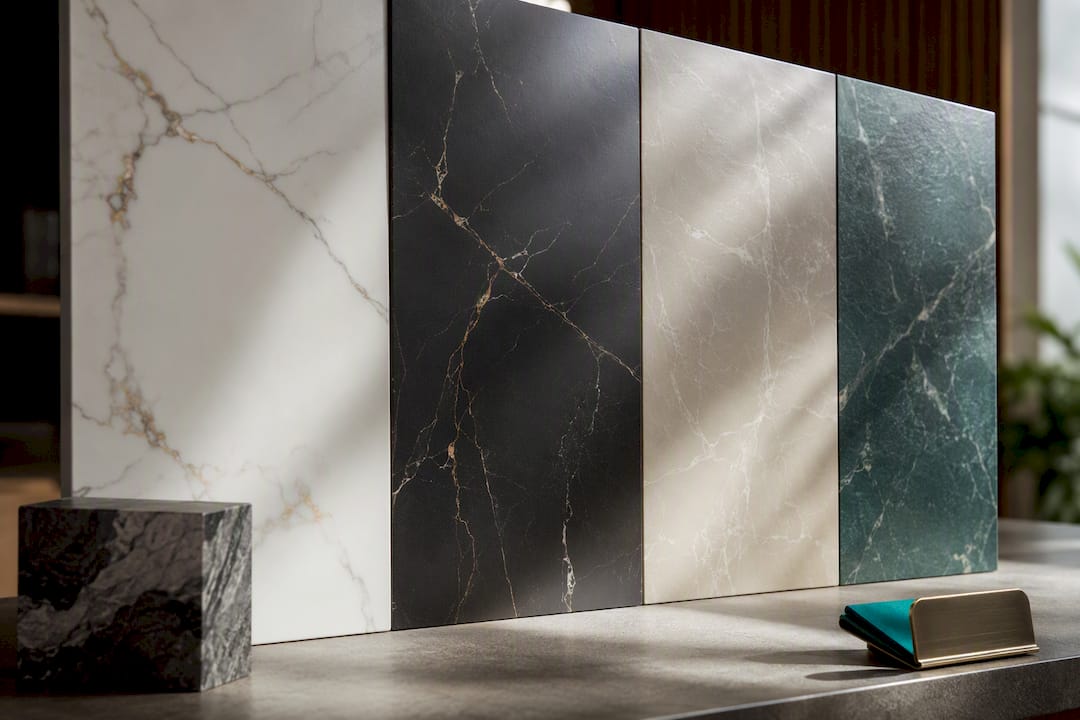
Pattern behavior matters as much as finish. Marble veining runs in one direction on most rolls, so directionality and pattern repeat determine how a wall or panel will read once multiple strips go up. Order wider formats or plan seam locations in advance for book-matched or continuous-vein effects, since pattern repeat and directional veining materially affect visible seams once installed.
Before committing to a full roll, request a physical sample. Screen colors lie about undertone and sheen, and a swatch in hand under your actual lighting is the only reliable way to judge whether a marble finish film will match your stone counters, trim, or existing fixtures. What to check when comparing catalogs:
- Finish type: matte, satin, gloss, or textured/structured
- Veining style: linear, dramatic Calcutta-style movement, or subtle Carrara-style flecking
- Roll width: standard commercial widths versus narrower craft-format options
- Repeat length: how often the pattern resets along the roll
- Color depth: whether the vendor offers light, medium, and dark stone tones in the same collection
What Technical Specs Actually Matter on the Datasheet?
Realism sells the look, but the datasheet decides whether the installation survives contact with daily life. Film thickness for interior architectural products typically runs around 200 microns for structured marble finishes, though total build height changes once adhesive layers and any protective topcoat are added. That extra thickness at seams and edges is exactly where premature lifting starts, so ask for the combined film-plus-adhesive figure, not just the face material number.
Statistic to flag: many interior films now ship with 10-year indoor warranties against cracking, yellowing, and delamination, though warranty terms vary by product and manufacturer, so confirm the exact coverage in writing before you buy.
Run through this checklist with any supplier:
- Adhesive type: air-release, pressure-sensitive adhesives let installers reposition film during application and push trapped air out through microchannels, which matters most on large panels.
- Primer requirements: some substrates need a primer coat before adhesive will bond reliably; get this in writing, not verbally.
- Stretch and formability: stretchable films conform to curved millwork and rounded edges, but heat guns matter. Cold-forming past the rated stretch limit causes whitening or thinning at the veins.
- Fire classification: for commercial or multifamily projects, ask for the actual ASTM E84 or UL 723 test report, not a marketing claim of “fire rated.”
- Cleaning compatibility: confirm which cleaners the film tolerates and which will haze or lift it.
Where Does Marble Film Work Best, and Where Should You Skip It?
Marble architectural film earns its keep on vertical and low-abrasion surfaces: accent walls, elevator cab interiors, cabinet fronts, doors, reception desks, and millwork that would cost a fortune to clad in real slab. Feature walls in a primary bath or a kitchen island face panel are common residential wins; commercial lobbies and hospitality corridors are common commercial ones. Manufacturer technical manuals confirm strong performance on melamine, sealed wood, MDF, and PVC foam substrates, which cover most cabinetry and paneling scenarios.
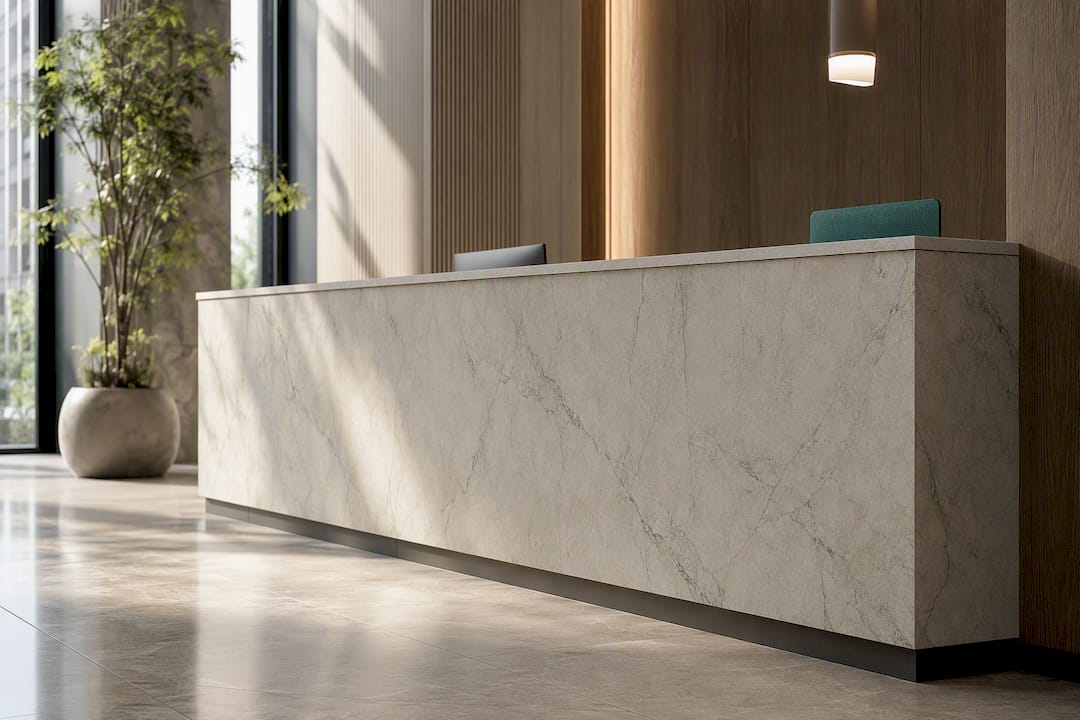
Skip it on horizontal, high-abrasion surfaces like kitchen countertops that see daily knife contact and hot pans, unless the specific product line is rated for that use, and avoid unfinished concrete or other porous mineral surfaces that won’t hold adhesive evenly.
Follow this prep sequence before any roll goes up:
- Clean the substrate thoroughly and let it dry completely, removing any wax, grease, or dust.
- Sand glossy or uneven surfaces lightly to give the adhesive a surface to grip.
- Apply primer where the substrate calls for it, especially on porous wood or previously painted surfaces.
- Edge-band exposed panel edges before film application so the wrap has a clean, finished line to fold around.
- Plan seam placement and pattern alignment on paper first, particularly on book-matched veining, so the final look reads intentional rather than accidental.
For deeper substrate guidance across wall systems, Bodaq’s wall finishing material guide covers compatible panel types in more detail.
How Do You Install and Maintain Marble Film Correctly?
Getting a professional result depends less on the film itself and more on workflow discipline. Gather a heat gun, a felt-edge squeegee, a seam roller, the manufacturer’s recommended primer, and an edge sealant before you start. Skipping any one of these tends to show up as a lifted corner within weeks.
- Prep the surface following the cleaning and sanding steps above.
- Dry-fit the film against the surface without removing the adhesive liner, checking pattern alignment and coverage.
- Activate the adhesive and stretch or form the film into place, using the heat gun on curves or corners as the datasheet specifies.
- Finish seams with a roller to eliminate trapped air and ensure a tight bond at joints.
- Seal exposed edges to prevent moisture or repeated contact from lifting the film over time.
For large commercial installs, curved millwork, or any job where warranty coverage depends on proper application, hire a certified installer and require documentation: dated installation photos, the product batch number, and written warranty confirmation from the supplier. That paper trail is what protects you if a seam fails eighteen months later.
Pro Tip: Always test any cleaner on a hidden section of film for 24 hours before using it building-wide. Ammonia-based cleaners, steam, and abrasive pads are common culprits behind premature film damage, and the damage often shows up weeks after the cleaning routine changed, not immediately.
Bodaq’s own maintenance guide and installation walkthrough walk through both processes step by step if you want the full detail before your first job.
Is Marble Film Actually More Sustainable Than Real Stone?
The honest answer is: it depends on what you’re comparing it to, and refurbishment context matters more than the material itself. Natural marble’s environmental footprint is well documented and it isn’t small. Cradle-to-gate quarrying and processing dominate marble’s lifecycle impact, often accounting for 60 to 80 percent of total environmental impact before the slab ever reaches a job site. A separate lifecycle study on marble tile production found a cradle-to-gate global warming potential of roughly 388 kilograms of CO2-equivalent per tonne, with processing energy and transport driving most of that number.
Film’s real sustainability case isn’t “always greener than stone.” It’s asset retention: refinishing an existing wall, door, or elevator cab with film avoids demolition waste and the embodied carbon of new material entirely, which is the strongest argument in film’s favor. A fair comparison has to weigh several variables together:
- Film’s own material composition and manufacturing footprint
- Transport distance for both the film and the substrate it’s applied to
- Expected service life of each material in the specific application
- Ongoing maintenance requirements and cleaning chemical use
- End-of-life disposal or recyclability
Film wins clearly in refurbishment scenarios where the alternative is tear-out and rebuild. Natural stone still makes sense for permanent structural cladding where multi-decade service life offsets its upfront footprint. Bodaq’s sustainability overview goes deeper into the refurbishment argument specifically.
What Should You Ask Suppliers Before You Buy?
Treat every marble film purchase like a small procurement project, not an impulse order. Realism in a photo doesn’t guarantee performance on your wall, so specifiers should require fire-test reports and technical datasheets as a baseline before approving any product for a commercial or high-occupancy interior.
Before you place an order, confirm you have:
- A physical sample matched to your actual lighting conditions
- The full technical data sheet (thickness, adhesive type, stretch rating)
- Fire test reports (ASTM E84 or UL 723) if the project is commercial or multifamily
- Written warranty terms, not a verbal assurance
- Confirmation the film is rated for your specific substrate
- References or photos from a certified installer who has handled that same pattern before
Ask vendors directly: “Can you provide the TDS and fire test reports for this exact product?” and “Has your installer network worked with this pattern on a substrate like mine?” Vague answers to either question are a reason to keep shopping.
On budget, expect cost to scale with film grade, roll size, any custom printing, and certified installer labor, which typically costs more than the material itself on complex jobs. Sourcing decisions around raw materials also shape pricing further upstream, something suppliers like B-a track closely on the building materials side.
Why Bodaq’s Marble Collections Fit Pro-Level Projects
Bodaq backs its marble and stone lines with a catalog of 450-plus textures and stretchable, self-adhesive film engineered to cut installation waste. Certain marble and stone lines pair convincing surface realism with durability suited for high-traffic walls and millwork.
— Bodaq
See Samples and Order Marble Film
Skip the demolition and skip the six-week slab lead time. Marble and stone films allow refinishing of walls, doors, or reception desks more quickly than traditional materials, enabling fast, low-waste transformations.
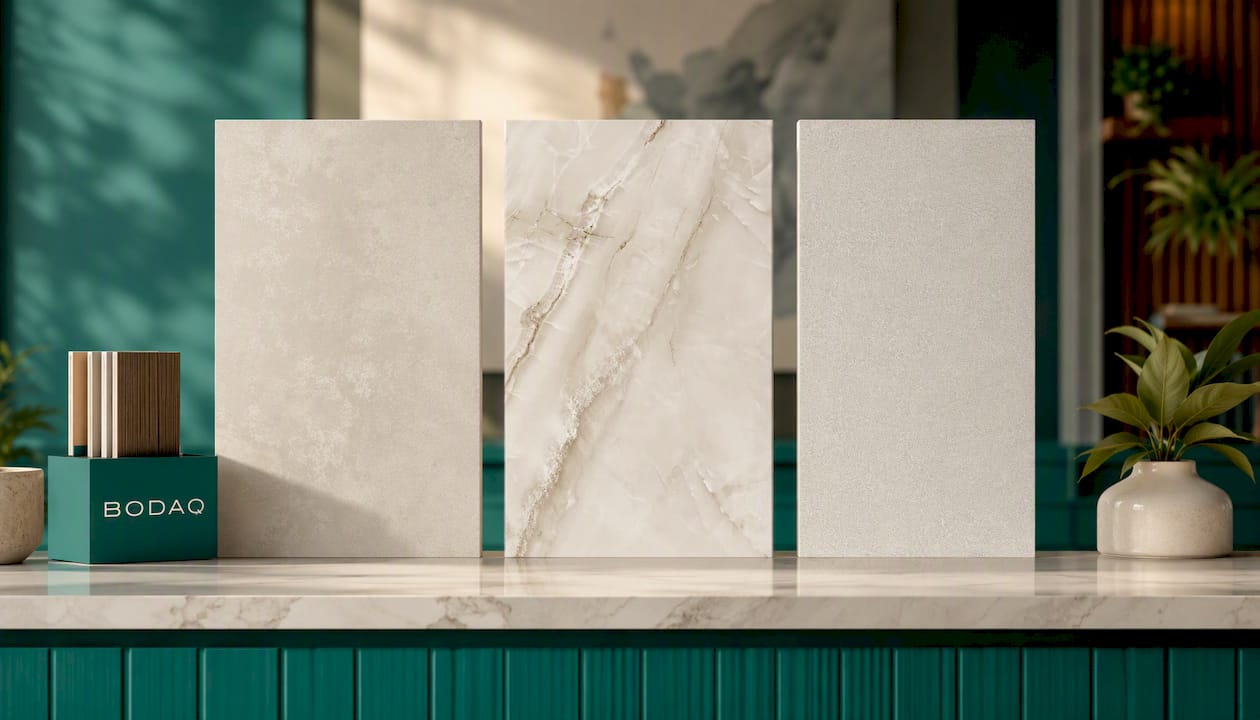
Start with the three collections covered in this guide. Rustic Stone EXF52 brings weathered, organic texture to feature walls and casework. Onyx EXF51 delivers a deeper, more dramatic vein pattern suited to statement pieces and commercial lobbies. Terranova MonoBlanc BLC04 offers a cleaner, brighter stone tone for spaces that want light without going fully monochrome. Browse the complete stone and marble collection to compare all the finishes side by side, or head straight to Bodaq’s US site to request a sample and get a quote. If you install for clients regularly, ask about the dealer and certified installer program when you reach out. Samples ship fast, and a swatch in your hand beats any photo on a screen.
Sources
- EPD – Marble facades, cladding & walls – Polycor
- Environmental, energy, and water footprints of marble tile production chain in a life cycle perspective — MDPI
- Avery Dennison Supreme Wrap technical data sheet (cleaning/maintenance guidance)
FAQ
Can Marble Film Be Used on Kitchen Countertops?
Most marble architectural films aren’t rated for horizontal, high-abrasion surfaces like countertops unless the specific product line states otherwise. They’re better suited to vertical applications such as backsplashes, cabinet fronts, and accent walls.
How Long Does Marble Architectural Film Last?
Many interior films carry warranties of up to 10 years against cracking, yellowing, and delamination, though terms vary by product and manufacturer. Always get the specific warranty in writing for the exact product you’re buying.
How Much Does Bodaq’s Marble Film Cost?
Bodaq doesn’t publish fixed pricing for its marble and stone collections online. Current pricing is available by requesting a quote directly through Bodaq’s collections page.
Do I Need a Certified Installer?
For large commercial jobs, curved millwork, or any project where warranty coverage matters, a certified installer is strongly recommended. They also carry the documentation, like installation photos and batch numbers, that protects your warranty claim if something fails later.
Can I Use Regular Household Cleaners on Marble Film?
Not always. Ammonia-based cleaners, steam, and abrasive pads can damage the film’s surface or adhesive, so test any new cleaner on a hidden area first before using it across a full installation.