
Choose matte film when you need low glare and forgiving surfaces that hide fingerprints and everyday wear across walls, cabinets, and heavy-touch areas. Choose gloss film when you want a reflective, high-impact look and can commit to more frequent cleaning. Watch for seam visibility on high-gloss runs, since light bounces off every joint. Both matte and gloss finishes are available across various collections, allowing you to match finish to function before committing to a full specification.
TL;DR:
- Matte film generally better hides fingerprints, dust, and scratches, making it ideal for high-touch, high-traffic surfaces like corridors and retail counters.
- Gloss film enhances reflectivity and visual impact but reveals smudges and imperfections more readily, requiring more frequent cleaning and maintenance.
- For large vertical walls and surfaces where glare reduction is essential, matte is safer, while gloss suits focal points and accent walls that benefit from reflection.
- Floor films are almost always matte and often require an overlaminate for slip resistance, especially in pedestrian areas, with some textured options providing built-in safety features.
- Testing samples under real lighting conditions before specification guarantees the right finish choice, since gloss and matte handle light and imperfections differently.
Table of Contents
- Matte vs Gloss Film: How Light Behaves on Each Surface
- Wear, Fingerprints, and Long-Term Durability
- Finish Recommendations by Surface and Design Goal
- Specification and Installation Checklist for Film Finish
- Maintenance and Cleaning by Finish Type
- Which Bodaq Collection Fits Your Finish Decision
- A Specifier’s Quick-Reference Verdict
- Get Samples and Spec Support From Bodaq
- Sources
- FAQ
Matte vs Gloss Film: How Light Behaves on Each Surface
The finish you pick changes how a room reads before anyone notices color or texture at all. That happens because matte and gloss films handle light in fundamentally different ways.
Matte film scatters light across its microtextured surface, a process called diffuse reflection. Gloss film bounces light back in a single, concentrated direction, known as specular reflection. Two films can carry the same Light Reflectance Value on paper and still look completely different once installed, because LRV measures total light returned, not how that light scatters.
That distinction drives real design decisions:
- Gloss surfaces produce sharp highlights that can make a room feel larger by amplifying reflected light and blurring the edges of a wall.
- Matte surfaces deliver a flatter, more uniform field of color with minimal glare, which reads calmer under direct lighting.
- Photography and video work generally favor matte backgrounds, since gloss throws hot spots that blow out under studio or ring lighting.
- Hospitality lobbies and retail focal walls often use gloss precisely for that light-bending effect, while corridors and high-sightline areas lean matte to avoid distracting glare.
Architects lighting a space around a glossy accent wall should plan fixture placement early. A pendant light positioned wrong can turn a dramatic gloss panel into a glare source that fights the rest of the room.
Wear, Fingerprints, and Long-Term Durability
Gloss film shows everything. Fingerprints, dust, light scratches, even minor installation imperfections stand out on a reflective surface in a way they simply don’t on matte. Matte finishes hide these small flaws far more effectively, which is why hospital corridors, high-traffic hallways, and busy retail counters lean matte more often than not.
Scratch and abrasion behavior follows a similar pattern:
- Matte and textured films disperse light around a scratch, making it far less noticeable than the same mark on a mirror-smooth gloss surface.
- Embossed or wood-grain textures go a step further, using surface relief to camouflage nicks that would otherwise catch light and draw the eye.
- Gloss film scratches are technically no deeper, but they read as more severe because the surrounding sheen highlights every disruption.
Floor film is its own category entirely. Most floor films are matte by design, and manufacturers often require a protective overlaminate to hit UL-410 slip resistance, the industry benchmark for pedestrian surfaces. Some textured single-step films build in slip resistance without a laminate, but that has to be a specific, tested claim from the manufacturer, not an assumption. If a floor graphic doesn’t carry that documentation, specify the overlaminate as a non-negotiable line item.
Finish Recommendations by Surface and Design Goal
Matching finish to surface prevents the two most common regrets on a fit-out: a glare-prone wall that photographs poorly, or a matte kitchen that looks flat under task lighting. Here’s how to think through it by application.
- Large vertical walls. Matte film is the safer default for expansive walls, since it delivers even color across a big surface without amplifying every ripple of ambient light. Gloss works better as a punctuation mark, on a single accent wall or reception backdrop where reflection is the point.
- Cabinets and millwork. Gloss reads modern and bright, which is why it dominates contemporary kitchen and bath specs. Matte, especially matte black or deep neutral tones, has become the default for hospitality millwork and moodier residential kitchens that want texture over shine.
- Furniture and case goods. Matte tends to age better on high-touch furniture like conference tables and reception desks, where hands and papers make daily contact. Gloss suits statement pieces that get admired more than touched.
- Doors and frames. Matte hides the scuffs that accumulate at push points and kick plates. Gloss can work on a feature door if the property has the housekeeping bandwidth to keep it spotless.
- Mixed-finish strategies. Pairing a matte field with targeted gloss accents lets a space stay visually calm while still delivering a branded or high-impact moment, a combination that works especially well for wayfinding and retail signage where the gloss draws the eye exactly where you want it.
Specification and Installation Checklist for Film Finish
Getting the finish right on paper doesn’t guarantee it survives install. Substrate prep and handling deserve their own line items in any spec.
- Substrate: Surfaces must be smooth, sealed, and non-porous. Bare drywall, unsealed wood, and textured plaster all need priming or a compatible base coat before film goes down.
- Temperature and humidity: Application temperature ranges are listed on the manufacturer’s technical data sheet alongside film thickness and expected indoor service life. Gloss films tend to demand tighter handling windows, since surface imperfections show up immediately once the sheen is applied.
- Humidity swings: Interior films generally aren’t advised in spaces with large, repeated humidity swings, which can affect adhesive performance over time regardless of finish.
- Seam strategy: Gloss film seams catch light and read as visible lines even with a clean double-cut. Matte and textured films are more forgiving here, which matters on darker colorways where seams are already harder to disguise.
- Overlaminates: Reserve overlaminates for floor applications or areas needing extra abrasion resistance, and confirm UL-410 testing whenever slip resistance is part of the performance requirement.
- Substrate-specific adhesive: Carpeted or textured floors need specially formulated tacky adhesives for clean removal later, a detail worth confirming before ordering rolls.
Pro Tip: Order physical samples of both finishes and tape them up under the project’s actual lighting before finalizing the spec. Digital renderings almost never capture how specular reflection behaves under real fixtures.
Maintenance and Cleaning by Finish Type
Both finishes clean up with the same basic toolkit: a soft microfiber cloth and a mild detergent diluted in water. Skip anything abrasive, and avoid solvent-based cleaners that can dull the surface or degrade the adhesive over time.
- Gloss film: Wipe down more frequently, since fingerprints and dust show almost immediately. Use light, even pressure to avoid swirl marks that become visible under raking light.
- Matte film: Clean on a normal schedule, but stay away from scouring pads or gritty cleaners that can burnish the surface and create a shinier patch that stands out.
- Both finishes: Blot spills quickly and rinse cleaning residue fully. Product-specific instructions and warranty terms are detailed in Bodaq’s cleaning and maintenance guide.
Which Bodaq Collection Fits Your Finish Decision
Bodaq’s catalog spans more than 450 textures and colors, built on a stretchable, self-adhesive film designed to reduce installation waste and simplify tricky substrates. Three collections map directly onto the choices above.
The Easy Clean – High-Performance Collection ECF01 targets high-traffic, hygiene-sensitive spaces where a matte or satin surface needs to shrug off daily contact. Onyx – High-Performance Collection EXF51 delivers the premium, high-impact gloss look for accent walls and feature millwork. Valen MonoBlanc – Premium Collection BLC01 offers a refined solid-color matte finish suited to minimalist, contemporary interiors. Full technical data sheets and sample requests are available for every collection.

A Specifier’s Quick-Reference Verdict
Every finish debate collapses to one question: how much reflection can this space tolerate before it becomes a maintenance problem instead of a design feature? If the answer is “very little,” go matte. If the answer is “we’ll manage it,” gloss earns its place.
- Low glare, forgiving, high-touch surfaces: matte.
- High-impact focal points with a maintenance plan: gloss.
- Uncertain lighting or unfinished design brief: order samples before deciding anything.
- Curved, wrapped, or 3D substrates: bring in a certified installer rather than guessing on stretch behavior.
— Bodaq
Get Samples and Spec Support From Bodaq
Bodaq turns the matte vs gloss decision into something you can actually test, not just imagine. With stretchable, self-adhesive film across more than 450 textures and colors, you can pull a sample, hold it against your project’s real lighting, and know within minutes whether matte or gloss earns its place on the wall.
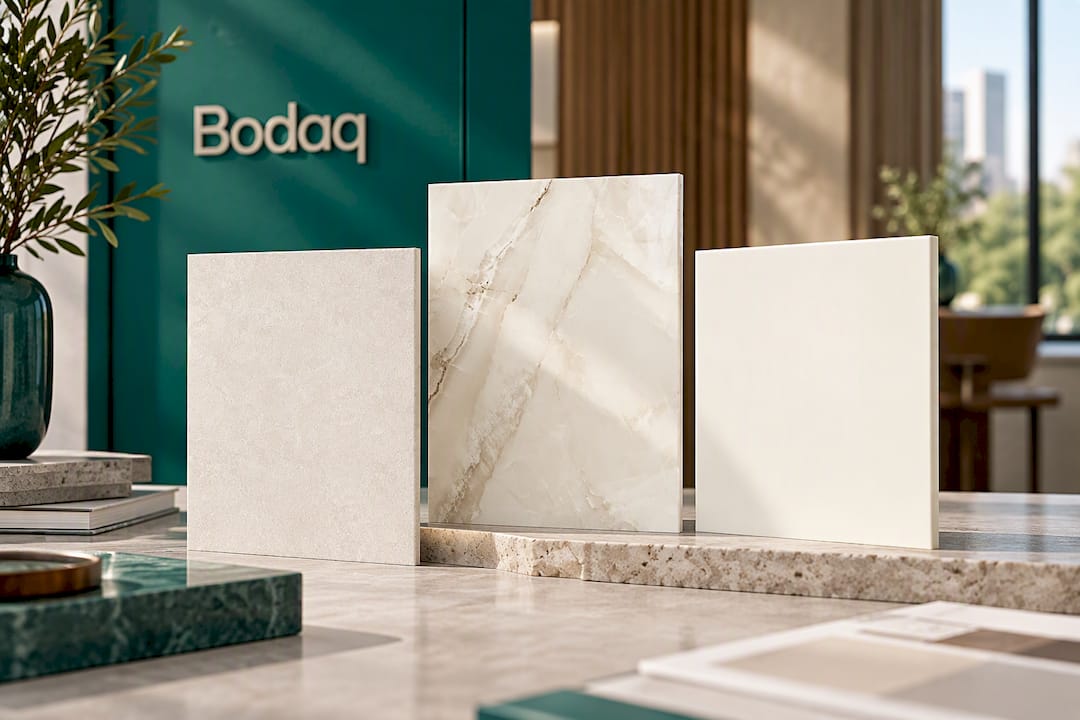
Start by browsing the full Interior Vinyl Film Collections, including the Wood, Metal, Stone & Marble collections and more, or go straight to the finishes covered in this guide: Easy Clean ECF01 for high-traffic matte performance, Onyx EXF51 for premium gloss impact, and Valen MonoBlanc BLC01 for refined matte solid color. Visit Bodaq’s U.S. site to request samples, download technical data sheets, or connect with a certified installer for your next fit-out.
Sources
- Indoor floor film buying guide
- Understanding Light Reflectance Value (LRV) in Decorative Films
- How to choose the right decorative film surface finish: matte, glossy, or textured?
- 3M™ DI-NOC™ Architectural Finishes (tech data sheet PDF)
FAQ
Is Matte or Gloss Film Better for Small Rooms?
Gloss tends to make small rooms feel larger because it bounces light and blurs wall edges through specular reflection. Matte still works well in small rooms if low glare and even color matter more than perceived size.
Does Gloss Film Show Fingerprints More Than Matte?
Yes. Gloss surfaces reflect light directionally, which makes fingerprints, dust, and smudges far more visible than on a matte finish, where diffuse reflection hides most minor marks.
Can I Use Gloss Film on Floors?
Most floor films are matte, and floor graphics typically need an overlaminate to meet UL-410 slip resistance standards. Confirm any gloss floor product’s slip rating with the manufacturer before specifying it for pedestrian traffic.
How Long Does Architectural Film Last Indoors?
Expected indoor service life varies by product and is listed on the manufacturer’s technical data sheet alongside thickness and application temperature. Check the specific collection’s data sheet rather than assuming a universal lifespan across finishes.
What Does Bodaq Film Cost?
Bodaq does not publish set pricing for its collections online. Current pricing and quotes are available directly through Bodaq’s website by requesting samples or contacting a certified installer.