
For most patient-care and circulation areas, medium-duty vinyl (Vinyl Type II) or a washable high-performance paint are the go-to choices; we reserve FRP, plastic panels, ceramic tile, stainless steel, and architectural film for specific wet, sterile, or feature locations. The right pick always comes down to cleanability, durability, VOC content, and lifecycle cost, so confirm your facility’s infection prevention standards before finalizing anything in a clinical or sterile space.
TL;DR:
- Specify Vinyl Type II in acute care, with welded or heat sealed seams and low VOC products, then verify compatibility with hospital grade disinfectants.
- Avoid standard latex in corridors and nurses’ stations; epoxy modified paint resists scuffs and chemical exposure better, while maintenance schedules should account for recoating.
- Choose ceramic tile with epoxy grout for showers and soiled utility rooms; cementitious grout is too porous for clinical use.
- For panel systems, seal every transition, cap edges, and use trims and sealants that resist chemicals to prevent moisture intrusion and weak joints.
- Test architectural film on a representative substrate with your actual disinfectant before approval, and reserve it for nonsterile spaces unless infection prevention approves clinical use.
Table of Contents
- Comparing wall finish categories: where each one earns its place
- Material profiles: cleanability, durability, cost, and installation notes
- How to choose the right finish for each room
- Installation and cleaning practices that protect hygiene and lifespan
- When architectural film fits hospital wall needs
- Balancing infection control with a space that still feels human
- Featured film collections for healthcare specification
- FAQ
- Sources
Comparing wall finish categories: where each one earns its place
Before specifying anything, it helps to see how the major material families stack up against each other on the factors that matter most in a healthcare setting.
- Paint (latex, epoxy, and antimicrobial formulas): versatile and budget-friendly, but standard latex wears quickly in high-impact corridors and equipment bays.
- Vinyl Type II: proven in acute care, easy to clean, and available in wide pattern ranges, though seams and substrate prep need careful attention.
- Rigid fiberglass (FRP): handles impact and abuse well with seamless panel options, but color and texture choices run narrower and installed cost runs higher.
- Plastic sheet panels (PVC): seamless and moisture-resistant, though the look stays utilitarian and adhesive-grade substrate prep is non-negotiable.
- Ceramic tile with epoxy grout: unmatched in wet-area durability, but grout lines demand epoxy formulations and a tighter maintenance routine.
- Stainless steel and metal: built for sterility-critical zones, but cost and glare limit it to select applications.
- Architectural film: delivers a fast aesthetic refresh with extensive texture and color choices; confirm cleaner compatibility and clinical sign-off before using it in sterile zones.
Material profiles: cleanability, durability, cost, and installation notes
Paint remains the most common wall finish in hospitals, and the differences between product types matter more than the category itself. Standard latex is the cheapest option but the least forgiving in corridors and nurses’ stations. Epoxy-modified paints resist scuffing and chemical exposure better, and EPA-registered antimicrobial paints add a supplemental layer of bioburden reduction, a field study found copper-containing antimicrobial paint reduced bacterial counts on large-area surfaces like walls and lockers, including a significant reduction in one preschool restroom application, though results varied across sites. Primer selection and recoat cycles drive lifecycle cost more than the paint itself, so budget for a maintenance schedule rather than a one-time application.
Vinyl Type II earns its reputation through seam management as much as the material itself. Properly seam-welded or heat-sealed transitions keep moisture and soil out of joints, which is the main reason it ranks first among facility managers surveyed on acute-care wall finishes. Cleaning crews can use standard hospital-grade disinfectants on it without degrading the surface, and VOC emissions tend to run low when specified correctly.
Rigid fiberglass (FRP) panel systems give you impact resistance that paint and vinyl cannot match, which is why we see it specified around loading docks, soiled utility rooms, and equipment staging areas. Seam treatments and trim pieces need to be chemical-resistant to match the panel itself, otherwise the joints become the weak point.
Plastic sheet paneling depends heavily on termination details. Coved bases, capped edges, and sealant at every transition are what keep moisture from migrating behind the panel, a detail echoed in hospital design standards that call for sealed transitions in rooms subject to aggressive cleaning.
Ceramic tile and epoxy grout stay the standard for wet walls in showers, soiled utility rooms, and some procedure areas. Standard cementitious grout is too porous for clinical use, so epoxy grout and a minimum tile height above splash zones are non-negotiable per the same design standards.
Stainless steel and metal finishes need attention to surface roughness. A cleanability study found rougher metal surfaces retained more residue after standardized wiping, so specifying a smoother finish and attaching panels without exposed fasteners both reduce the cleaning burden.
Architectural film, including our own interior vinyl film collections, works best on smooth, properly primed substrates. We recommend our wall wrap installation guidance for primer and adhesive selection, and we always advise confirming disinfectant compatibility before using film in sterile zones.
How to choose the right finish for each room
Start with the room’s function, not the finish you like best. A nurses’ station, a soiled utility room, and a waiting area have almost nothing in common once you map infection control, traffic, and moisture exposure.
- Identify the room category first: wet area, sterile or semi-sterile, high-touch corridor, or decorative/public space.
- Rank your criteria in order: infection control and cleanability, durability, VOC content, maintenance burden, aesthetics, and lifecycle cost.
- Set minimum material attributes: nonporous surface for high-touch zones, seamless or sealed transitions everywhere, epoxy grout in wet areas, and capped edges on all panel systems.
- Ask every supplier the same questions: which disinfectants the finish tolerates, whether VOC test data exists, expected service life, repair process, and warranty terms.
Pro Tip: Request physical samples and run your actual cleaning protocol, including your facility’s disinfectant, on a representative substrate before you sign off on any finish.
Installation and cleaning practices that protect hygiene and lifespan
Substrate prep determines whether a finish performs the way its spec sheet promises. Continuous seals and capped edges close off the gaps where moisture and soil collect, a point hospital design guidance treats as a baseline requirement rather than an upgrade.
- Match your disinfectant to the finish: quaternary ammonium compounds suit most vinyl and paint, while bleach-based cleaners require chemical-resistant surfaces like FRP or epoxy-grouted tile.
- Clean metal finishes in multiple directions, not just one pass, since testing on metal surfaces found directional wiping improved soil removal.
- Build a maintenance schedule around recoating and seam inspection rather than waiting for visible wear.
Smoother, nonporous finishes consistently showed lower residual ATP readings after standardized wiping in controlled testing on metal surfaces, reinforcing why surface roughness belongs on every specification checklist.
When architectural film fits hospital wall needs
Stretchable, self-adhesive film gives facility teams a fast way to refresh non-sterile surfaces without the downtime a full repaint or repanel job requires, and a catalog of textures and colors supports brand-consistent looks across a campus. We see it specified most often in non-sterile patient rooms, corridors, nurse stations, and elevator interiors, where our elevator interior upgrade examples show how film handles high-visibility, high-traffic surfaces. Confirm disinfectant compatibility with infection prevention before specifying film in any clinical or sterile area.

Balancing infection control with a space that still feels human
Facility managers and infection control teams too often work from separate checklists, and that gap shows up in finishes that clean well but feel clinical and cold, or finishes that look warm but fail cleanability testing. We think the better path treats cleanability and durability as the floor, not the ceiling, then builds color and texture choices on top of that floor rather than around it. Trial your shortlist on real substrates with your actual cleaning protocol before you commit a whole unit to one finish.
— Bodaq
Featured film collections for healthcare specification
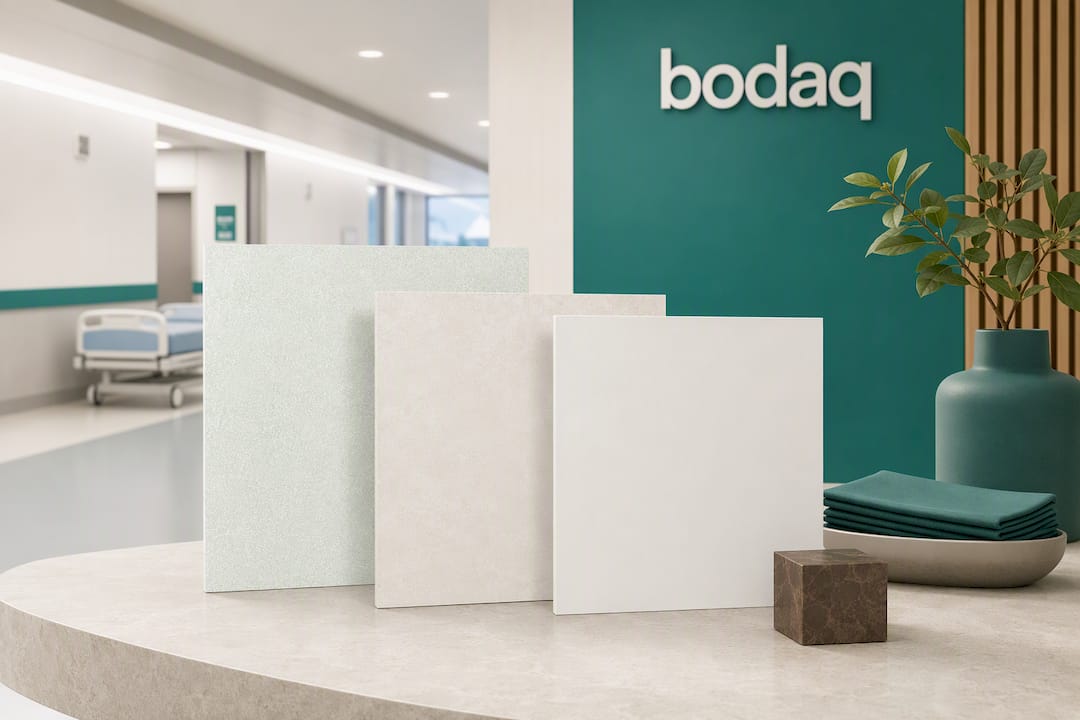
When film is the right call for your project, three of our collections come up most often in healthcare settings:
- Easy Clean – High-Performance Collection ECF01: built for high-touch surfaces where wipeable performance matters most.
- Refined White – Premium Collection BLC07: a clean, neutral finish suited to corridors and patient rooms.
- Valen MonoBlanc – Premium Collection BLC01: a soft matte option for nurse stations and public-facing walls.
Browse the full Bodaq Interior Film range or request samples and spec sheets to test against your facility’s cleaning protocol before you order.
FAQ
What are the main types of wall finishes?
The main categories are paint, vinyl wall covering, rigid fiberglass (FRP), plastic sheet paneling, ceramic tile, metal, and architectural film. Each one fits a different combination of moisture exposure, traffic level, and cleaning requirements.
What are hospital walls usually made of?
Hospital walls are typically gypsum board or masonry substrates finished with paint or Vinyl Type II, the two most common finishes according to facility manager surveys. Wet areas like showers and soiled utility rooms usually get ceramic tile with epoxy grout instead.
What are the best wall panels for hospitals?
Rigid fiberglass (FRP) panels and plastic sheet panels are the most common choices for impact-prone and moisture-exposed areas because they offer seamless, chemical-resistant surfaces. The right choice depends on whether the space needs impact resistance, moisture resistance, or both.
What color is best for hospital walls?
There is no single best color; facility managers weigh infection control, VOC emissions, and ease of maintenance above aesthetics when selecting a finish, according to facility manager surveys. Lighter, neutral tones are common in patient areas because they support a calming atmosphere while still working with washable finish types.
Are antimicrobial paints effective in hospitals?
EPA-registered antimicrobial paints can reduce surface bioburden as a supplement to routine cleaning, though results vary by setting. A field study found copper-containing antimicrobial paint reduced bacterial counts on large-area surfaces, with varying effectiveness by site, but antimicrobial paint works best alongside, not instead of, standard disinfection protocols.
Sources
- Cleanability of metal surface finishes found in medical devices and the environment of care
- Reduction of bioburden on large area surfaces through use of a supplemental residual antimicrobial paint
- Facility Managers’ Preferred Interior Wall Finishes In Acute-Care Hospital Buildings
- HOSPITAL BUILDING DESIGN STANDARDS — ELEMENT C3010, WALL FINISHES