
Use smooth, nonabsorbent hygienic panels such as stainless steel, PVC cladding, or FRP in wet prep and warewashing zones, and reserve washable decorative finishes for dining and service areas. Local health departments expect this zone-based split, and we design our Easy Clean collection around that distinction between back-of-house compliance and front-of-house brand expression.
TL;DR:
- Health departments require smooth, nonabsorbent, durable, easily cleanable walls in food preparation, warewashing, and storage areas; confirm local approval because rules vary.
- Stainless steel offers the greatest durability and cleanability at the highest cost, while PVC cladding creates seamless coves and FRP costs less than both.
- Decorative films suit dining walls and counters outside splash zones, but direct splash exposure requires approved test reports before they can replace hygienic cladding.
- Before full installation, test adhesion for 48 hours, match fire reports to the exact product, substrate, and mounting method, and verify cleaner compatibility.
- Seal every joint in wet areas against moisture intrusion, and repair separated seams or persistent stains promptly to preserve the hygienic barrier.
Table of Contents
- Zones and code basics for restaurant walls
- Material options that meet hygiene and durability needs
- Design and finish strategies for dining rooms and front-of-house areas
- Installation and maintenance best practices
- Why a high-performance film like our Easy Clean collection can be the right fit
- Author perspective: balancing compliance and brand-led design
- Samples, specs, and quotes for your next renovation
- FAQ
- Sources
Zones and code basics for restaurant walls
Every restaurant splits into zones that demand different wall performance, and the finish you choose should follow the function of the room, not just the look you want. Food prep, warewashing, and dry or cold storage count as wet or splash zones where moisture, grease, and steam hit the walls daily. Dining rooms and service corridors see foot traffic and occasional spills, but they rarely face the sustained moisture load of a cookline.
Health department guidance built around FDA Food Code principles requires walls in food-prep, warewashing, and storage areas to be smooth, nonabsorbent, durable, and easily cleanable. That requirement shapes nearly every material decision in the back of house:
- Food prep and cookline walls need nonabsorbent, scrubbable surfaces that tolerate grease and repeated sanitizing.
- Warewashing areas face constant splash and steam, so seams and corners matter as much as the surface itself.
- Dry and cold storage need moisture resistance but see less direct abuse than active cooking zones.
- Dining and service areas allow more decorative latitude since they are not classified as food-handling surfaces.
Textured finishes are typically prohibited outright in wet zones because grout lines, fabric weaves, and embossed patterns trap soil and resist sanitizing. Before any installation moves forward, pull the manufacturer’s spec sheet and confirm sign-off with your local inspector, since requirements vary by jurisdiction even when the underlying logic stays consistent.
Material options that meet hygiene and durability needs
Stainless steel remains the default behind cooklines, hoods, and other high-heat splash zones. It resists corrosion, shrugs off repeated scrubbing, and holds up to decades of commercial use, though its cost and industrial look make it a poor fit for dining rooms.
PVC hygienic cladding has become a strong alternative to older systems in many modern builds. It thermoforms into seamless coves, resists mold growth, and cleans easily without the glass-fiber concerns that come with older panel types, which is why many specifiers now prefer it to FRP in new installs.
FRP panels remain the traditional, widely accepted choice for smooth, scrubbable wall protection. They cost less than steel and PVC systems but carry some tradeoffs: exposed glass fibers at cut edges can pose a handling concern, and the aesthetic range stays narrow compared to newer hygienic cladding.
Glazed tile and epoxy or semi-gloss paints fit specific applications. Tile holds up well visually but grout lines need regular sealing to stay nonabsorbent. Epoxy paint works on walls that see light splash but not direct scrubbing with abrasive pads.
Washable commercial vinyl and high-performance wall films deliver decorative durability for front-of-house surfaces. PVC hygienic cladding outperforms many traditional systems in cleanability and appearance, and a similar logic applies to high-performance films: they belong in dining rooms and service counters, not in direct splash paths, unless backed by approved test reports.
- Stainless steel: highest durability and cleanability, highest cost, limited design range.
- PVC hygienic cladding: strong cleanability and seamless installation, moderate cost, modern appearance.
- FRP: good cleanability, lower cost, constrained design flexibility.
- Glazed tile: attractive but maintenance-heavy at the grout lines.
- Washable film and vinyl: strongest design flexibility, best suited to non-splash zones.
Maricopa County’s policy states textured finishes are not acceptable in wet or splash zones. That single rule eliminates a large share of decorative finishes from consideration anywhere near a cookline.
Design and finish strategies for dining rooms and front-of-house areas
Dining rooms give you room to express a brand identity that the kitchen simply cannot. A smooth hygienic panel transitions naturally into a richer, more sculptural finish once you cross into guest-facing space, and the handoff point, usually a doorway or pass-through, is where the material story should shift.
Low-height protective panels or wainscoting absorb the scuffs from chairs and foot traffic while leaving the upper wall open for a feature finish, a mural, or a textured film. Accent walls built from interior wall finishing materials that mimic wood, stone, or fabric let a dining room feel warm without the upkeep burden of the real material.
- Choose mid-tone colors and subtle textures that mask fingerprints and minor wear between cleanings.
- Use film overlays on booths, host stands, and bar fronts for a tailored look without custom millwork costs.
- Add acoustic panels or fabric-wrapped sections where dining noise needs softening, away from any splash exposure.
A cocooning effect in a booth area, built from warm texture and controlled lighting, does more for repeat visits than a few extra square feet of stainless steel ever could.
Installation and maintenance best practices
Getting a wall covering right starts well before anyone opens an adhesive tube. A disciplined sequence protects both the finish and your inspection timeline.
- Assess the substrate for moisture, flatness, and prior coatings before selecting any material.
- Request mockups and physical samples so the kitchen staff and ownership can approve the finish under real lighting.
- Collect manufacturer spec sheets and fire-test documentation that match the exact product, substrate, and mounting method.
- Prep the surface thoroughly, then apply a bonding primer where the substrate is porous, glossy, or otherwise difficult.
- Treat seams and coving carefully in wet zones, sealing every joint to prevent moisture intrusion behind the panel.
- Set a cleaning and inspection schedule using approved commercial disinfectants compatible with the chosen finish.
Our wall wrap installation guidance covers primer selection and seam technique in more detail for crews working with film systems.
Pro Tip: Always confirm your chosen cleaner is listed as compatible with the specific finish, since some disinfectants that are safe on stainless steel will cloud or degrade vinyl and film surfaces over time.
Replace or repair panels as soon as seams separate or surfaces show persistent staining, since a compromised seal defeats the entire purpose of a hygienic finish.
Why a high-performance film like our Easy Clean collection can be the right fit
Our Easy Clean – High-Performance Collection ECF01 gives dining rooms and brand-facing surfaces a self-adhesive finish. Because our interior film stretches and adheres cleanly, it suits host stands, bar fronts, and accent walls where a premium look matters as much as upkeep.
- Appropriate for dining walls, non-splash service counters, and feature surfaces that need brand-consistent color or texture.
- Not a substitute for hygienic cladding in cookline, warewashing, or other direct splash zones without approved test documentation.
- Best validated with a 48-hour adhesion test and project-specific fire-test reports before a full rollout.
Request product specs and run adhesion checks before committing to a large installation, particularly near any zone with intermittent moisture exposure.
Pro Tip: Difficult substrates such as glossy tile or sealed concrete often need Bodaq Water-Based Primer first for a clean, lasting bond.
Author perspective: balancing compliance and brand-led design
Hygiene code should never feel like an afterthought bolted onto a design plan, and it should never be the only voice in the room either. The strongest restaurant interiors treat the kitchen’s smooth, nonabsorbent walls as a given and spend the design budget where guests actually look: the dining room.
Bring your installer and local health inspector into the conversation early, before finishes get locked in. A sample board and a short mockup review save far more time than a failed inspection ever will.
— Bodaq
Samples, specs, and quotes for your next renovation
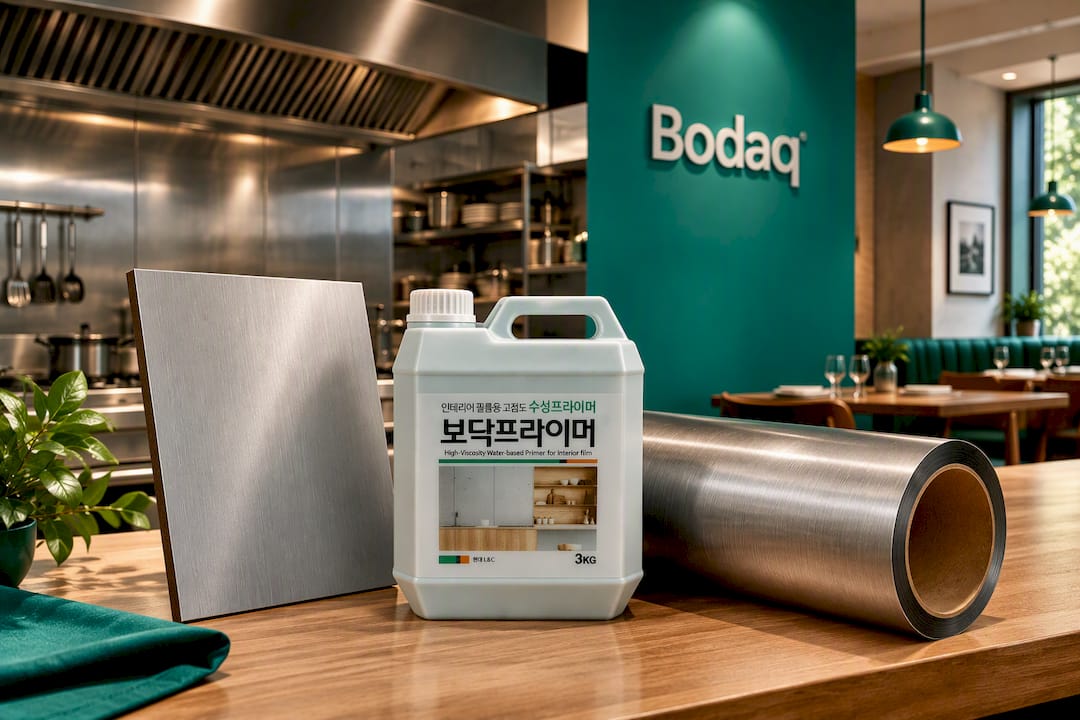
Request a sample of our Easy Clean – High-Performance Collection ECF01 alongside our Water-Based Primer to run your own adhesion checks before your inspector walks the space. Browse our full interior film catalog for the texture and color that fits your dining room, and download spec sheets or ask our team for project-specific test evidence before any wide installation begins.
FAQ
What is the best wall covering for a commercial kitchen?
Stainless steel, FRP, and PVC hygienic cladding are the standard choices because they are smooth, nonabsorbent, and withstand repeated scrubbing and splash exposure. Health department guidance accepts all three when installed with sealed seams and proper coving in food-prep and warewashing areas.
What are wall coverings called?
Wall coverings span several categories including wallpaper, vinyl wall film, FRP panels, PVC hygienic cladding, and tile, each named for its material or installation method. In commercial kitchens, the smooth plastic panels used for hygiene compliance are most often called FRP or PVC wall cladding.
What are some stylish feature walls for a restaurant?
Textured film overlays, wood-look or stone-look panels, and fabric-wrapped acoustic sections all work well as feature walls in dining rooms. Our Wood Collection, Metal Collection, and Stone & Marble Collection offer this range of looks without the cost of sourcing the real materials.
What is the plastic wall covering in commercial kitchens called?
The plastic panels common in commercial kitchens are usually called FRP, short for fiber-reinforced plastic, or PVC hygienic cladding depending on the specific product line. Both are prized for being smooth, nonabsorbent, and easy to sanitize, which is why health departments list them among acceptable wet-zone finishes.
How do I know if a wall finish meets fire code for my project?
Fire compliance depends on the exact product, substrate, thickness, and mounting method tested together, not a generic marketing claim. Request a project-specific fire-test report that matches your installation before approving any finish for a restaurant build.
Sources
Consult Alameda County’s approved wall finishes guidance and Maricopa County’s substantive policy statement for the regulatory expectations behind this guide. Always request manufacturer spec sheets and project-specific test reports before finalizing any installation, and loop in your door and millwork supplier, such as One Day Doors & Closets, when finishes meet access points.
- Approved Wall Finishes for Retail Food Facilities | Environmental Health Department | Alameda County Health
- SUBSTANTIVE POLICY STATEMENT