Architectural Film Basics12 min read
Hotel Headboard Wrap: Refinish Guest Room Headboards in Place
A hotel headboard wrap refreshes worn headboards without replacing them. See what it covers, how to measure, prep, install and maintain it across rooms.
A hotel headboard wrap is a new surface applied over the headboard you already own, so the room gets a fresh look without a furniture order, a freight delay or a bed frame leaving the building. For hard-surface headboards (wood, laminate and similar panels), the most direct way to do that is architectural film: a thin, self-adhesive finish that stretches around edges and returns a room to service quickly. Bodaq Interior Film, made by Hyundai L&C, comes in over 450 textures and colors, including wood, stone, metal, solid colors and fabric and leather looks, which is why one film family can match a headboard to the rest of a room.
This guide explains what a wrap covers, how to choose the finish, how to measure and plan the work across many rooms, and how to keep the result looking right under guest use.
TL;DR
- A headboard wrap refinishes the visible surface of an existing headboard, which keeps the frame, the mounting and the room layout as they are.
- Choose the finish by wear: the zone above the pillows takes hair oil, skin contact and luggage knocks, so pick a texture that hides marks.
- Measure the face width and height, plus any returns and edges, and survey switches, sconces and outlets before you order.
- Work floor by floor, with a standard sequence per room, so rooms return to inventory in days rather than weeks.
- Bodaq’s film comes in over 450 textures and colors, so headboards can match casegoods, doors and wall panels in the same room.
Table of Contents
- What a headboard wrap covers, and what it solves
- Choosing the finish for a headboard
- Measuring the headboard
- Preparing and installing the wrap
- Planning a multi-room rollout
- Keeping a wrapped headboard looking new
- Wrap or replace: how to decide
- Our perspective
- Start with samples and a quote
- FAQ
- Sources
What a headboard wrap covers, and what it solves
Headboards are the visual anchor of a guest room, and they are also the surface that guests touch, lean on and bump suitcases against. Over a few years the typical problems are the same: scuffed or chipped edges, dull or yellowed finishes, a dated color or wood tone, and a headboard that no longer matches refreshed bedding, walls or lighting.
A wrap addresses the surface. It suits headboards with a sound structure and a worn or outdated face, such as wood, laminate or painted panels, and it also works across the rest of the furniture set. Because the same film can be applied to nightstands, desks, wardrobes, doors and wall panels, the headboard stops being the odd piece out in a refresh. Bodaq’s film is designed for walls, furniture, doors and other surfaces in residential and commercial spaces, so one specification can carry through the whole room.
What a wrap does not do is rebuild a broken frame. If a headboard is structurally loose, repair the structure first, then finish the surface.
Choosing the finish for a headboard
Start from how the headboard is used, not from a swatch. Three questions narrow the choice quickly.
Where is the wear? Soiling concentrates in a band just above the pillows from hair oil and skin contact, according to one fabric guide’s editorial team. Pick a finish with visible grain, texture or pattern in that zone. A subtle wood grain or a woven linen look reads as intentional even after months of use, while a flat pale solid shows every mark.
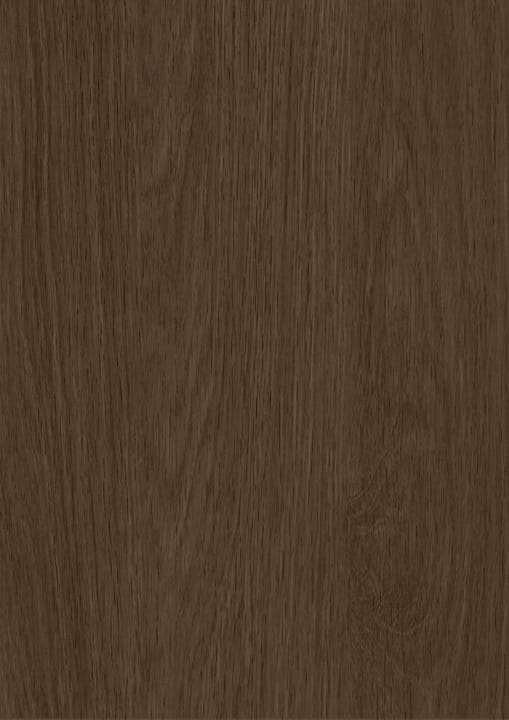
What does the brand standard say? Hotel brands usually specify a palette of tones. Matching the headboard to casegoods and doors is easier when the film collection covers several materials. In the Bodaq range you can look across the Wood, Metal, Stone & Marble, Solid Colors and Fabric & Leather collections and keep one family of finishes throughout.
What mood is the room? Think of the headboard as a tailored garment for the bed wall:
- Warm wood tones such as Natural Oak LW108 or Deep Walnut Oak LW109 give a calm, organic feel and pair with linen bedding.
- Woven and fabric looks such as Woven Linen SF803 or Silver-Ash Linen NF906 bring a soft, upholstered feel to a hard panel.
- Leather looks such as Soft Leather Light SL401 or Steel Grey SL402 suit a tailored, urban property.
- Stone and travertine such as Travertine NS202 make a sculptural statement behind the bed.
- Solid colors such as Silver Mist S263 work for a quiet, color-drenched room where the headboard blends into the wall.
Pro tip: request samples and look at them under the room’s actual lighting, at bed height, before you commit a whole floor. Bodaq offers samples for this purpose.
Performance standards worth knowing
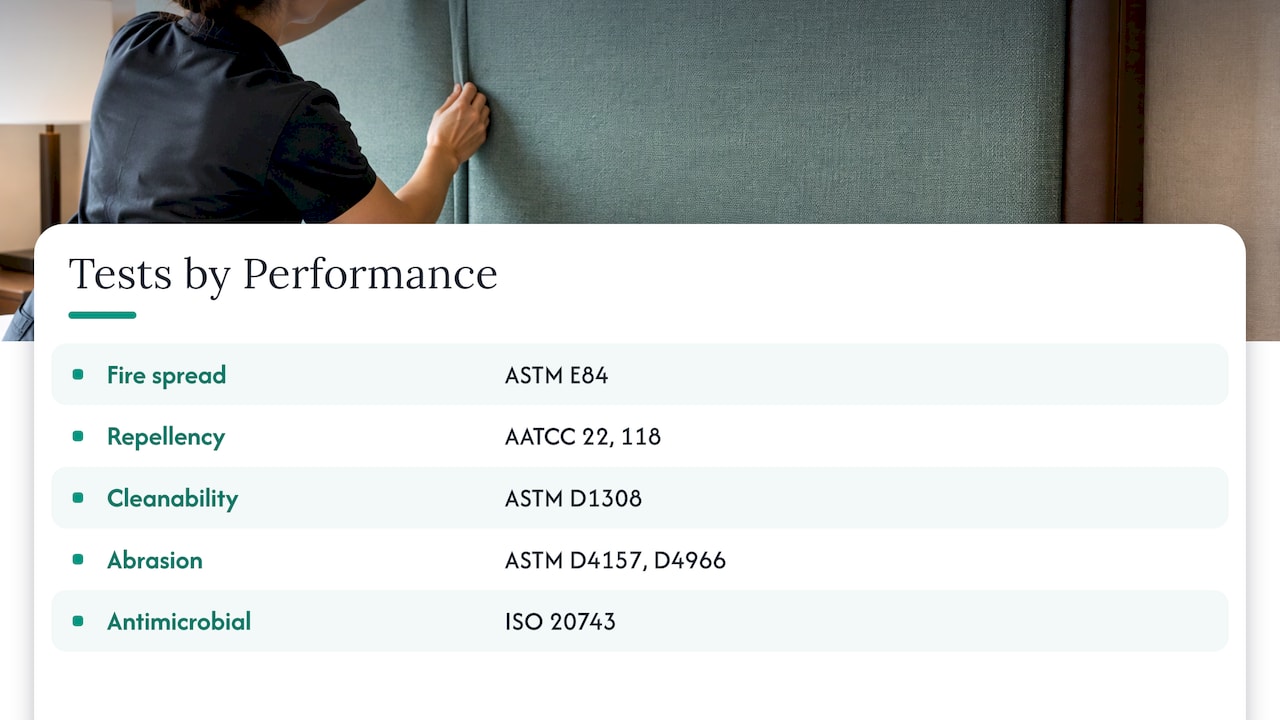
Properties that matter for a headboard surface go beyond looks. A headboard application sheet from a US textile supplier lists a recommended test suite for headboard materials: ASTM E84 for fire code compliance, AATCC 22 and 118 for repellency, ASTM D1308 for cleanability, ASTM D4157 and D4966 for abrasion, and ISO 20743 for antimicrobial performance. ASTM E84 is a surface burning test that measures how quickly flame spreads across a material. Fire and life-safety requirements differ by state, city and brand, so give your facilities team or fire marshal the product documentation for the film you plan to use and confirm the requirement for guest rooms before you specify. Bodaq positions its film as certified for durability in high-traffic environments and as meeting eco-friendly standards; ask your Bodaq contact for the documents that match your project.
Measuring the headboard
Measurement drives ordering, so do it once, carefully, and record it per room type.
- Face width and height. Measure the widest and tallest points of the visible face. Record them in inches to the nearest eighth.
- Edges and returns. Note the edge profile (square, eased, beveled) and whether the sides of the panel are visible. Film that wraps edges needs extra material on each side.
- Obstructions. Mark every switch, outlet, sconce, reading light and USB panel near the headboard. In a rollout across a property, a headboard that sits a half inch too wide can cover a switch plate, and fixing it after the fact costs far more than a tape measure ever did. One hotel renovation account describes mismeasured custom queen headboards that blocked switches and needed off-site rework.
- Room types. Group rooms by bed size and headboard model. Measure one of each group, then spot-check a few others, since older properties often have small variations.
For reference, guidance on fabric covers suggests adding 6 to 8 inches to each dimension so there are 3 to 4 inches to wrap around each side. That allowance is for sewn fabric. For film, your roll width and the way it stretches around edges set the plan, so give your Bodaq contact the measured dimensions and the edge profile and ask for the yield per roll.
A worked example: a property has 120 rooms with the same queen headboard, 62 inches wide and 30 inches tall. Because the face is under the typical roll width, one headboard can usually be covered in one continuous piece, which means no seams in the guest’s line of sight. Seams are what make a wrap look like a repair, so plan the cut to avoid them in the pillow zone.
Preparing and installing the wrap
Installation is where a wrap either looks like factory finish or like a sticker. Here is the routine, and where it usually goes wrong.
1. Inspect and repair the substrate
Film shows what is under it. Fill chips and gouges, sand raised edges and remove loose laminate. Skipping this step is the most common reason a finished edge lifts or a dent telegraphs through the surface.
2. Clean and degrease
Headboards carry hair oil and skin oils, exactly where adhesive needs a clean surface. Wipe down with a suitable cleaner, let it dry fully and remove dust. Where the substrate is porous or has an old coating that needs help, Bodaq sells a water-based primer among its installation tools.
3. Cut the film with margin
Cut each piece oversize, leaving a few inches to wrap edges. Use the pre-measured plan so your installers repeat the same cut in every room.
4. Apply and stretch
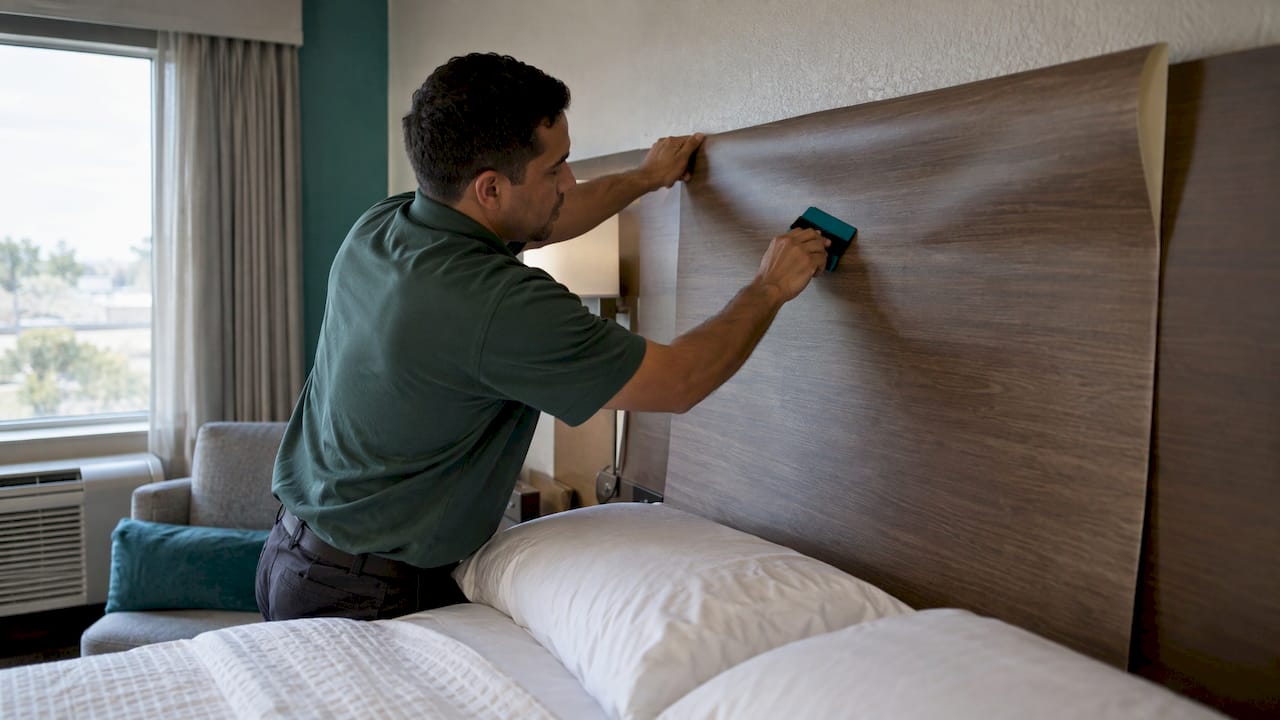
Bodaq film is self-adhesive and stretchable, and our adhesive is designed with air channels, so air bubbles can be pushed out as the film is applied. That makes wrapping edges and corners faster and cleaner than methods that rely on rigid sheets or wet application. Start at the center of the panel, work outward with a squeegee and relieve tension around curves rather than forcing it.
5. Trim and finish edges
Trim along the back or side with a sharp blade and press the wrapped edges firmly. Use a quality knife and replace blades often, since a dull blade drags the film.
6. Inspect, then return the room
Check the surface in raking light for bubbles, lifted edges and misaligned seams. Because film is a finish rather than a furniture swap, a trained crew can often finish a headboard in the room, then move on. See how this approach works across whole properties in our guide to hotel renovations without downtime.
Bodaq also offers certified training for professional installers, so a property’s maintenance staff or contractor can learn the technique before a rollout.
Planning a multi-room rollout
The wrap is a small job per room. Across 100 rooms, the schedule is the real project. Renovators of occupied hotels talk about treating every day as if the hotel were fully booked, with three to four days’ notice before each floor transition. The same principle works for a headboard refresh:
- Work in a fixed sequence. Same steps, same order, same tools in every room, so quality does not depend on who is on the crew.
- Go floor by floor. Block a set of rooms, finish them, release them and move on. Revenue returns to inventory while the next floor is underway.
- Stage materials. Pre-cut films by room type and label them, so installers do not measure on the spot.
- Coordinate with housekeeping and front desk. Give them a list of rooms out of service and the expected return time.
- Do a final walk. One person inspects every room against the same checklist before it is handed back.
Wall-mounted headboard systems that allow headboards to be removed non-sequentially for cleaning or refresh also make wrapping easier: a headboard that comes off the wall can be finished at a bench, then rehung. If your headboards are fixed to the wall, in-place wrapping avoids the lift entirely.
For more on the economics, read our overview of high-ROI hospitality renovation materials and the five reasons architectural films suit hospitality design.
Keeping a wrapped headboard looking new
Care comes down to routine, not heroics.
- Wipe regularly. Include the headboard in housekeeping’s standard dust and wipe path, with a soft cloth and the cleaner your property already uses on furniture surfaces. Check the care guidance for the specific film before changing products.
- Watch the pillow band. Since soiling concentrates above the pillows, that band is the place to look first on inspection rounds.
- Protect edges. Corners and bottom edges take the most knocks from luggage and cleaning equipment. Check them at routine room inspections and press down any lifted edge early.
- Keep spare film. Order a little extra of each finish and record the batch. A damaged panel can then be rewrapped in place, instead of waiting on a furniture order, and the new film matches the old.
A film finish is also easy to renew. When a design cycle ends or a brand standard changes, the headboard can be refinished in the same way as the first time, which keeps the cost of the next refresh predictable.
Wrap or replace: how to decide
A wrap is the right call when the structure is sound and the surface is the issue, when you want matching finishes across many pieces, and when you cannot take rooms out of service for long. Replacement of a headboard is a different project: it involves procurement lead times, delivery, disposal of the old piece and often new mounting hardware. Reupholstery is a further route for soft headboards; one 2025 survey of US shops put a queen flat headboard at $150 to $260 with a turnaround of several days from drop-off, which is per-piece and off-site. A film wrap on a hard-surface panel stays in the room, so the headboard never leaves the building.
For a commercial property manager, that difference shows up as fewer out-of-order nights. For a designer, it shows up as freedom to match the headboard to any other finish in the room. For a homeowner who wants a boutique-hotel look at the head of the bed, it means a headboard refresh without replacing furniture.
Our perspective
Headboards are small in area and large in impact. We see the best results when teams treat the headboard as one surface in a family of surfaces: the same film language on the headboard, nightstands, doors and wall panels, so the room reads as designed rather than assembled.
That is why we built Bodaq Interior Film as a stretchable, self-adhesive finish with a catalog of over 450 textures and colors. Stretch helps film follow edges and curves, and our air-channeled adhesive is designed to make installation cleaner, which matters when you are repeating the same job in dozens of rooms.
Our advice for properties planning a headboard refresh: standardize the sequence, pick a texture that is forgiving in the pillow zone, and plan floor by floor. If you want your installers to do the work themselves, our certified training and tools are there for that. If you want to see the finishes in your own lighting, ask for samples first.
Bodaq
Start with samples and a quote
If you are planning a refresh for one room or a hundred, the next step is to see the finishes. Bodaq Interior Film is available in wood, metal, stone and marble, solid color and fabric and leather collections, with installation tools, dealer kits, certified installer training and samples to support the work.
Browse the full range at Bodaq Interior Film, compare looks in the Bodaq gallery, or download the PDF catalog to specify finishes for your project. To see how hotel teams have used film across guest rooms and common areas, read about transforming hotels with Bodaq finishes.
FAQ
What is a hotel headboard wrap?
It is a new surface applied over an existing headboard, so the piece stays in the room while its look changes. With architectural film, the finish is self-adhesive and can match wood, stone, metal, solid color or fabric looks used elsewhere in the room.
How long does it take to wrap a headboard?
The time depends on the headboard’s size and shape, the condition of the surface and the crew’s experience. Preparation, such as repairs and cleaning, often takes as long as the application itself. A repeatable sequence, installers trained on the same method and pre-cut film by room type make timing predictable across a floor.
Which finish hides wear best on a headboard?
Textured finishes such as wood grain, woven linen and leather looks tend to disguise light marks better than flat pale solids. Since soiling gathers in the band above the pillows, review samples in that zone under real room lighting before you choose.
Can the same film match other furniture in the room?
Yes. Bodaq film is designed for walls, furniture, doors and other surfaces, so you can carry one finish across the headboard, nightstands, wardrobe and door for a coordinated look.
Do I need to confirm fire requirements before specifying?
Yes. Requirements vary by jurisdiction and brand standard, and headboard materials are commonly checked against flame-spread testing such as ASTM E84. Share the product documentation with your facilities team or local fire authority and confirm the requirement for guest rooms before ordering.
Sources
- Applied Textiles: headboard application and recommended tests
- Best Fabric to Cover a Headboard: Materials, Durability and Costs
- From Lobby to Guest Room: Behind the Scenes of a Hotel Renovation
- How to Attach a Headboard to a Bed Frame: Commercial Guidance
- How Much Does It Cost to Reupholster a Headboard?