Hotel casework refacing means keeping the sound carcasses of your headboards, dressers, desks, nightstands, vanities and closets, and giving them a new surface. For many properties that is the fastest way to change how a room looks without gutting it. The method only works when the structure underneath is healthy and the new finish is chosen for the way your property is actually cleaned and used. This guide covers when refacing makes sense, how to compare the methods, how to protect the result from housekeeping, and how to phase the work so rooms return to inventory quickly.
TL;DR
- Refacing suits casework that is structurally sound but worn, dated or off-brand. It does not repair swollen boards, failed joints or broken hardware.
- Choose the finish against your real cleaning chemicals and dwell times, and test a sample before you commit to a full floor.
- Architectural film is a dry, low-dust method that can be installed in the room, which helps with occupied-floor renovations and short room-out windows.
- Phase the work floor by floor and treat the first rooms as a pilot you inspect after a few weeks of real housekeeping.
- Pair refacing with a documented end-of-life plan so it is a sustainability decision, not only a cosmetic one.
Table of Contents
- What refacing covers, and what it does not
- Why owners are looking at refacing now
- Your options for refacing hotel casework
- Choosing a finish that survives housekeeping
- Planning the work: phasing, pilots and downtime
- What architectural film brings to casework
- Our perspective: refacing is a design decision, not a shortcut
- How to specify a refacing project step by step
- Ready to test film on your casework?
- FAQ
- Sources
What refacing covers, and what it does not
Casework, or casegoods, is the built or freestanding wood-based furniture in a guestroom: headboard panels, nightstands, dressers, desks, luggage benches, TV consoles, minibar cabinets, closet fronts and bathroom vanities. In most hotels this is the visible, heavily touched part of the room, and it is the first thing to look tired. Corners chip, desk edges lift, laminate scuffs from luggage, and a finish that once matched the brand standard drifts away from it.
Refacing replaces only the surface. The substrate, the box construction and usually the hardware stay. That is the whole logic: the cost and the waste sit mostly in the structure you are already paying for.
It works well when:
- Boxes are rigid, drawers run properly and the substrate is dry and intact.
- Damage is cosmetic: scratches, sun fade, dated wood tones, peeling or worn laminate, cigarette or cup rings.
- The room layout and function still suit your guests and your brand.
It is the wrong tool when:
- Particleboard or MDF has swollen from moisture, particularly at vanity bases and minibar cabinets.
- Hinges and slides are failing across the board and the pieces need rebuilding anyway.
- The brand is changing the room program entirely, with new dimensions, power, USB or layout.
Be honest about that inspection. A film or coating will not hide a failing substrate for long, and a 10-minute survey of a sample of rooms will save you from a bad purchase order.
Why owners are looking at refacing now
FF&E is a large line in any renovation. One 2026 analysis puts FF&E cost per guestroom key between $3,000 in economy hotels and more than $58,000 in luxury properties. Casework is only part of that, but it is the part where a surface change can substitute for a full purchase.
Three pressures push owners toward refacing:
- Brand refresh cycles. A property improvement plan (PIP) often wants a new look before the furniture has reached end of life.
- Downtime. Every room out of order is lost revenue. Methods that finish a room in a day or two beat methods that need a week of lead time, delivery, demolition and install.
- Waste and carbon. Reusing sound components avoids landfill. A University of California case study on interior reuse reports that circular strategies can cut embodied carbon by 45 to 68 percent in its modeled scenarios. That figure describes the study’s scenarios, not a guaranteed saving on any single hotel project, so treat it as direction rather than a promise.
Your options for refacing hotel casework
There are several routes. Each has a place, and the right one depends on the condition of the pieces, the look you need and how long rooms can stay offline.
| Method | How it works | Where it fits | Watch for |
|---|---|---|---|
| Architectural interior film | Self-adhesive film applied over cleaned, sound surfaces | Fronts, tops, panels, doors, vanity faces, in-room work | Surface prep, edge and corner detailing, installer skill |
| Spray refinishing | Coating applied by spray, often with masking and ventilation | Wood pieces that need a tone change or touch-up | Fumes, cure time, overspray control in occupied buildings |
| New laminate or veneer | Old surface removed, new sheet bonded | Pieces that need a different material or full rebuild of surfaces | Shop time, transport, longer room-out periods |
| Full replacement | New casegoods ordered and installed | Failed structure or full concept change | Lead times, cost, disposal of old pieces |
A fair reading of the table: film is not the answer to everything, and neither is replacement. But for the very common case of sound pieces with tired surfaces, film lets you change color, grain and texture on site without sanding, solvents or a long cure. If you want a deeper comparison of the economics, our piece on why interior film wins over replacement in hotel and office renovations walks through it.
If you are also rethinking the concept behind the rooms, not only the surface, a hospitality interior design consultancy can help with construction methods and material options for updating a hotel while retaining existing cabinetry.
Choosing a finish that survives housekeeping
The most common refacing failure is not a bad install. It is a finish that was never tested against the way the hotel is cleaned.
Hospitality design guidance makes the point directly: surfaces see harder use and more aggressive cleaning than a typical residence, and finishes should be checked for chemical compatibility and tested. The same guidance lists casegoods, millwork, seating, flooring and architectural surfaces as needing durability, disinfection and sustainability review.
Here is how to turn that into a working checklist.
- Ask housekeeping and engineering for the actual products. Get the list of disinfectants, glass cleaners and degreasers on the carts, their dilution and their dwell times. Brand standards and what the night crew really uses are not always the same.
- Request the manufacturer’s technical documentation. For Bodaq, technical bulletins are collected on our technical bulletins page, so your team can check cleaning guidance against your protocol.
- Run a controlled sample test. Apply the candidate finish to a spare drawer front or a mock-up panel, then clean it with your real chemicals at your real dwell times, repeatedly. Look for dulling, edge lift, staining and tackiness.
- Test high-contact spots separately. Desk edges, luggage-bench tops and nightstand corners take more abuse than drawer fronts.
- Write the result down. A one-page approved finish and cleaning guide for housekeeping belongs in your turnover documents.
A note on codes: fire and flammability requirements for hospitality furnishings are set by local authorities and vary by jurisdiction. California, for example, publishes its Technical Bulletin 133 for seating furniture in public occupancies. That bulletin covers seating, not casework, but it shows the kind of test documentation your authority may expect. Confirm which rules apply to your building with your local fire marshal and your brand’s standards team before you specify anything.
Planning the work: phasing, pilots and downtime
Hospitality renovation fails more often on logistics than on materials. A good plan treats rooms as a production line.
Start with a survey and a pilot
Walk a representative sample of rooms across floors and room types. Tag each piece as refaceable, repair first or replace. Then reface two or three pilot rooms and leave them in normal service for a few weeks. Inspect them with housekeeping, the front desk and engineering in the room. You will learn more from that than from any sample board.
Phase by floor
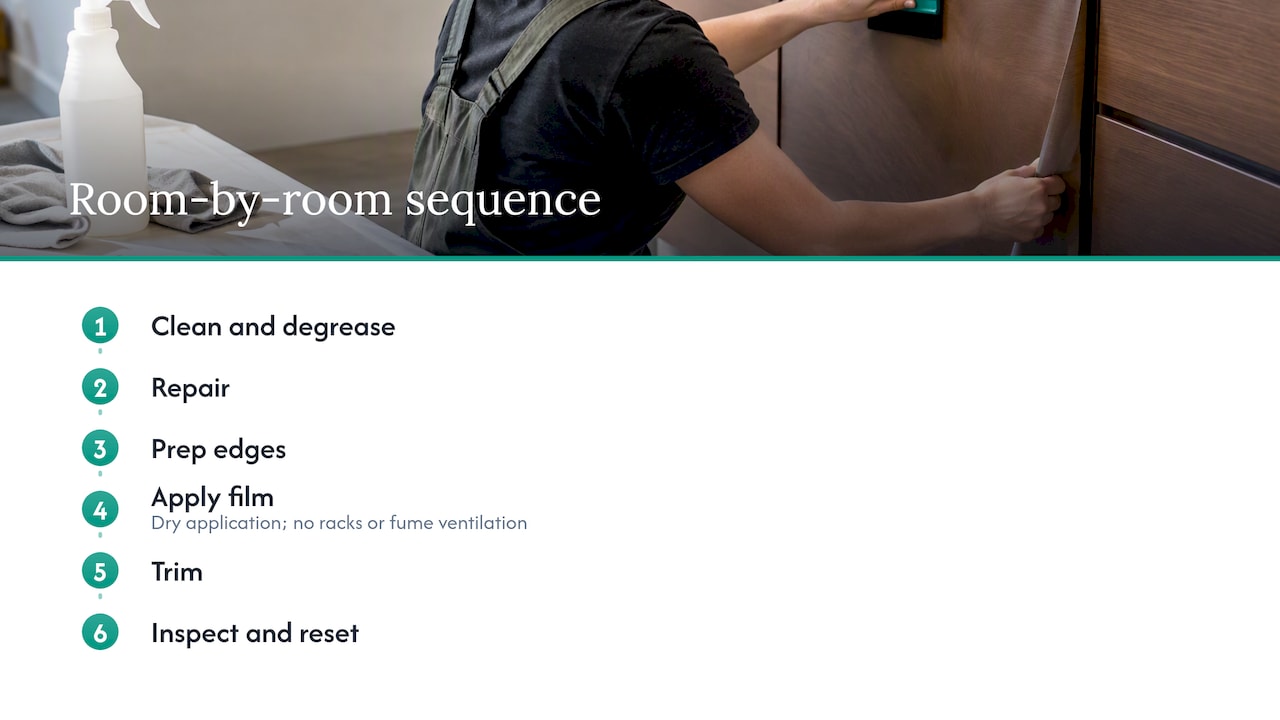
Work floor by floor so you can keep inventory open elsewhere. Keep materials staged on the floor being worked, with a clear sequence per room: clean and degrease, repair, prep edges, apply, trim, inspect, reset. Because film is applied dry, the crew does not need drying racks or ventilation for fumes, which simplifies working near occupied rooms. We cover this approach in our guide to hotel renovations without downtime.
Budget the invisible parts
The surface material is only one line. Also count:
- Substrate repairs and hardware replacement
- Surface prep and cleaning labor
- Protection for floors and walls during work
- Inspection and punch-list time per room
- A small attic stock of film for future touch-ups, so a chipped corner in year three can be matched
For a wider view of which materials pay back for procurement and operations teams, see our summary of three high-ROI hospitality renovation materials.
What architectural film brings to casework
Bodaq is a premium architectural interior film by Hyundai L&C. It is self-adhesive and stretchable, which matters on casework because guestroom pieces are full of edges, radiused corners and profiled fronts. The stretch lets an installer wrap those details rather than seam around them, and the air-channeled adhesive helps release trapped air for a cleaner application.
The catalog runs to more than 450 textures and colors, so a refacing project can go in several directions:
- Warm and organic. Oak, walnut and linear wood grains give headboards and desks a tactile, lived-in look. Options include Natural Oak LW108, Smoked Charcoal Oak LW113 and Driftwood Walnut SPW73.
- Sculptural and mineral. Stone and marble patterns suit vanity fronts and console tops, for example Travertine NS202 or Pietra Dark Grey Marble PM007.
- Quiet and graphic. Solid colors such as Gentle Creme S257 or Deep Forest S266 let you color-drench a closet run or a wet bar for a bold, immersive effect.
- Metallic accents. Metal and patina finishes like Brass RM008 work on trim, inserts and lobby casework.
For high-touch surfaces, the Easy Clean ECF01 high-performance film is the one to put in front of your housekeeping team during testing.
Beyond guestrooms, the same approach carries into lobbies, front desks, corridors, meeting rooms and F&B outlets, which is how a property keeps a consistent look across public and private spaces. Our overview of how film transforms hotels shows examples, and five reasons architectural films suit hospitality design explains the design logic.
Our perspective: refacing is a design decision, not a shortcut
We see refacing as the point where operations, design and sustainability finally agree. A tired casegood is rarely tired all the way through. The box is solid, the drawers work, the proportions are right. What has aged is the skin, and skin is the cheapest part to change.
That said, we do not think film is a magic wrapper. Three things decide whether a refacing project looks sharp in year one and still looks sharp in year four.
Preparation beats product. A clean, dry, sound surface is what the adhesive bonds to. Time spent on degreasing, filling and edge prep is where the finish is won.
Detail beats coverage. Corners, edges and joints are where guests and luggage do damage. A stretchable film that wraps those details, installed by someone trained to do it, outlasts a flat surface treatment that stops at the edge. This is why we offer certification and training for professional installers alongside the film.
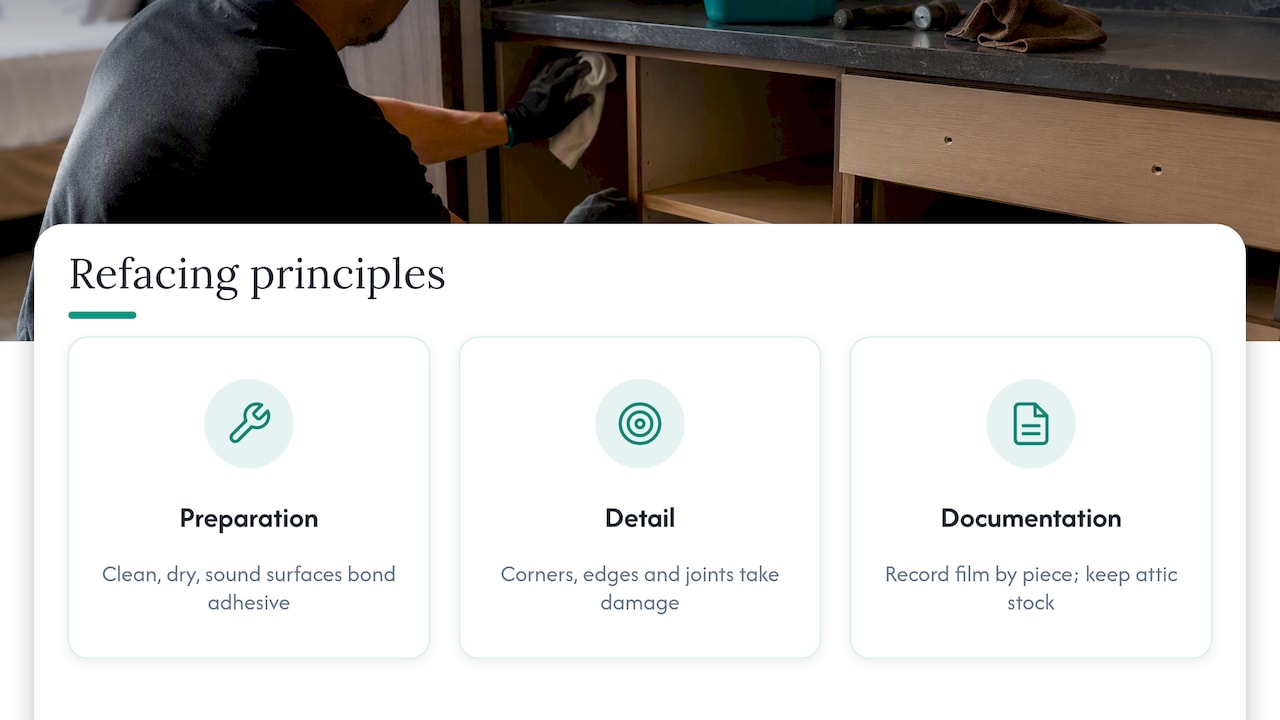
Documentation beats memory. Sustainability guidance from hospitality education points out that renovation decisions shape future material impact and landfill burden, and that refacing is strongest when it preserves sound furniture and comes with a plan for end of life. Record what film went on which piece, keep attic stock, and note how the pieces will be refinished or removed later. That is what turns a cosmetic upgrade into a responsible one. We go deeper in Refinish, Don’t Replace.
The design equivalent of a tailored garment is not a new wardrobe, it is a perfect fit on what you already own. That is what a well-specified refacing does for casework.
— Bodaq
How to specify a refacing project step by step
- Define the goal. Brand refresh, damage repair, or a new concept? The answer tells you how far to go on color and texture.
- Survey and sort. Tag every piece as reface, repair, or replace.
- Shortlist finishes. Pick three to five patterns that fit the brand palette. Request samples rather than judging from screens, since grain depth and sheen change in guestroom lighting.
- Test against your chemicals. Follow the sample protocol above.
- Pilot rooms. Reface two or three rooms and observe for several weeks.
- Lock the spec. Record pattern codes, installer requirements, edge details and cleaning instructions.
- Schedule by floor. Plan room-out windows with revenue management, not around them.
- Inspect and document. Punch list each room, photograph it, and file the attic stock location.
Ready to test film on your casework?
If you manage or renovate a hotel, the quickest way to judge film is to hold it. Browse the full Bodaq interior film collections, download the PDF catalog, and request samples from the Bodaq US site to run on a spare drawer front with your own cleaning products. Dealers and installers can also ask about training and tool kits, so your crew or contractor arrives ready.
FAQ
Is refacing hotel casework cheaper than replacing it?
Usually yes when the structure is sound, because you are not buying, shipping, installing and disposing of new pieces. Exact savings depend on piece count, condition and labor in your market, so get a pilot-room quote and compare it with a replacement quote for the same rooms. We do not publish film prices, so request a quote for your project.
How long are rooms out of service during refacing?
It depends on the scope and the crew size. Film is applied dry and does not need a cure period, which shortens the window compared with methods that involve coatings or shop work. Confirm timing on your pilot rooms and plan the floor schedule from what you measure.
Will a film finish stand up to hotel cleaning products?
It should be tested rather than assumed. Ask housekeeping for the real products and dwell times, check them against the manufacturer’s technical bulletins, and run a sample test on a mock-up before you order for a whole floor.
Can every piece of casework be refaced?
No. Pieces with swollen substrate, failed joints or damaged structure should be repaired or replaced first. Refacing works best on rigid, dry and clean surfaces where the problem is appearance.
Does refacing help with sustainability goals?
It can, because it keeps sound furniture in service and avoids the waste of wholesale replacement. Research on interior reuse shows meaningful embodied-carbon reductions in its scenarios, but results vary by project, so document what you keep and what you discard.
Sources
- Optimizing Performance and Design for the Hospitality Industry, I+S Design
- FF&E specification for hospitality projects, DataDrivenAEC
- UCLA and UCSD’s Surplus Programs and Interior Reuse, University of California
- Sustainable Innovations and Low-Impact Hotel Strategies, EHL Hospitality Insights
- Technical Bulletin 133, California Bureau of Home Furnishings and Thermal Insulation