Architectural Film Basics9 min read
Non-Yellowing White Film: How to Choose One That Stays White
What makes a white architectural film turn yellow, which materials resist it, and how to specify and care for a white interior film that keeps its color.

A white film that yellows within a few years is a failed finish. The fix is made at specification, not during cleaning: whiteness is decided by the pigment, the stabilizers and the resin the film is built on, and by how much light, heat and cleaning chemistry it meets once installed. If you are refinishing walls, doors, millwork or furniture in white, choose the film for those conditions first, then choose the shade. Bodaq’s white solid colors, including Pure White and Luminous White, are the place to start for interior surfaces.
TL;DR
- Yellowing is a chemical change inside or on the film. Once it happens, cleaning will not bring the white back, so material selection matters more than maintenance.
- The main drivers are UV light, heat, oxygen, moisture, contaminants and harsh cleaners. White shows even slight change first.
- Documented weathering data is the best predictor of whiteness. The best-documented white films use titanium dioxide pigment and a UV-stable fluoropolymer or a comparably stable construction.
- Good installation protects the finish: clean substrate, correct temperature, firm edges and a full adhesion period.
- For interior refinishing, Bodaq offers white solid colors and an Easy Clean collection that suit walls, doors and furniture.
Table of Contents
- Why white films yellow in the first place
- What a genuinely stable white looks like
- Matching the white to the space
- Installation decides how the white ages
- Keeping white film white
- Perspective
- Bodaq whites for interior projects
- FAQ
- Sources
Why white films yellow in the first place
Yellowing happens when chromophores, molecular structures that absorb blue-violet light, form or accumulate in or on the film. When blue light is absorbed, what the eye reads as white shifts toward yellow. Coating chemistry research lists light, heat, oxygen, moisture, contaminants and side reactions during curing as contributors, and notes that white and clear systems are the most sensitive because even a small amount of chromophore is visible.
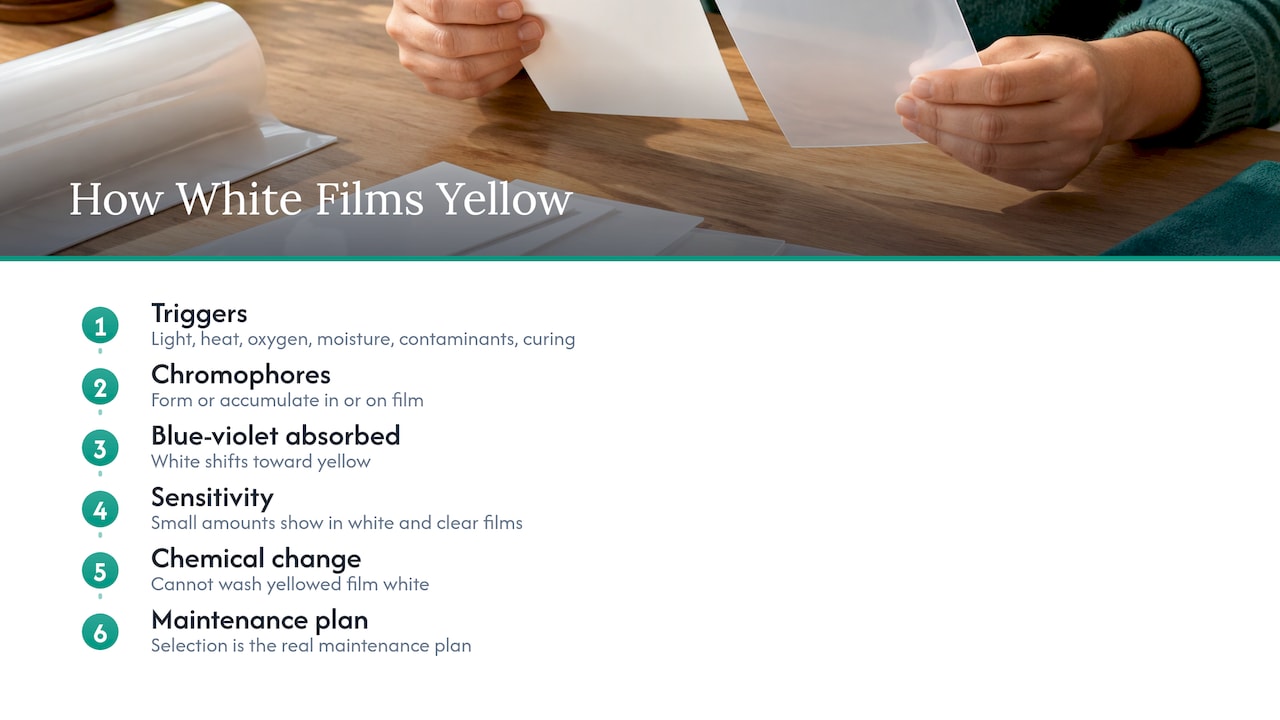
The same source makes the point that matters most for a specifier: when the color change is chemical and sits inside the film, cleaning or removing the light source does not reverse it. You cannot wash a yellowed film white again. That is why we treat selection as the real maintenance plan.
The usual culprits
- UV light. A coatings industry review names UV attack on aromatic resin structures as the most common cause of yellowing in protective coatings, and notes that even interior epoxy floors can yellow in sunlight through windows. Glass does not make a sunny wall safe.
- Heat. Heat speeds up the reactions above. Over-curing is described as the most frequent cause of yellowing in white powder coatings, according to a Los Angeles finishing shop. Think of south-facing glazing, radiators, and kitchen surfaces near ovens.
- Combustion gases. The same shop notes that nitrogen oxide gases from combustion can cause “gas yellowing,” which may be reversible if cleaned promptly. Gas appliances and fireplaces are the interior sources.
- Pigment and additives. White depends on titanium dioxide, which gives bright, opaque white at minimal thickness. Resins, flow agents and optical brighteners around it are what can shift color.
A note on coating defects: surface imperfections and additive behavior are part of how a finish performs over time, and a primer on coating defects and control shows how formulation choices show up in the finished surface.
What a genuinely stable white looks like
The most thoroughly documented benchmark for white film stability is polyvinyl fluoride, or PVF, sold as Tedlar. It is useful as a reference point for what “non-yellowing” means in numbers, whatever film you end up choosing.
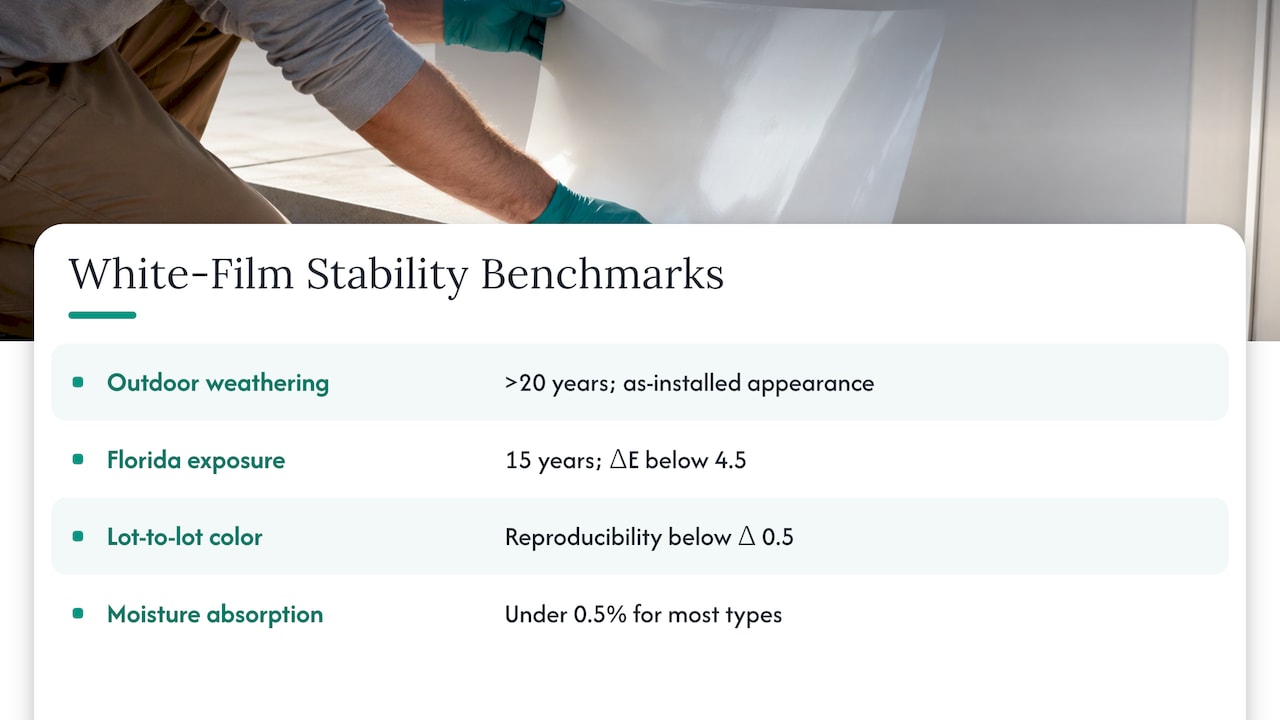
According to DuPont’s property data sheet, PVF is a homopolymer made without plasticizers, it does not substantially absorb visible or UV light, and it has more than 20 years of outdoor weathering with as-installed appearance on a variety of substrates. The same table rates white grades “Excellent” for cleanability and for South Florida weathering, with moisture absorption under 0.5% for most types.
The architectural brochure goes further. It reports that Tedlar passed a 15-year Florida exposure test with a color difference (ΔE) below 4.5, and controls lot-to-lot color reproducibility to a delta below 0.5. ΔE is simply a number for how far a color has moved: the lower it is, the closer to the original.
A second manufacturer’s whitepaper explains why this works. PVF top-finish film carries high-grade TiO2 pigment and stabilizers, reflects heat, and acts as a barrier against liquid modifiers migrating from the coated material below. Whiteness retention, in other words, is the product of UV blocking and barrier performance together. A PCI Magazine article adds that PVF’s carbon-fluorine bond is extremely stable and that its resin does not absorb UV light.
Treat these as the yardsticks, not as a promise about every film. They show the kind of evidence worth looking for in any white: pigment grade, stabilizer package, a named exposure test, and a stated color-change limit.
Matching the white to the space
Most interior jobs do not face Florida sun, but they do face a mix of light, heat and cleaning. The right white depends on which of those dominates.
| Space | Main yellowing risk | What to prioritize |
|---|---|---|
| Street-facing lobby or storefront interior | Direct sun through glazing | Highest UV stability, documented weathering |
| Hotel guest room walls and headboard surrounds | Frequent contact, cleaning chemicals | Cleanability, scrub resistance |
| Commercial kitchen or café back-of-house | Heat, grease, steam | Moisture and heat tolerance, easy cleaning |
| Bathrooms and wet-adjacent walls | Moisture, disinfectants | Edge sealing, moisture performance |
| Residential cabinets and doors | Light from windows, daily handling | Smooth, consistent white that wipes clean |
| Interior partitions, millwork, reception desks | Handling, cleaning | Durability in high-traffic areas |
For a deeper look at where films earn their place, our guide on matching film grade to substrate walks through the pairing of film and surface, and what lasts and what doesn’t covers durability expectations.
Which interior surfaces suit a white film
Bodaq’s stretchable, self-adhesive film is made for walls, furniture, doors and other surfaces in both residential and commercial spaces. White is most often requested for:
- Doors and frames that have been repainted too many times
- Built-in cabinetry and wardrobes
- Reception counters and service desks
- Feature walls and column wraps
- Elevator interiors and corridor walls in hospitality and office settings
If you want a broader view of the category first, what architectural film is and how to use it is a good primer.
Installation decides how the white ages
A stable white can still look poor if the film is installed badly. Edge lifts collect dirt, and dirt reads as yellowing even when the film itself is fine. Three points matter most.
- Prepare the surface. Dust, grease and loose paint create weak spots. Our five-step surface prep guide shows how to prevent edge lifts before the film goes on.
- Control temperature. For the architectural PVC film in DuPont’s brochure, the substrate and room should be between 60 and 82 °F (15 to 38 °C), and edges are secured by heating to 150 °F (70 °C) and re-squeegeeing. Use the same discipline on any film, and follow the maker’s own instructions.
- Allow adhesion to build. The same brochure puts final adhesion at 24 to 48 hours. Avoid heavy cleaning or contact in that window.
Bodaq film is stretchable and uses an air-channeled adhesive, which is designed to make installation cleaner and simpler, including around curves and profiles where seams and trapped air would otherwise show up in a white finish. White is unforgiving of bubbles and seams, so that matters.
If the wall is moisture-prone, see our 48-hour adhesion test for moisture-resistant wall finishes before specifying.
Keeping white film white
Cleaning will not reverse chemical yellowing, but the wrong cleaning can cause damage that looks like it. Harsh solvents, abrasive pads and strong disinfectants can dull the surface and leave it holding soil. A sensible routine for any white interior film:
- Wipe with warm water and a mild detergent using a soft cloth.
- Skip acetone and abrasive pads.
- Clean spills, grease and cooking residue promptly rather than letting them bake in.
- Keep combustion appliances ventilated, since NOx gases can leave a film of discoloration if left on the surface.
Our full guide to cleaning and maintaining architectural film covers products and frequency in more detail.
Perspective
We hear the same worry from designers and property managers: a white finish looks perfect on handover day, but will it still look that way after three summers and a few hundred wipe-downs?
Our answer starts with the fact that white never forgives a poor choice. Because yellowing is a chemical change, you cannot clean your way out of it. So the decision that counts is the one you make before the roll is cut: a film with a reliable white, a durable surface and a construction suited to the room.
That is how we approach our whites. Bodaq is a premium architectural interior film from Hyundai L&C, made for high-traffic commercial and residential spaces and backed by certified durability. Its stretchable, self-adhesive construction with air channels is designed so installers get a clean finish without the dust, odor and downtime of repainting or replacing surfaces. Hospitality teams can refinish a room or corridor quickly. Homeowners can refresh a dated door or cabinet without a full replacement. Architects get one material that works across walls, furniture and millwork, so the white stays consistent from one surface to the next.
Choose the white for the light and the cleaning it will face, install it with care, and treat it gently. That is how a white interior stays crisp.
Bodaq
Bodaq whites for interior projects
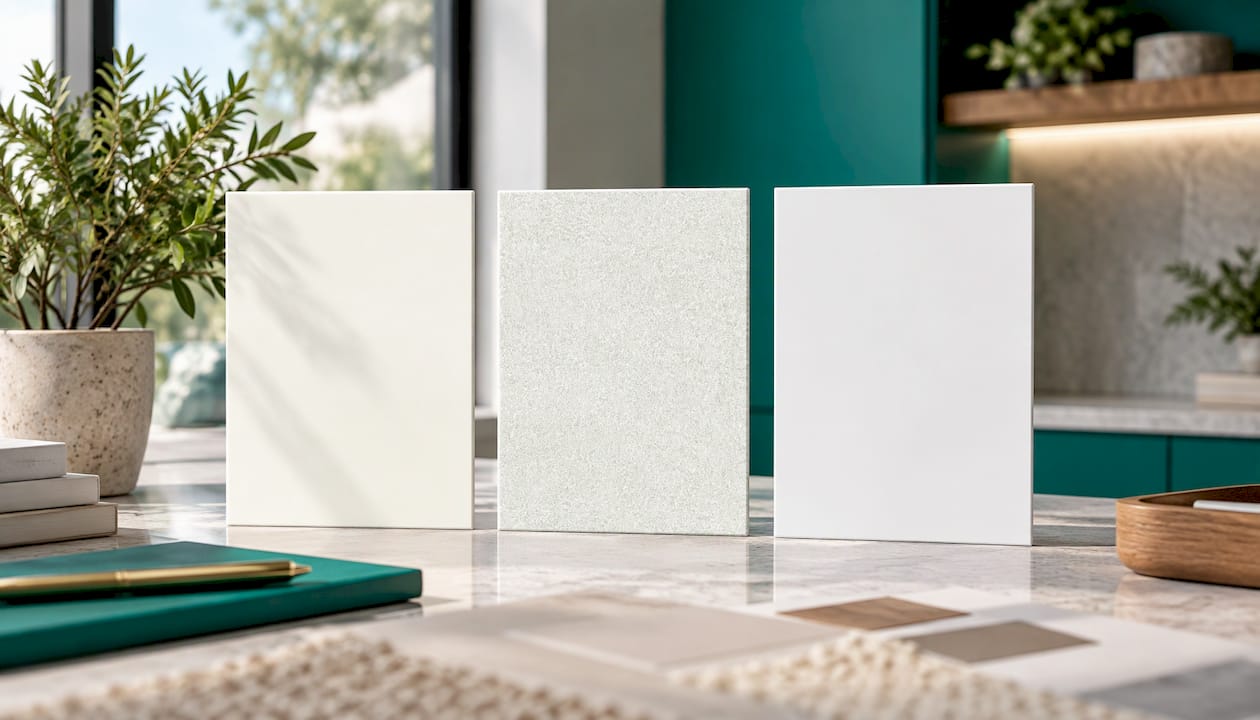
Our solid color range includes several whites for different looks and uses. Pure White (BLC05) is a premium collection shade, Luminous White (S255) is a bright white from the solid color collection, and the Easy Clean high-performance collection (ECF01) is made for surfaces that get wiped often. You can browse the wider solid color range or request samples to see the whites next to your lighting and existing finishes.
If your project is ready to move, start at Bodaq Interior Film for the full catalog of more than 450 textures and colors, tools and samples.
FAQ
Does white architectural film turn yellow?
Any white material can yellow if it is exposed to enough UV, heat or chemical attack, and white shows the change first. The risk depends on the film’s pigment, stabilizers and resin, and on where it is installed. Specify the white for its exposure and follow the care routine above.
Can you clean yellowed film white again?
Not when the change is chemical and inside the film, which is the usual case. Surface soil and gas deposits can sometimes be cleaned off if caught early, but true chromophore yellowing stays. That is why choosing a stable white at the start matters more than cleaning later.
Is sunlight through windows enough to cause yellowing?
Yes. UV passing through glass can still affect light colors and resins, and even interior epoxy floors have been reported to yellow from window sunlight. For south- or west-facing walls and storefront interiors, give UV stability more weight when you choose the white.
What should I clean white film with?
Warm water and a mild detergent on a soft cloth. Avoid acetone, abrasive pads and strong chemicals, which can dull the surface. Our cleaning guide has the details.
Sources
- Mechanisms and Control of Coating Yellowing, Aladdin Scientific
- Yellowing & Discoloration, Coatingpedia
- Powder Coating Yellowing Causes and Prevention, Sundial Powder Coating
- General Properties of Tedlar PVF Films, DuPont
- Long-lasting protection for architectural applications, DuPont Tedlar
- Architectural Top-Finishes whitepaper, Seaman Corporation
- PVF Technology, PCI Magazine reprint
- Microfoam in Coatings: Causes, Defects and Control