
A scratch resistant wall finish is a surface system, such as a high-wear laminate, an architectural film, or a high-performance topcoat, engineered to resist surface abrasion from daily contact. For most residential and commercial projects, durable laminates, self-adhesive architectural films, and high-performance coatings deliver the best balance of toughness and look. Before you commit to any option, check the product sheet for ASTM D3363 pencil-hardness data and adhesion test results, since those measurements tell you more than any marketing claim.
TL;DR:
- ASTM D3363 reports scratch and gouge hardness separately, so compare both values; a finish rated 2H for scratches but HB for gouges can still dent.
- Choose rigid panels or high performance coatings for corridors facing carts and repeated traffic; laminates or films suit kitchens when paired with waterproof backing.
- Before buying, verify primer and substrate requirements, warranty limits, and sheen; matte or textured finishes hide scuffs better than high gloss surfaces.
- For occupied refinishing projects, films can finish in a day or two with little dust or odor, while coatings need preparation and curing.
Table of Contents
- What scratch resistance means (and how it differs from gouge resistance)
- Laminates, films, rigid panels, and coatings compared
- Why scratch resistance pays off beyond the obvious
- Where to use each finish: a room-by-room guide
- How to choose: a practical checklist before you buy
- Keeping your finish scratch resistant for years
- Bodaq film and primer: where they fit in your project
- Scratch resistant finishes versus impact and abrasion resistant systems
- VOCs, recyclability, and other health considerations
- Professional installation versus DIY: what affects performance
- Common problems that shorten a finish’s life
- The real tradeoff: film and laminate versus paint
- See the finish before you commit
- FAQ
- Sources
What scratch resistance means (and how it differs from gouge resistance)
Scratch resistance describes how well a surface resists rupture when something drags across it, like a key, a zipper pull, or a pet’s claw. Gouge resistance is a different measurement: it describes how much force it takes to cut all the way through the finish down to the substrate. A finish can score well on one and poorly on the other, which is why both numbers matter when you are comparing data sheets.
The most common way manufacturers quantify this is ASTM D3363 pencil-hardness testing, which uses graded pencil leads from 6B (softest) to 6H (hardest) to find the point where a surface fails. Testing standards distinguish the two outcomes precisely: scratch hardness is the hardest pencil that does not rupture the surface, while gouge hardness is the hardest pencil that does not cut through to the substrate. A coating rated 2H for scratch but only HB for gouge will shrug off light abrasion yet dent under a sharp impact, so the right number depends on what your wall actually faces.
Laminates, films, rigid panels, and coatings compared
Each finish family handles scratch resistance differently, and the differences show up in cost, installation time, and how the surface ages.
Decorative laminates build their durability into a wear layer bonded over a printed design layer, which is what actually resists abrasion. The thicker and harder that wear layer, the longer the pattern underneath stays visible and sharp.
Architectural self-adhesive films work differently: a stretchable, pressure-sensitive vinyl layer bonds directly to a primed substrate, so performance depends heavily on adhesion quality and surface prep rather than thickness alone. Rigid panels, including SPC and PVC systems, trade some of that flexibility for impact resistance, making them a common choice where walls take hard knocks rather than light scuffs. High-performance coatings like epoxy and polyurethane topcoats sit at the harder end of the pencil scale and suit surfaces that need a seamless, wipeable finish without seams or panel joints.
- Laminates: moderate to high durability, moderate cost, wide pattern range, straightforward installation over flat substrates.
- Architectural films: high scratch resistance when properly primed, low installation waste, fast turnaround for refinish projects.
- Rigid panels (SPC/PVC): strong impact resistance, higher material cost, more involved installation with trim and seams.
- Epoxy/polyurethane coatings: high pencil hardness, seamless finish, but require cure time and surface preparation before use.
Why scratch resistance pays off beyond the obvious
A finish that resists scratching also tends to resist the broader wear that shortens a wall’s useful life, so the benefit extends well past avoiding visible marks.
- Longer service life: a harder wear layer delays the point where a wall needs refinishing or replacement, lowering the total cost over time.
- Easier cleaning: scratch-resistant surfaces typically resist staining too, since an intact surface layer blocks spills from soaking in.
- Better performance in wet zones: many scratch-resistant films and panels pair that hardness with moisture resistance, which matters in kitchens and bathrooms.
- Appearance retention: a surface that does not scuff easily keeps its color and sheen consistent, so the wall looks new for longer instead of showing patchy wear.
Where to use each finish: a room-by-room guide
Matching the finish to the task saves money and frustration, since the toughest option is not always the most practical one for every wall.
- Kitchen cabinetry and backsplashes: a laminate or film over a waterproof core resists both scratches from utensils and splashes from cooking.
- Bathrooms and wet areas: waterproof panels or moisture-rated films and coatings handle humidity and splashing without lifting or warping.
- High-traffic corridors and lobbies: rigid panels or high-performance coatings stand up to carts, luggage, and constant foot traffic better than lighter finishes.
- Furniture, doors, and trim: films work well for refinishing existing pieces without replacement, while paint suits projects where a fully custom color is the priority.
How to choose: a practical checklist before you buy
A few minutes spent reading a data sheet can prevent a finish choice you will regret in a year.
- Check pencil hardness and wear-layer thickness: look for an ASTM D3363 reference and compare the scratch and gouge values side by side.
- Confirm adhesion requirements: verify what primer or substrate prep the manufacturer recommends, since skipping this step is the most common cause of early failure.
- Read the warranty scope: understand what is and is not covered, including whether normal wear voids any claim.
- Match sheen to scratch visibility: high-gloss finishes show scratches more readily than matte or textured surfaces, so busy areas often do better with a lower sheen.
- Weigh upfront cost against replacement cost: a slightly pricier finish that lasts twice as long often costs less over the life of the wall.
Pro Tip: Ask for the product’s pencil-hardness rating in writing before you order, not just a general “scratch resistant” claim on the packaging.
Keeping your finish scratch resistant for years
Routine care matters as much as the initial material choice, since even a hard-wearing surface can be undone by the wrong cleaning habits.
- Clean with mild, pH-neutral solutions: avoid abrasive pads or harsh solvents, which can dull a finish faster than daily use would.
- Spot-treat scratches early: touch-up pens work for laminates, light polishing can help some coatings, and small film patches can address isolated damage on architectural film. Our cleaning and maintenance guidance covers the specifics for film surfaces.
- Call a professional for structural damage: gouges that reach the substrate usually need a trained installer rather than a DIY fix.
- Keep your records: hold onto product data sheets and warranty documents, since they make future repairs or claims far easier to resolve.
Bodaq film and primer: where they fit in your project
Our architectural film stretches and self-adheres, allowing it to wrap corners and curves that rigid materials cannot handle, and is available in a wide range of textures and colors so a refinish project is not limited to a handful of looks. The film has passed a 48-hour adhesion test and carries moisture-resistant properties suited to kitchens and bathrooms.
- Rustic Stone, High-Performance Collection EXF52: a textured stone look suited to accent walls and surfaces that need warmth without the weight of real stone.
- Easy Clean, High-Performance Collection ECF01: a solid-color film built for wipeable, high-traffic surfaces where stains and scuffs are a daily concern.
- Bodaq Water-Based Primer (3 KG): the substrate prep step that supports the adhesion our film depends on, recommended ahead of installation on most interior surfaces.
Film suits refinish projects where downtime and waste are the priority, while a high-performance coating may fit new construction better when a seamless painted look is the goal.
Scratch resistant finishes versus impact and abrasion resistant systems
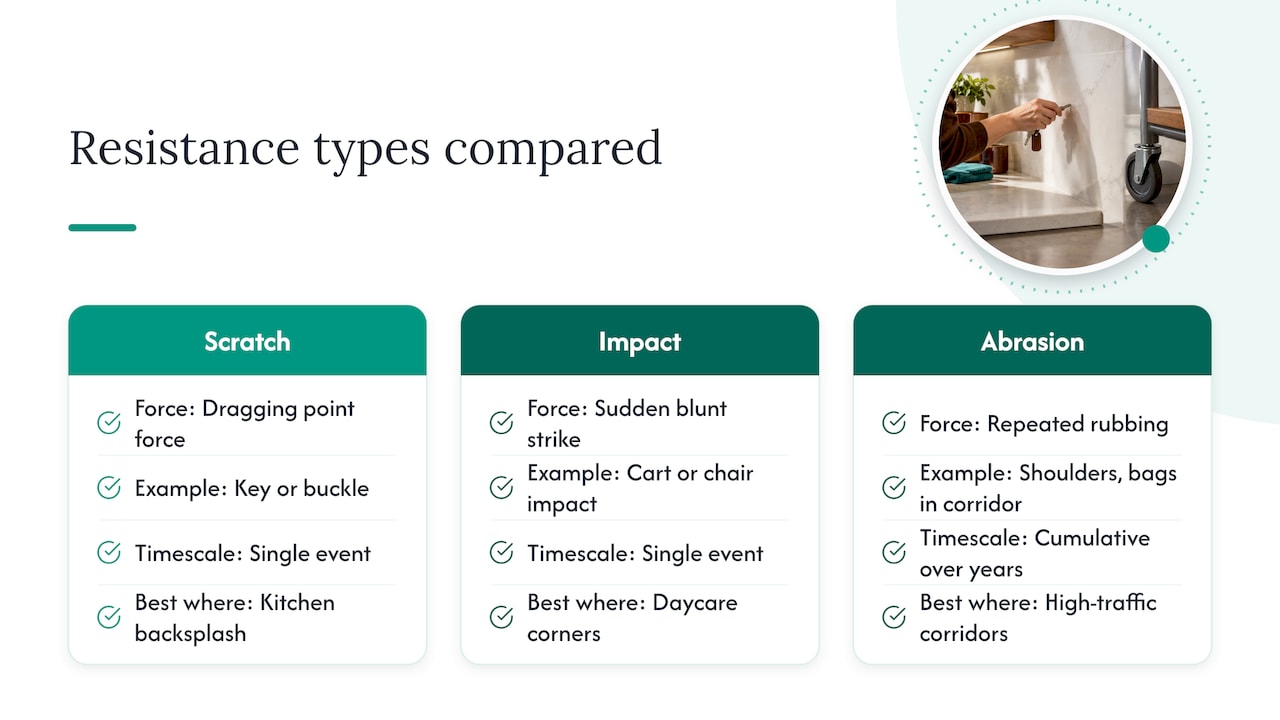
Scratch resistance, impact resistance, and abrasion resistance sound similar but measure different kinds of stress, and a finish built for one does not automatically perform at the other.
Scratch resistance, as ASTM D3363 pencil-hardness testing measures it, concerns surface rupture from a dragging point of contact, like a key or a buckle. Impact resistance concerns a different force entirely: a sudden blunt strike, such as a cart bumping into a wall or a chair backing into a corner. A finish can carry a high pencil-hardness rating for scratch resistance and still crack or dent under impact if it lacks flexibility or backing support. Rigid panels tend to perform better against impact because the panel itself absorbs and spreads the force, while a thin film or coating depends more on the substrate underneath it.
Abrasion resistance, meanwhile, describes how a surface holds up under repeated rubbing over time rather than a single scratch or strike, which is a slower, cumulative kind of wear. A corridor wall brushed by passing shoulders and bags for years needs strong abrasion resistance even if it rarely faces a sharp scratch or a hard impact. This is why a specifier should ask what risk a wall actually faces before choosing a finish: a daycare hallway needs impact and abrasion resistance more than scratch hardness, while a kitchen backsplash near a knife block needs the opposite priority. Practitioner guidance on pencil hardness also notes that higher hardness can trade off against brittleness under thermal cycling, so the hardest-rated option is not always the toughest one in practice.
VOCs, recyclability, and other health considerations
Indoor air quality and material sourcing matter alongside durability when you are choosing a wall finish, especially for spaces where people spend extended time.
Liquid-applied coatings, including many epoxy and polyurethane systems, release volatile organic compounds during application and curing, and agency product-specification documents compiling acrylic and polyurethane wall coatings reflect how varied these formulations and their performance categories can be. Proper ventilation during and after application reduces exposure, and low-VOC formulations are worth asking about directly rather than assuming from a product name alone.
Self-adhesive films and rigid panels generally avoid the wet-application VOC concern since they install dry, though adhesives and primers used alongside them can still carry their own emissions profile worth checking on the data sheet. Recyclability varies widely by material: PVC-based products have a more complex end-of-life path than some laminate substrates, so if that matters for your project, ask the manufacturer directly rather than assuming. Eco-friendly certifications, where a manufacturer holds them, are worth confirming against the specific product line you are buying rather than the brand in general, since certifications do not always extend to every item in a catalog.
Professional installation versus DIY: what affects performance
How a finish gets installed affects its scratch resistance almost as much as the material itself, since even the hardest-rated surface fails early if it is applied poorly.
Professional installation tends to matter most for substrate preparation, which is the step most likely to be rushed in a DIY job. A professional installer will typically clean, degrease, and sometimes sand a substrate before applying primer, and will account for temperature and humidity conditions that affect cure and adhesion. For architectural film specifically, a trained installer also knows how to handle stretch and seams around corners, outlets, and trim without introducing air pockets that weaken adhesion over time, a skill set reflected in our architectural film use guidance on matching film grade to substrate.
DIY installation can work well for smaller, lower-risk projects, like an accent wall or a single piece of furniture, where mistakes are easier to correct and the stakes are lower. The tradeoff is time and risk: skipping or rushing primer application is one of the most common reasons a scratch-resistant film or coating underperforms its rated hardness. If you are installing in a high-traffic or commercial space, the labor cost of a professional installer is usually worth it, since a failed adhesion job often costs more to fix than it would have cost to do right the first time. For doors and trim specifically, it is also worth weighing refinishing against replacement, and guidance on interior door materials can help frame that comparison for larger renovation projects.
Common problems that shorten a finish’s life
Most scratch-resistant finishes fail early for a handful of predictable reasons, and knowing them ahead of time helps you avoid an expensive repeat job.
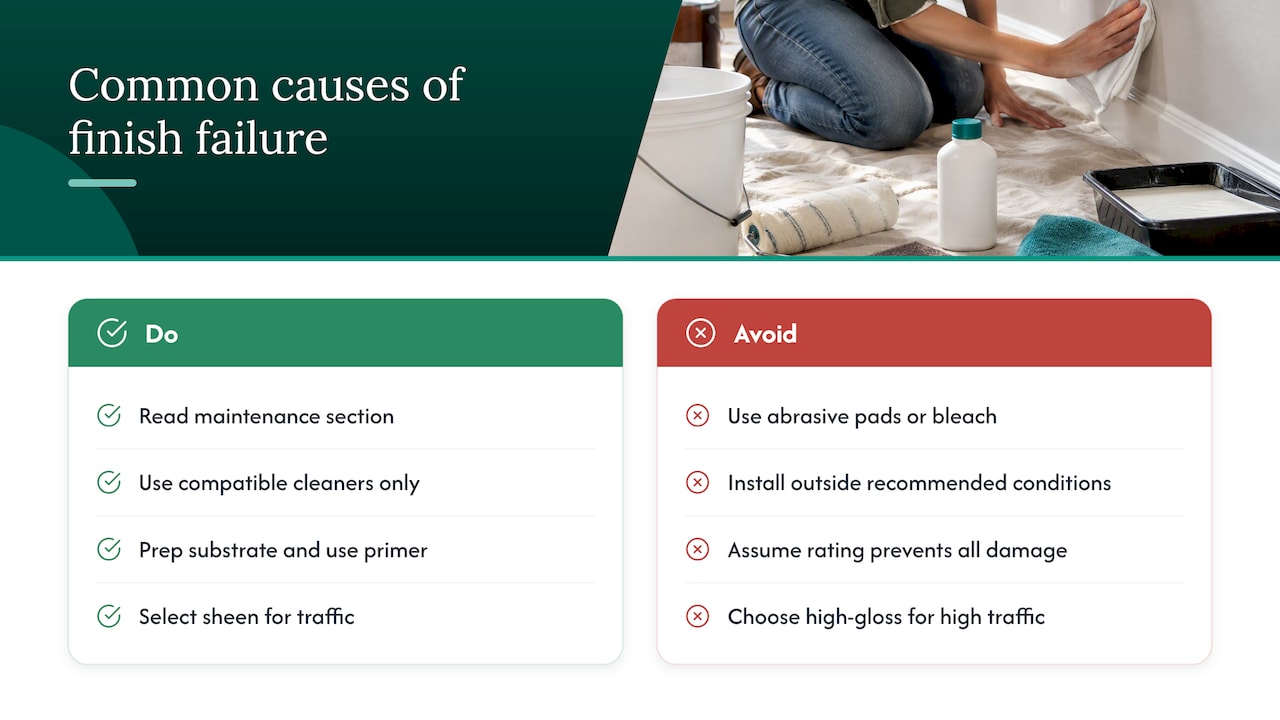
Degradation over time is the most common complaint, often from UV exposure fading a film or coating faster than expected, or from repeated cleaning gradually dulling a surface that was not rated for harsh chemicals. Incompatibility with cleaning products is a close second: abrasive pads, bleach-based cleaners, or ammonia-based glass cleaners can strip the gloss or hardness off a finish that was never designed to handle them, even when the base material itself is rated for scratch resistance. Reading the maintenance section of a product’s data sheet before choosing a cleaning routine prevents most of this damage.
Poor adhesion is another frequent pitfall, usually traced back to inadequate primer, a contaminated substrate, or installation in conditions outside the recommended temperature and humidity range. This shows up months later as lifting edges or bubbling, which is harder and more expensive to fix than it would have been to prevent. A mismatch between sheen and use case causes complaints too: a high-gloss finish in a high-traffic hallway will show every scuff mark clearly, even if the underlying material has a strong pencil-hardness rating, simply because gloss highlights surface texture changes that a matte finish would hide. Finally, treating a scratch-resistant rating as a guarantee against all damage leads to disappointment: these finishes reduce and delay wear, they do not eliminate it, and setting that expectation early avoids frustration later.
The real tradeoff: film and laminate versus paint
Film and laminate win on disruption: a refinish project wraps up in a day or two with little dust or odor, which matters for occupied homes and businesses that cannot close for a repaint. Paint still wins on bespoke color matching and unlimited custom texture, though it typically demands more frequent touch-ups in high-contact areas. The honest comparison is not which looks better on day one, but which costs less in labor, waste, and repeat maintenance over five years.
— Bodaq
See the finish before you commit
We know a photo on a screen is not the same as seeing a texture under your own lighting, which is why we make it easy to request samples before you order anything in bulk. If you are specifying for a refinish project, our Rustic Stone EXF52 and Easy Clean ECF01 pages show the full texture range and technical specifications side by side.
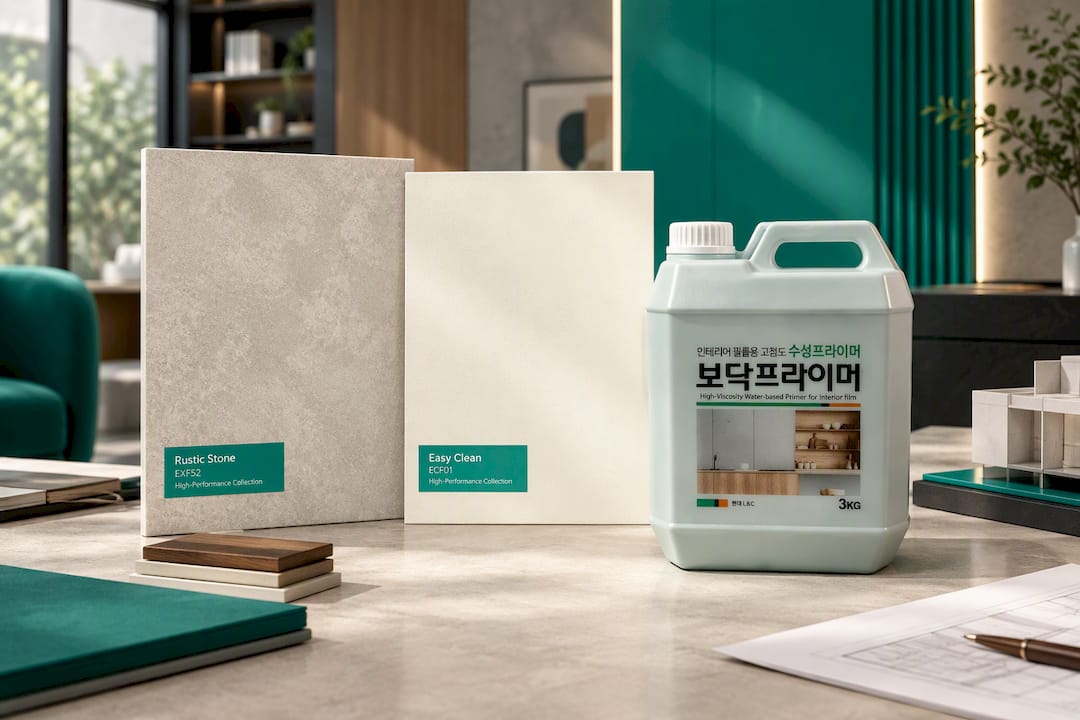
If you are prepping a substrate yourself or briefing an installer, the water-based primer is worth reviewing alongside the adhesion and maintenance documentation before you place an order, so the finish performs the way its data sheet promises.
FAQ
What is the best scratch-resistant paint for walls?
Among coatings, polyurethane topcoats generally test harder on the ASTM D3363 pencil-hardness scale than standard epoxy primers, typically falling in the H to 4H range versus HB to 2H for epoxies. The right choice still depends on your substrate and expected wear, so check the specific product’s data sheet rather than relying on the coating type alone.
What’s the difference between scratch proof and gouge resistant?
Scratch resistance measures a surface’s ability to resist rupture from a dragging point of contact, while gouge resistance measures resistance to a point cutting all the way through to the substrate. No finish is truly scratch proof, so treat the term as marketing shorthand and ask for the actual pencil-hardness rating instead.
What is the best scratch-resistant coating for wood?
Polyurethane topcoats are commonly specified for wood surfaces that need both scratch resistance and a durable seal, often scoring higher on pencil hardness than epoxy alternatives. For wood furniture or trim you want to refinish rather than recoat, a self-adhesive architectural film offers a scratch-resistant alternative without sanding or curing time.
How do I protect a wall from scratches?
Choosing a finish with a documented pencil-hardness rating and proper adhesion prep is the most reliable starting point, since poor substrate preparation undermines even a hard-rated surface. In high-traffic areas, pairing a durable finish with sensible cleaning habits, avoiding abrasive pads and harsh chemicals, extends its scratch resistance considerably further.
Sources
- ASTM D3363 Pencil Hardness Test Explained | Film Hardness by Pencil Method | QCSQCI
- ASTM D3363 coating film hardness (Infinita Lab description)
- AQMD project appendix (product-spec compilation)