
Architectural interior film can provide stain resistant surfaces for walls, doors, and furniture when specified to recognized cleanability standards and paired with the right maintenance plan. Ask for ASTM D4828 washability results and ASTM D3450 scrub data on submittals. Our film is a surface finish to consider when specifying cleanable surfaces.
TL;DR:
- Request ASTM D4828 washability and ASTM D3450 scrub results for the exact pattern and sheen, tested on the same substrate for valid comparisons.
- Require scratch data, moisture adhesion results after 48 hours, written warranty terms, and a certified installer; approve an installed mockup with the facility’s cleaner.
- Clean elevators daily and deep clean them weekly; clean high touch doors and furniture weekly, and feature walls monthly, using nonabrasive products on semigloss finishes.
- Choose paint for the lowest upfront cost, laminates or veneers for planned rebuilds, and film when occupied spaces need a fast refresh without panel replacement.
Table of Contents
- 1. What is stain resistant interior film, and where does it fit in a spec?
- 2. Which standards and test methods prove a surface is easy to clean?
- 3. What should you check before specifying stain resistant film?
- 4. How do you clean and maintain stain resistant film?
- 5. How does film compare with paint, laminates, and veneers?
- 6. How long do stain resistant films last, and what does a warranty cover?
- 7. Is stain resistant film a sustainable choice?
- 8. A spec writer’s view: when film is the right call
- 9. Which of our films suit stain resistant specs?
- FAQ
- Sources
1. What is stain resistant interior film, and where does it fit in a spec?
Interior film is a self-adhesive, stretchable surface finish applied over an existing substrate. Instead of tearing out a wall, door, or casework face, you refinish it in place. That is why film is so often chosen for occupied renovations and fast-turn tenant fits, where demolition, dust, and downtime cost more than the finish itself. To be clear, this guide covers interior film only, not countertop materials.
Stain resistance matters most where hands, carts, coffee, and cleaners meet the surface every day:
- Elevator interiors, where scuffs and spills build up daily
- High-touch door panels and push plates
- Office furniture faces and reception desks
- Casework in break rooms, clinics, and hospitality back-of-house
- Feature walls that must stay camera-ready
Performance on paper only carries over to the building if the details are right. Specify surface prep, substrate condition, edge treatment, and seam detailing, and require certified installers. A film applied over a dusty or failing substrate will not clean like the sample panel did. For a broader view of how film sits among wall treatments, see our overview of interior wall finishing materials.
2. Which standards and test methods prove a surface is easy to clean?
Marketing language about “stain proof” finishes tells you little. Test methods tell you a lot, and they give you a common yardstick across products.
ASTM D4828 is a practical washability method that measures how easily soil or stains come off interior coatings using household cleaners. Its real value for specifiers is comparison: it lets you judge ease of soil removal between products under the same procedure.
ASTM D3450 looks at the other half of the story: what scrubbing does to appearance. It measures the relative ease and completeness of removing a specific soilant by scrubbing, and it notes that semigloss finishes often need only nonabrasive cleaners while flat finishes may need abrasives.
Semigloss finishes generally need only nonabrasive cleaners, while flat finishes may require abrasive ones, according to ASTM D3450. Sheen level changes your cleaning protocol, so choose finish and maintenance plan together.
Two complementary signals round out a durable surface:
- Scratch resistance: ASTM D3363 references show whether a film survives cart bumps and keys. Our own ASTM D3363 scratch testing is summarized on a dedicated page.
- Adhesion under moisture: a 48-hour adhesion check shows whether edges hold when wiped repeatedly.
Require every test on the same substrate or sample panel. Results from different backings are not apples to apples.
3. What should you check before specifying stain resistant film?
Treat the submittal as the product. A tight checklist keeps vendors honest and saves you from surprises after installation.
- Intended surface and expected traffic level
- ASTM D4828 and D3450 results for the exact pattern and sheen
- Scratch or abrasion rating, such as ASTM D3363
- Adhesion and moisture data, including the 48-hour adhesion test
- Recommended cleaning methods and compatible cleaners
- Finish, sheen, and texture match to the design intent
- Available sample panels
- Certified installer availability
- Warranty and maintenance terms
Our 48-hour adhesion test page shows what that moisture evidence looks like. Sheen also drives how a surface looks after years of cleaning, a point echoed in this practical piece on the best sheen for interior doors.
Two adaptable spec snippets you can paste and edit:
- “Provide ASTM D4828 and ASTM D3450 test results for each specified film, performed on the same substrate, with submittal.”
- “Provide an installed mock-up on the project substrate by a manufacturer-certified installer for approval before full installation.”
Pro Tip: Approve the mock-up only after you have cleaned it yourself with the cleaner the facility team will actually use.
4. How do you clean and maintain stain resistant film?
Maintenance frequency should follow how the surface is used. As a working range, high-touch walls, doors, and office furniture benefit from weekly cleaning. Elevator interiors usually need a daily wipe-down plus a weekly deep clean. Low-traffic feature walls can be cleaned monthly.
For each cleaning, work in this order: dust with a soft dry cloth, apply a nonabrasive cleaner suited to the finish, rinse with clean water, and dry with a soft cloth. Test any new cleaner on a hidden area first. Prefer nonabrasive liquids for semigloss finishes, and avoid harsh abrasives on low-sheen surfaces, which follows the guidance in ASTM D3450. Our step-by-step page on how to clean and maintain architectural film goes deeper on products to avoid.
A schedule facility managers can post in the janitorial closet:
- Daily: wipe elevator interiors and the highest-touch surfaces.
- Weekly: targeted cleaning of doors, walls, and office furniture, plus a deep clean of elevator cabs.
- Monthly: deep inspection of seams, corners, and edges, with a cleaning pass on feature walls.
- Annually: compare an installed area against the original mock-up and note any change in sheen or edge adhesion.
Pro Tip: Keep a labeled spray bottle of the approved cleaner on each floor so crews never improvise with whatever is on the cart.
5. How does film compare with paint, laminates, and veneers?
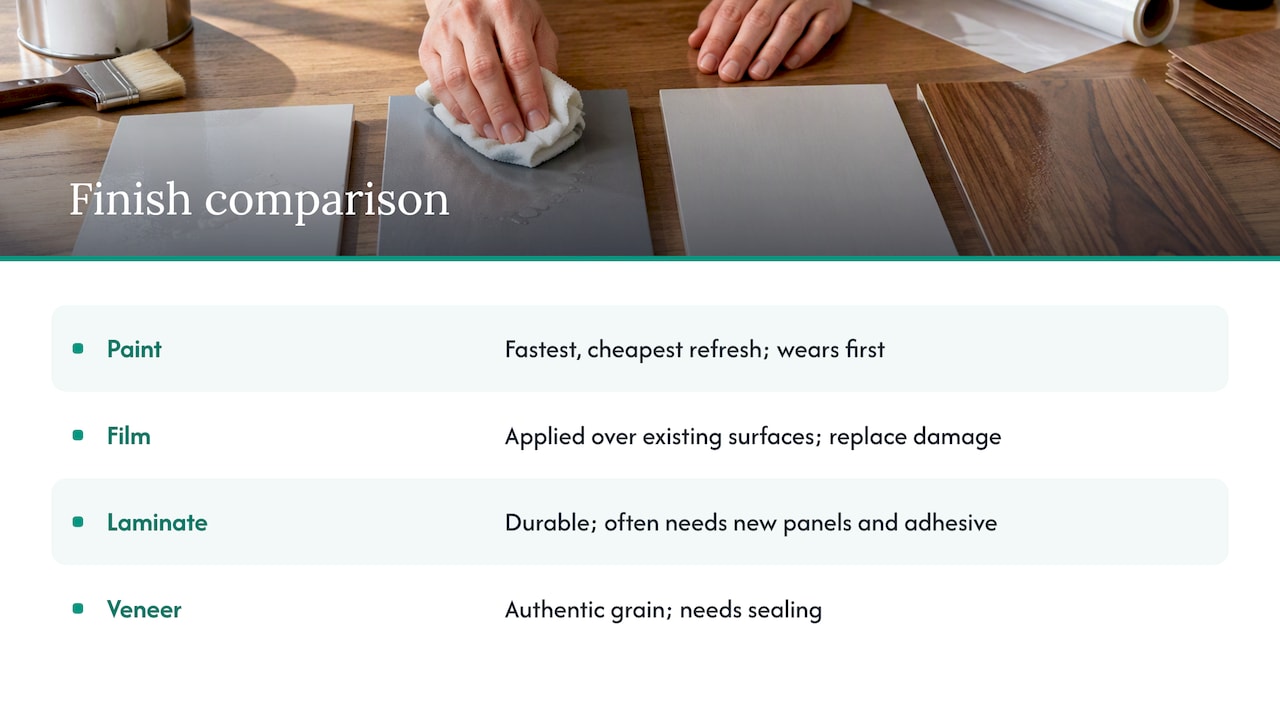
Paint is the fastest and cheapest refresh, but it is also the finish that wears first in a corridor. Touch-ups rarely match, and scrubbing can burnish the sheen, which is exactly the effect ASTM D3450 measures. Film brings a consistent factory-made surface, so a damaged panel is replaced rather than patched.
High-pressure laminates are durable and familiar, yet they usually mean new panels, new adhesive, and removal of the old surface. Seams and edges can chip, and changing the look later means starting over. Film is applied over existing substrates, so a design refresh does not require a rebuild.
Veneers bring authentic grain but need sealing, and they can be unforgiving to spills and aggressive cleaners. A wood-look film delivers the visual warmth with a surface made to be wiped down. The tradeoff is honest: real wood has a depth and repairability that film imitates rather than replicates.
For maintenance, the practical difference is predictability. Film cleans with nonabrasive products on a schedule you can write into a facilities manual, while paint and veneer often demand gentler, more specialized care. Durability follows the same logic. Pair film with scratch data such as our ASTM D3363 scratch resistant finish results and you have evidence rather than adjectives. In short, choose paint for the lowest first cost, laminate or veneer where a new build-out is already planned, and film where speed, variety, and cleanability drive the decision.
6. How long do stain resistant films last, and what does a warranty cover?
Longevity depends on three things you control: the substrate, the installer, and the cleaning routine. A film on a sound, properly prepared surface and maintained with compatible cleaners holds its look far longer than the same film on a flaking wall cleaned with abrasives.
Warranty terms vary by product line and application, so we do not quote a single universal number here. Ask for the written warranty with your datasheet and read three things closely: which applications are covered, whether coverage depends on certified installation, and which cleaners or conditions void it. Warranties that ignore the maintenance plan are worth less than they look.
Use the same evidence to forecast life in service. Moisture and adhesion data tell you whether edges will lift near sinks and in humid cabs. Scratch data tells you how a surface will age under carts and chair backs. Cleanability results tell you whether stains will stay in the surface or wipe away after repeated cleaning.
Elevator interiors are a good stress test, since they combine constant touch, luggage strikes, and daily cleaning. Our elevator interior upgrade page shows how film performs in that setting. For the annual review in your maintenance plan, photograph the mock-up area each year so any change in sheen or edge adhesion is visible and documented rather than remembered.
7. Is stain resistant film a sustainable choice?
Sustainability is easiest to judge by what you avoid. Refinishing in place means less demolition debris, fewer new boards or panels manufactured, and fewer truck trips. Stretchable film with air-channeled adhesive also trims installation waste, because panels are fitted to the surface instead of cut from large sheets of new material.
Durability is the other half of the equation. A surface that wipes clean with water and mild cleaner needs fewer harsh chemicals and fewer early replacements. A finish that must be repainted or replaced every few years carries its own recurring footprint in materials, labor, and disruption.
Our film adheres to eco-friendly standards, and you should still verify the specifics for your project. Ask for environmental certifications and emissions documentation alongside the cleanability submittals, and compare them with what paint, laminate, and veneer suppliers will provide. Be careful with blanket claims in any direction: a film is a plastic product, so end-of-life handling matters, and a fair comparison weighs the whole lifecycle rather than one attribute.
For occupied buildings there is a quieter benefit. Fewer fumes, less dust, and shorter work windows mean fewer complaints and fewer disrupted workdays. That is a human-scale sustainability gain that rarely shows up on a materials spreadsheet but matters to the people using the space.
8. A spec writer’s view: when film is the right call
We think film earns its place on the spec when time and appearance both matter. Occupied renovations, rapid refreshes, elevator interiors, and tenant fit-outs all share one trait: the building cannot afford a long shutdown, and the finish still has to look intentional. That is where film beats rebuilding.
The common mistake is writing “stain resistant” into a spec and stopping there. The word promises nothing. Require ASTM references on the submittal, ask for samples early, and make the certified installer a condition of the work. Those three lines decide whether the finish performs like the sample or like a gamble.
Keep the language short enough that contractors read it. One sentence naming the test methods, one sentence requiring a mock-up on the project substrate, and one sentence tying acceptance to the approved cleaner will do more than a page of adjectives. Copy the snippets above and adapt them to your project.
— Bodaq
9. Which of our films suit stain resistant specs?
We built our catalog so specifiers can name a product, not just a category. Our product families are a natural starting point.
Easy Clean ECF01 is formulated for easier cleanability and is our recommendation for high-touch doors, walls, and elevator interiors, where wipe-downs are constant.

Rustic Stone EXF52 brings a high-performance stone aesthetic with a durable finish, a strong fit for feature walls and casework where texture carries the design.
Steel Grey SL402 is a lightweight, durable patterned finish suited to furniture and interior elements.
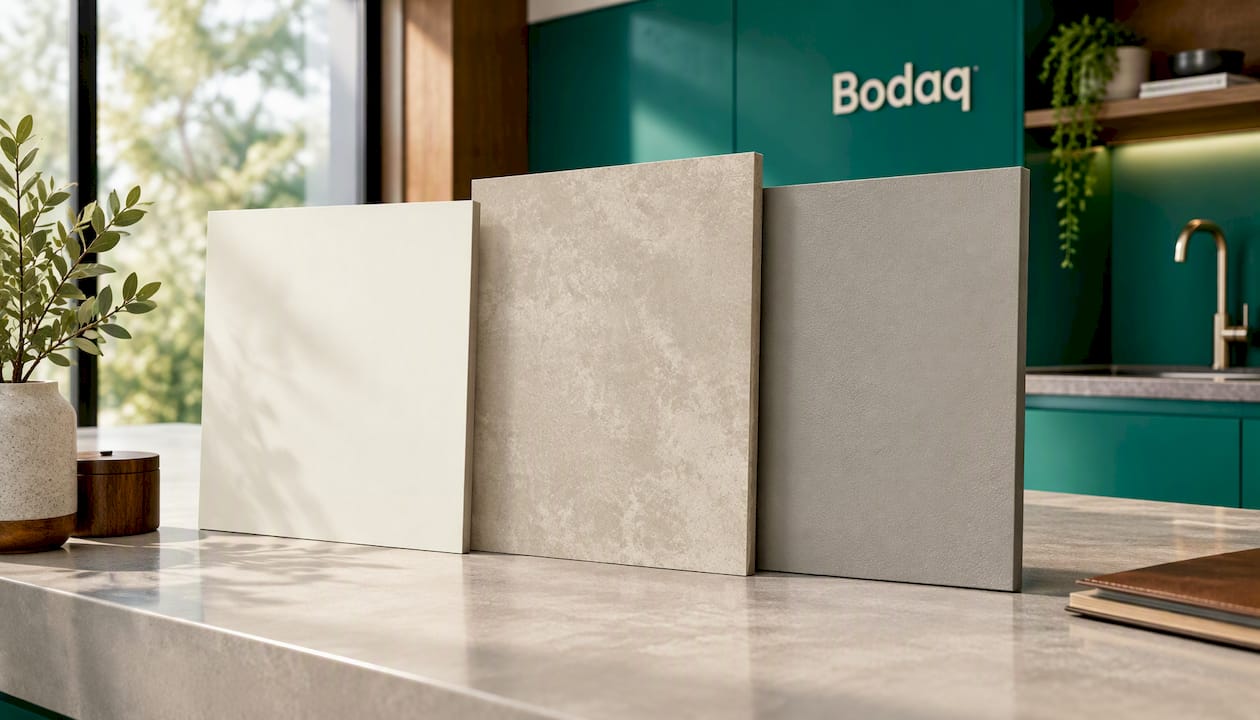
Behind these is a wide range of textures and colors across the Bodaq interior film collections, so a cleanable surface does not force a compromise on look. To move forward, request datasheets, test reports, and samples from our team through Bodaq, and ask us about installation support. Send us your surface, traffic level, and finish preference, and we can discuss the submittal package.
FAQ
Can interior film really resist stains on walls and doors?
Yes, when the film is specified to cleanability standards and maintained properly. ASTM D4828 lets you compare how easily soil comes off different surfaces, so request those results rather than relying on a “stain proof” label.
How often should stain resistant film be cleaned?
Frequency follows traffic. High-touch walls, doors, and office furniture suit weekly cleaning, elevator interiors need a daily wipe-down plus a weekly deep clean, and feature walls can wait a month between cleanings.
Which cleaner is safe for semigloss film finishes?
A nonabrasive liquid cleaner is the safe default. ASTM D3450 notes that semigloss finishes generally need only nonabrasive cleaners, and you should test any product on a hidden area first.
What should a specifier request on a submittal?
Ask for ASTM D4828 and D3450 results run on the same substrate, scratch resistance data, adhesion and moisture results, the written warranty, and a sample panel. Add an installed mock-up by a certified installer before full installation.