Adhesive cure time is the period an adhesive needs to reach its full, final strength. For most products that means anywhere from a few hours to several days, and the exact number depends on the adhesive chemistry, the temperature and humidity in the room, how thick the layer is and what you are bonding. A construction adhesive may feel solid in an hour and still need 24 to 48 hours before it carries a load. This guide walks through the vocabulary, the real figures from manufacturer data sheets, and the habits that keep your schedule honest.
TL;DR
- Cure is a chemical process that builds final strength. Drying and setting come earlier and do not mean the bond is ready for load.
- Published ranges are narrow only on paper: a 24 to 48 hour cure assumes a specific temperature and humidity, and your jobsite may differ.
- Warm, humid conditions speed up moisture-cure adhesives. Cold, dry air and thick layers slow them down.
- Read the technical data sheet for open time, set time, clamp time and full cure, then plan the next step around the last number.
- For interior film projects, surface prep and the right primer matter as much as waiting time.
Table of Contents
- What adhesive cure time actually means
- Cure time by adhesive type
- What speeds up or slows down cure
- How to read a technical data sheet
- Worked example: planning a 48 hour window
- Cure time and interior film: what changes
- Common mistakes that stretch (or shorten) the schedule
- Ready to plan a refinish?
- FAQ
- Sources
What adhesive cure time actually means
People use “dry,” “set” and “cure” as if they were the same word. They are three different events, and mixing them up is the most common reason a bond fails early.
Drying is the loss of water or solvent. According to Gluegun’s guide to curing methods, drying means liquid leaves the adhesive until it becomes solid, without the chemical change that happens during curing.
Setting is the point where the adhesive has developed enough mechanical strength to hold parts together without external support. Adezif’s overview of curing stages calls this fixture or set time. Permabond’s glossary adds a practical rule: once parts can no longer move independently, you still should not add extra load until the joint reaches working strength.
Curing is the chemical reaction, typically polymerization, that solidifies the adhesive and brings it to maximum strength, as Chemique Adhesives explains. The same source defines open time as the window after application when surfaces can still be brought together and bonded successfully.
Put those in order and you get a timeline most data sheets follow:
- Open time: you can still position the parts.
- Set or fixture time: the parts hold on their own.
- Handling or clamp time: you can remove clamps or move the work carefully.
- Full cure: the bond reaches its rated strength.
Final polymerization can take several hours to several days to reach maximum mechanical performance, and Kevos notes that full cure is often days at room temperature.
Cure time by adhesive type
There is no single number, but manufacturer data sheets give a useful sense of scale. The figures below come from U.S. product documents and apply only to the named product under the stated conditions.
| Adhesive type | Example product | Set or tack time | Full cure | Conditions |
|---|---|---|---|---|
| Polyurethane construction adhesive | LOCTITE PL Premium Max | 20 minute open time, 15 to 20 minute repositioning | 24 to 48 hours (24 hour clamping) | 78°F (25°C), 50% relative humidity |
| Polyurethane construction adhesive | QUIKRETE polyurethane adhesive | Not listed here | 5 to 8 days | Mechanical support may be needed until fully cured |
| Cyanoacrylate gel | LOCTITE Super Glue Gel Control | 15 to 30 seconds | 12 to 24 hours | Depends on temperature, humidity, porosity and amount |
| Spray adhesive | CRC Spray Adhesive | Tack-free in 10 to 30 seconds, fully dry in 1 hour | 24 hours | Listed curing time |
| Two-part epoxy | General range from Adezif | 15 minutes to 10 hours handling | About 24 hours to reach 90% of properties, about 36 hours for full polymerization | Varies by formulation |
The pattern is worth noticing. The fast number (seconds or minutes) describes when you can touch or position something. The slow number (hours or days) describes when the bond is actually finished.
Construction adhesive
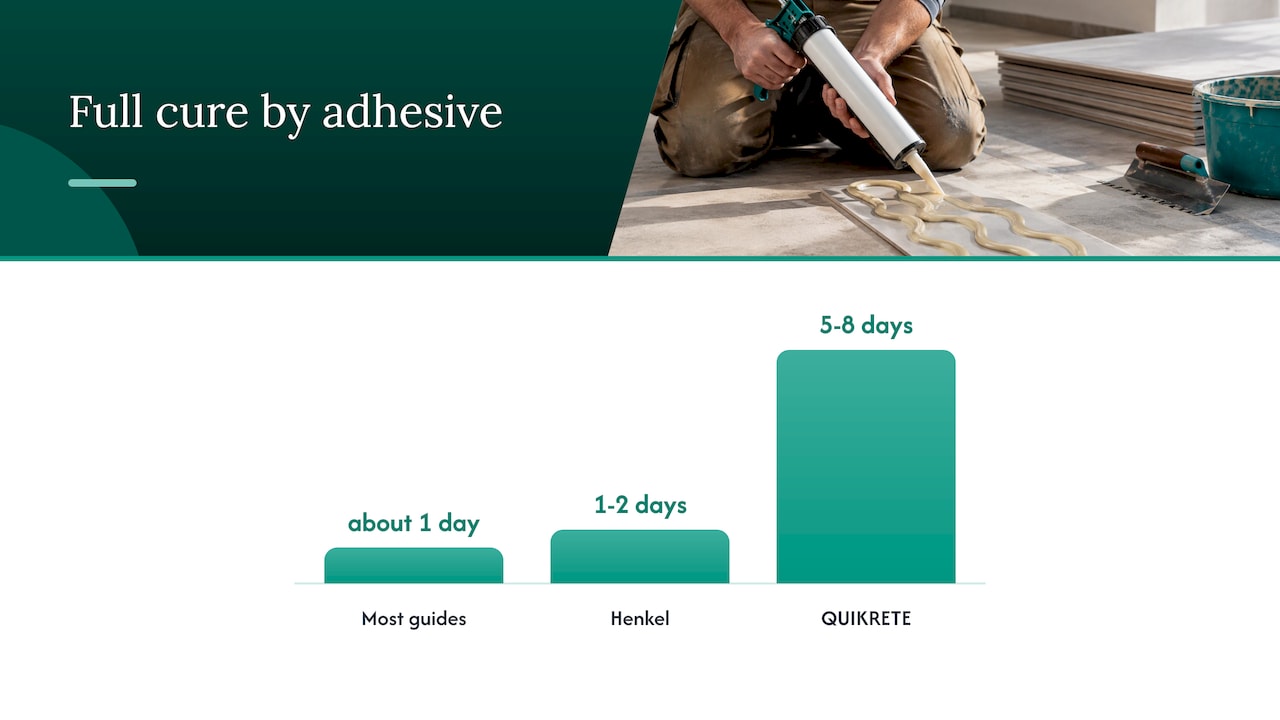
The top-ranking guides say most construction adhesives need about a day for full cure, with clamps removable far sooner. The data sheets back that up with a wider spread: the Henkel polyurethane product lists 24 to 48 hours, while the QUIKRETE polyurethane construction adhesive lists 5 to 8 days for full cure and notes that mechanical support may be needed until then. Two products in the same category, two very different schedules. That is exactly why you plan from the label in your hand rather than a general rule.
Spray adhesive
Spray adhesive is the clearest example of dry versus cure. CRC’s specification shows a product that is tack-free within seconds and fully dry in an hour, yet lists 24 hours for curing. Henkel’s spray glue guidance tells users to wait 2 to 3 minutes after spraying for tack and to leave the bond undisturbed overnight for full strength. SprayIdea makes the same point: permanent spray adhesives are handling-ready in minutes but generally need up to 24 hours for full cure.
Epoxy and acrylic
Two-part epoxy is more forgiving about time but strict about mixing. As a general range, handling time runs from 15 minutes to 10 hours, with about 24 hours to reach 90% of properties and about 36 hours for full polymerization, according to Adezif. Structural acrylics behave similarly: in a cold workshop, a heat lamp can speed cure, but the assembly should not be moved during the fixture period, as one industrial guide advises.
What speeds up or slows down cure
Four variables explain most surprises on a jobsite.
Temperature
Heat accelerates chemical reactions. Sika’s guidance for one-component products says high temperatures and humidity make the products react faster, while low temperatures and humidity slow curing. Notice also that data sheet times are tied to a reference temperature, such as the 78°F (25°C) in the Henkel sheet. A room at 60°F is not the data sheet’s room.
Humidity
Moisture-cure adhesives such as polyurethanes and silicones use water vapor from the air to react. Tytan reports that higher ambient humidity speeds them up, while arid conditions can significantly extend the time to full strength. A heated winter building with very dry air can therefore cure slower than the same adhesive in a mild, damp spring.
Layer thickness
Thick beads cure from the outside in. According to the same Tytan guidance, thicker layers take longer because moisture needs more time to reach the center. For cyanoacrylates the opposite instinct applies: Cyberbond’s technical manual says an ideal bond line is thin, preferably under 0.2 mm, because thinner layers polymerize faster and give better cohesion. Sika likewise notes that adhesive-layer size affects complete-cure time.
Substrate
Porous materials such as raw wood, concrete or drywall can pull moisture in or out of the adhesive, and unpredictable surfaces such as some natural stones react differently again. Henkel’s construction adhesive sheet recommends testing adhesion on a small area first in those cases. Henkel’s polyurethane sheet also names porosity and adhesive quantity as factors that change the stated cure window.
How to read a technical data sheet
The data sheet, often called the TDS, is where the real answer lives. A good routine takes five minutes:
- Find the test conditions. Temperature and relative humidity should be printed beside every time. If your site is colder or drier, expect longer.
- Separate the four times. Look for open time, fixture or clamp time, handling time and full cure. One buyer’s guide recommends asking for all four, with their test conditions, when a supplier lists only one.
- Plan the next trade around full cure. The same guide says to follow the full-cure time and not to machine or load joints until it has passed.
- Hold the room steady. Sika’s advice is that consistent control of temperature and humidity is best practice when possible.
- Mark the clock. Write the application time on the surface or in the job log so nobody guesses later.
Worked example: planning a 48 hour window
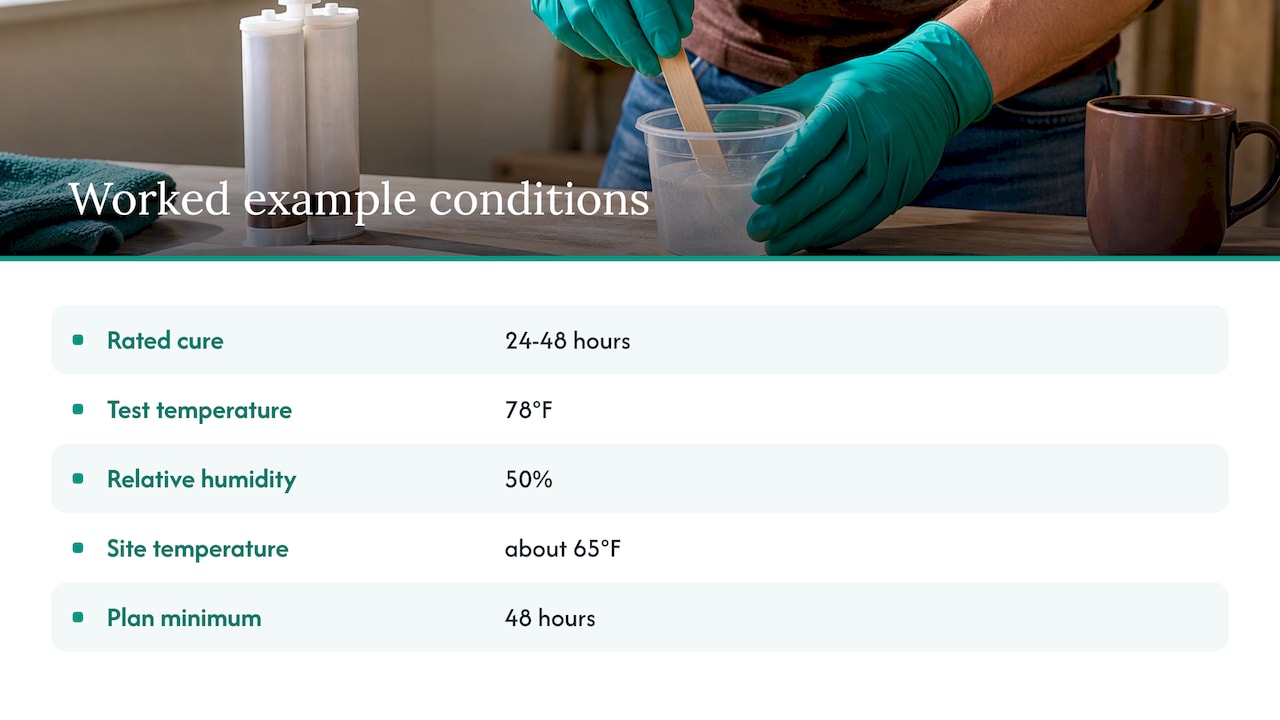
Suppose a polyurethane adhesive lists a 24 to 48 hour cure at 78°F and 50% relative humidity, and your site sits at about 65°F with dry heating running. The data sheet does not give a number for those conditions, so the only defensible plan is to treat 48 hours as the minimum and leave extra margin before loading. Check with the manufacturer if the schedule is tight. If the heat comes on at night and drops during the day, the swings matter as much as the average.
Now reverse it. A warm, humid room with a thin bead may reach handling strength sooner, but the sheet still sets the rated time for full strength. Speed in one direction is a reason to check, not a reason to skip the wait.
Cure time and interior film: what changes
Pressure-sensitive film adhesives behave differently from liquid construction adhesives. They do not mix, pour or react on the wall in the same way, so the long wait associated with epoxy or polyurethane is not the right mental model. The thinking carries over, though: the bond depends on the surface underneath, and any coating or filler beneath the film has its own drying and curing clock.
That is where most delays hide. Fresh paint, patching compound or a new primer coat need to be dry and stable before film goes over them. Our guide to wrapping over painted walls covers prep, cure time and what sticks, and our surface prep checklist for film installers shows how to avoid edge lifts by getting the substrate right first. If you are specifying finishes for wet or humid areas, the 48 hour adhesion test guide explains how to check performance before committing a whole project. And if something does lift, start with our adhesion failure installer guide.
A simple rule for any job: let the substrate finish its own cure, then apply the film in stable room conditions, and keep the space steady while the installation settles in.
Common mistakes that stretch (or shorten) the schedule
- Treating tack-free as finished. A spray adhesive can feel dry in seconds and still need a day.
- Ignoring room conditions. Data sheet times assume a reference climate.
- Loading early. Clamps off is not the same as ready for weight.
- Applying too thick. Moisture-cure products slow down as the layer grows.
- Skipping a patch test. On unfamiliar or porous surfaces, test a small area first.
- Forcing heat. Warmth helps some systems, but follow the product’s guidance rather than improvising with a heat source.
Our perspective
We see cure time as a planning tool, not a delay. When a team knows which clock is running, whether it is a primer, a patch, or an adhesive, the schedule stops being a guess.
Bodaq is a premium architectural interior film from Hyundai L&C, made to be stretchable and self-adhesive, with an air-channeled adhesive that is designed to make installation easier and cleaner. For designers and property managers, that means a refinish can move quickly because the work is built around the surface, the prep and the film, not around waiting for a liquid system to harden.
Our advice is the same on every project: prepare the surface carefully, let any coatings underneath finish their own curing, and keep the room conditions steady. With over 450 textures and colors across wood, metal, stone and marble, solid colors, and fabric and leather, you can commit to a look without committing to a long shutdown.
Bodaq
Ready to plan a refinish?
If your project calls for a fast, low-waste way to renew walls, doors, furniture or fixtures, Bodaq Interior Film is built for exactly that. Browse the full range, then request samples to see the textures in your own light.
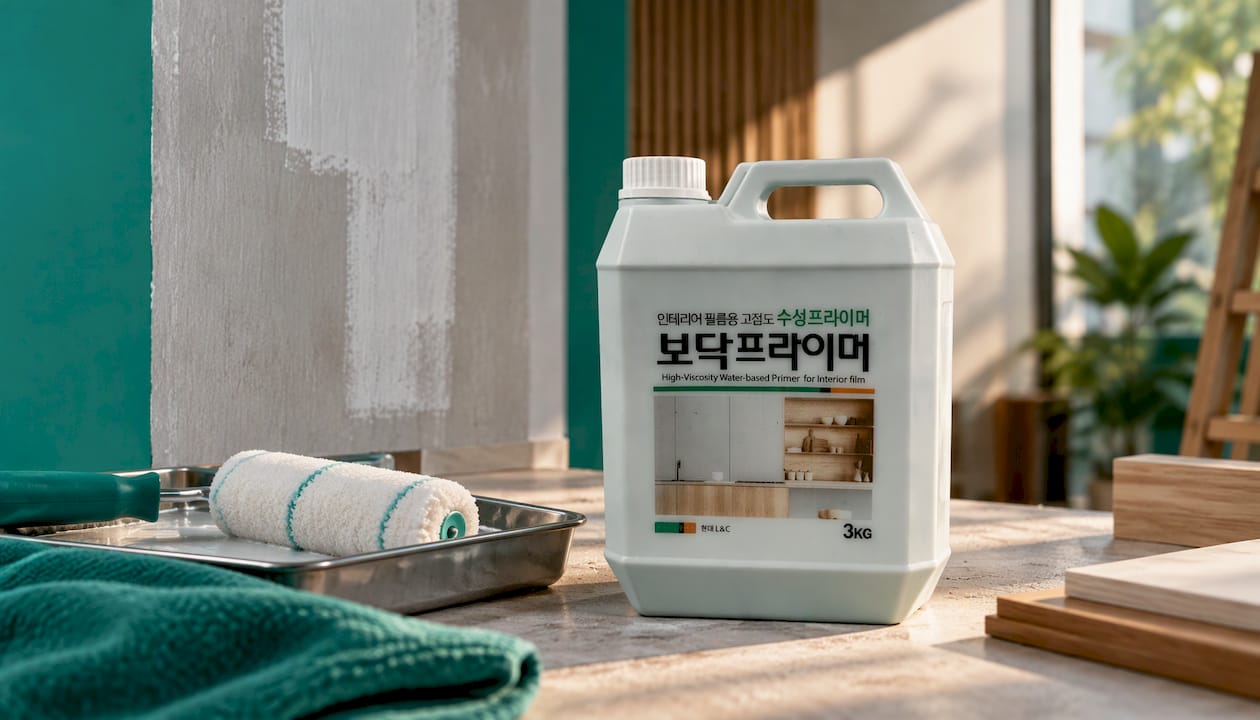
Start with the Bodaq Interior Film range, explore the Wood, Metal, Stone and Marble collections, or add the Bodaq Water-Based Primer to your prep kit.
FAQ
How long does construction adhesive take to fully cure?
It depends on the product. One Henkel polyurethane construction adhesive lists 24 to 48 hours at 78°F and 50% relative humidity, while a QUIKRETE polyurethane adhesive lists 5 to 8 days. Clamps can often come off much earlier, but follow the label for load.
How long does spray adhesive take to cure?
Spray adhesive usually becomes tacky or tack-free within seconds to minutes. Full cure is typically about 24 hours, and CRC’s U.S. spray adhesive lists exactly that. Leave the bond undisturbed overnight when strength matters.
How long does epoxy take to cure?
Two-part epoxy can be handled in roughly 15 minutes to 10 hours, depending on the formulation. A general guide puts about 24 hours to reach 90% of properties and around 36 hours for full polymerization. Always check the data sheet for your specific product.
What is the difference between dry time and cure time?
Dry time is when water or solvent has left the adhesive and it turns solid. Cure time is when a chemical reaction finishes and the bond reaches full strength. An adhesive can be dry to the touch long before it is fully cured.
Does temperature change adhesive cure time?
Yes. Higher temperature and humidity generally speed up moisture-cure adhesives, and lower temperature and humidity slow them. Data sheet times apply only to the stated test conditions, so allow extra time in cold or dry spaces.
Sources
- Adhesive Terminology: Fundamentals Of Adhesion & Bonding (Chemique Adhesives)
- Curing stages of adhesives (Adezif)
- Glossary of Cure Time Terms (Permabond)
- Guide to Different Adhesive Curing Methods (Gluegun)
- Adhesives and how they cure (Kevos)
- LOCTITE PL Premium Max data sheet (Henkel)
- LOCTITE Super Glue Gel Control data sheet (Henkel)
- Power Grab Ultimate Construction Adhesive (Henkel)
- Bonding and Sealing with 1-component Sikaflex (Sika)
- How Quickly Do Polyurethane Adhesives Dry? (Tytan)
- IV Cyanoacrylate Adhesives (Cyberbond)
- Polyurethane construction adhesive data sheet (QUIKRETE)
- CRC Spray Adhesive (CRC Industries)
- Spray glue: What it is and when to use it (Loctite)
- Spray Adhesive vs Contact Cement (SprayIdea)
- Industrial Adhesive Types guide (AIMS Industrial)
- Adhesive Drying and Cure Time for B2B Buyers (GlueMFG)