A self-adhesive wall finish is a thin, patterned film with a pressure-sensitive adhesive back. You apply it straight onto an existing surface, so you get a new color, grain or texture without demolition, wet trades or long downtime. Architectural film is the professional-grade version of this idea. It is built for walls, doors, millwork and furniture in homes, offices, restaurants and hotels, and it is the approach we have designed Bodaq Interior Film around.
Below, we cover what separates film from panels and peel-and-stick sheets, where it works best, how to prepare a surface, and how to choose a look from a catalog of more than 450 textures and colors.
TL;DR
- Self-adhesive architectural film covers existing walls, doors, cabinetry and furniture with a new finish, without tearing anything out.
- Bodaq film is stretchable and self-adhesive, with an air-channeled adhesive designed for cleaner, easier installation and less waste.
- Surface preparation decides the result: clean, sound, fully cured and primed where needed.
- Choose by collection (wood, metal, stone and marble, solid colors, fabric and leather) and by how hard the surface is used.
- One film family can carry the same look across a wall, a door and a piece of furniture.
Table of Contents
- What a self-adhesive wall finish actually is
- Why film suits real projects
- Where a self-adhesive finish works best
- Choosing a look: the five collections
- How to prepare and apply a self-adhesive finish
- Design ideas that make the most of film
- Bodaq Interior Film for your next project
- Our perspective
- FAQ
- Sources
What a self-adhesive wall finish actually is
Search for this term and you will mostly find 3D foam panels, decorative sheets and boxed peel-and-stick kits. Those products share one trait: they are made to be stuck up quickly. They are a different category from architectural interior film.
Architectural film is a decorative surfacing material that arrives on a roll and bonds to a substrate through its own adhesive layer. Think of it as the design equivalent of a tailored garment. It follows the surface it covers: flat drywall, a paneled door, the edge of a counter, the curve of a column.
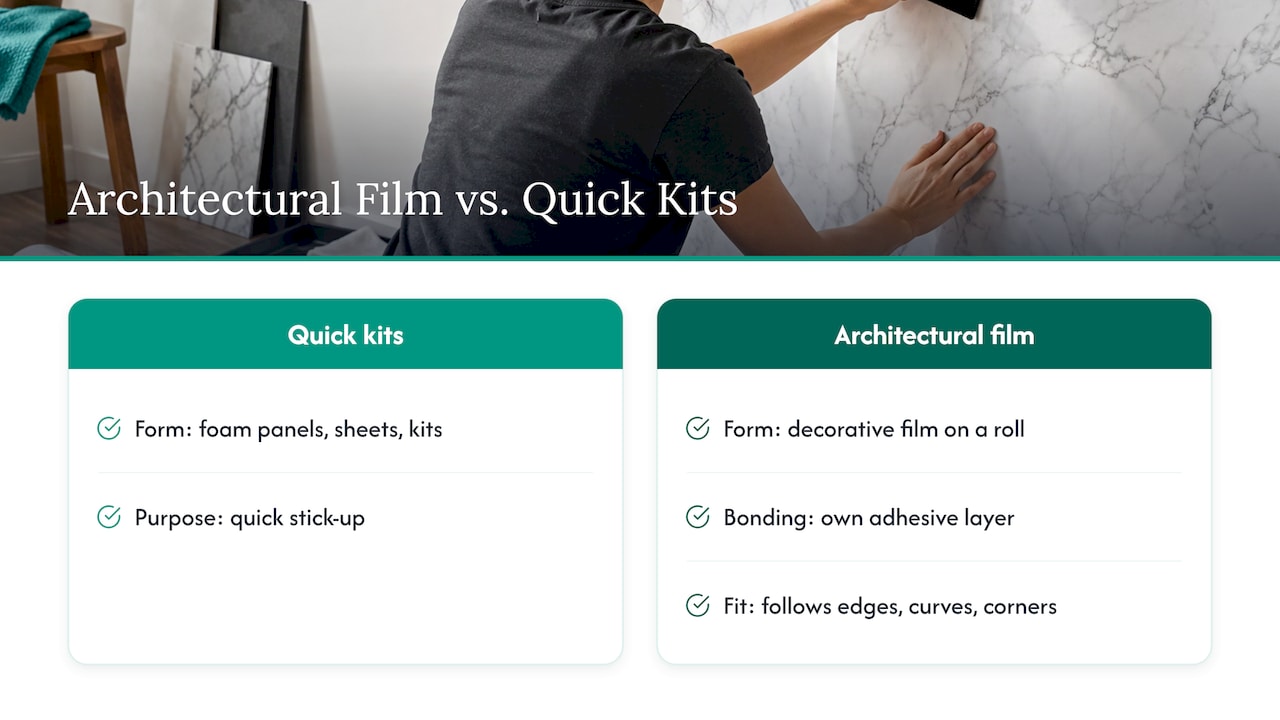
Bodaq Interior Film is made by Hyundai L&C. It is a stretchable, self-adhesive film, and that stretch is the point. A film that can give a little will wrap around edges and profiles and settle into corners, so the finished surface reads as a material and not as a sticker.
Film, panels and peel-and-stick sheets compared
| Architectural film | 3D adhesive panels | Boxed peel-and-stick sheets | |
|---|---|---|---|
| Form | Roll, cut to the surface | Rigid or foam tiles | Pre-cut sheets or rolls |
| Best for | Walls, doors, furniture, millwork, columns | Accent walls with raised relief | Small decorative refreshes |
| Handles edges and profiles | Yes, the stretch lets it wrap | Limited, panels are flat or molded | Limited |
| Look | Flat or fine-grain texture across a wide range of finishes | Sculptural, three-dimensional | Mostly printed patterns |
| Typical buyer | Designers, specifiers, property managers, homeowners planning a full refresh | Homeowners making a single feature | Casual decorators |
Panels are a good answer when you want physical depth on one wall. Film is the answer when you want a continuous, consistent finish across many different surfaces.
Why film suits real projects
The appeal is practical first and aesthetic second, though the aesthetic part is where it gets exciting.
Speed with little disruption. Film goes over what is already there. That matters for a hotel corridor that cannot close for weeks, a retail unit between tenants, or a family that does not want to live in a construction zone. Our own guides on refreshing commercial interiors in two days and renovating offices in hours, not weeks walk through how that plays out on site.
Less waste. There is no demolition debris, no stripped drywall and no old cabinet doors in a dumpster. Because the film is cut from a roll to the dimensions you need, offcuts stay small.
A wide palette from one system. With over 450 textures and colors, a designer can specify a walnut grain for a reception desk, a matching tone for the wall behind it and a contrasting solid on the door, all from one family.
Durability for daily use. Our film is positioned for high-traffic environments, and the Easy Clean line is built around surfaces that get touched and wiped constantly.
Where a self-adhesive finish works best
Walls and feature walls
A single wall in a deep, saturated solid can do what a full repaint cannot: define a zone. In an open-plan office, it separates collaboration from quiet work. In a living room, it anchors the sofa. Stone and marble patterns add a sense of weight and permanence on lobby or bathroom-adjacent walls where the real material would be heavy and costly to install.
Doors and built-ins
Doors are one of the most rewarding surfaces. A tired hollow-core door becomes a warm oak or a sleek matte color in an afternoon. If your renovation also includes new windows or exterior doors, it can help to compare local window and door installers first, then use film to bring the interior doors and frames into the same palette.
Furniture and fixtures
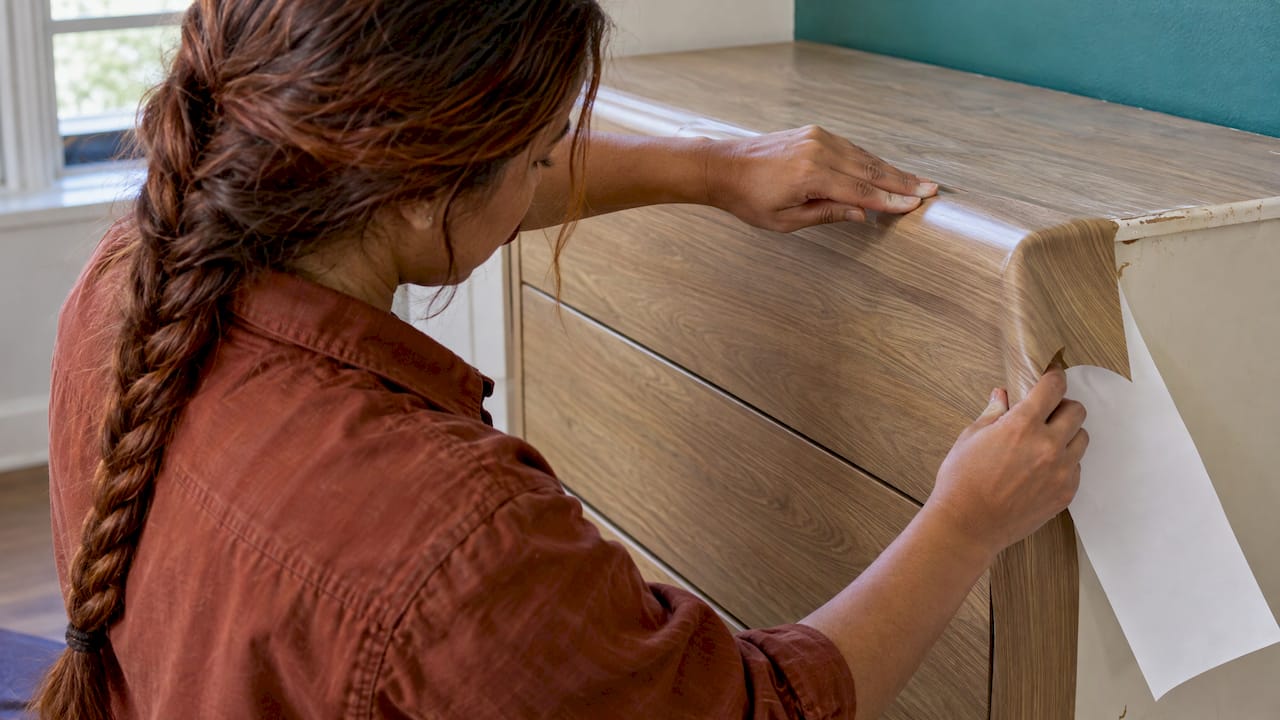
Peel-and-stick furniture wrap is one of the most common things readers look for, and it is where a stretchable film shines. Dresser fronts, desks, reception counters and wardrobe doors can all be re-covered. The stretch helps the film follow rounded edges, so you get a continuous look instead of seams at every corner.
Hospitality, offices and retail
Hotels and restaurants need to change a look without losing revenue days. Film lets a brand update a dining room, a lobby or a run of guest-room doors in stages. For more on this, see why architectural films suit hospitality design and how we treat restaurant wall coverings, where steel makes sense in the kitchen and film carries the dining style.
Choosing a look: the five collections
Our catalog is organized so you can start from the feeling you want and narrow down from there. You can browse everything in the Bodaq interior film collections.
- Wood. Warm, organic and familiar. Light ash and oak feel airy and Scandinavian; dark walnut feels grounded and cocooning. Wood grain is the easiest way to bring natural character into a space that has none.
- Metal. Brushed and cool-toned finishes bring a sleek, industrial edge. They work well on elevator surrounds, columns, counters and accent panels.
- Stone and marble. The look of travertine, slate or veined marble without the weight. The Rustic Stone EXF52 from our high-performance range is a good example of a textured, tactile stone finish.
- Solid colors. For bold, color-drenched rooms, or for quiet, matte neutrals. The Easy Clean ECF01 collection suits spaces that need frequent wiping.
- Fabric and leather. Soft, tactile surfaces that bring a boutique feel to headboards, banquette backs, wall panels and doors.
A quick guide to matching finish and space
| Space | Suggested direction | Why it works |
|---|---|---|
| Hotel corridor doors | Wood or solid color | Consistent look across many identical doors |
| Open-plan office | Solid color accent wall plus wood on joinery | Zones the room and adds warmth |
| Restaurant dining room | Stone or fabric and leather | Tactile, atmospheric, brand-friendly |
| Home entry or hall | Wood or stone | Durable, forgiving and welcoming |
| Kitchen cabinet fronts | Easy Clean solid colors or wood | Wipeable surfaces for everyday use |
Pro tip: look at the film in the room’s actual light. Daylight, warm bulbs and LED strips can shift a color noticeably. Samples are available from us, so you can hold the finish against your own wall, floor and fixtures before you commit to a full order.
How to prepare and apply a self-adhesive finish
The finish looks only as good as the surface beneath it. Film copies what is under it, so the preparation is where professionals spend their care.
- Inspect the substrate. Surfaces should be sound, clean and dry. Loose paint, crumbling plaster, dust and grease all weaken adhesion. Fill and sand dents, and remove anything that might telegraph through the film.
- Repair and condition. Damaged drywall needs patching first. Sherwin-Williams, for example, notes that its drywall conditioner needs about 3 hours of drying time before a skim coat, patching, new wallcovering or primer goes on. Follow the product maker’s guidance for whatever you use.
- Let new paint cure. Fresh paint can feel dry well before it has fully hardened. Give it the time its manufacturer recommends before applying any film.
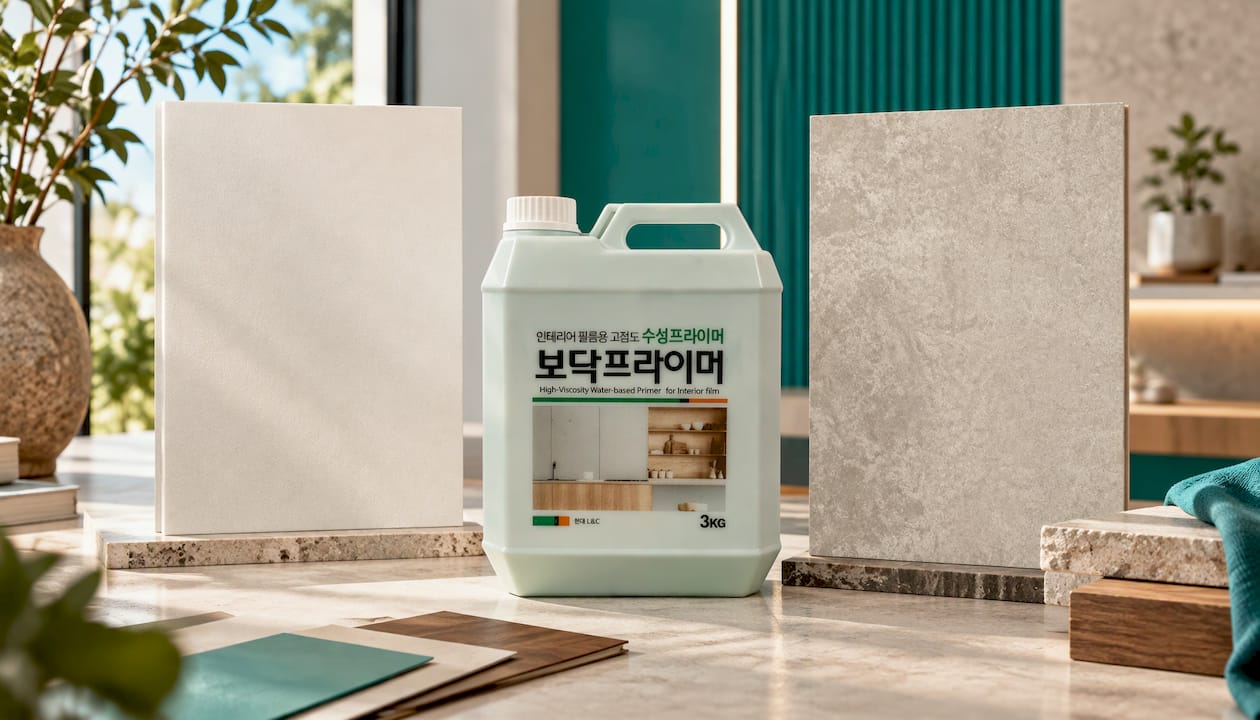
- Prime where needed. A primer gives porous or uneven surfaces a uniform base. We offer the Bodaq Water-Based Primer (3 KG) for this step.
- Measure and cut. Cut the film a little oversized, then trim after it is placed.
- Apply from one edge. Peel back a short section of the liner, position the film, and work across with a squeegee. Our adhesive is air-channeled, which is designed to let trapped air escape so you can press out bubbles instead of chasing them.
- Wrap edges and finish details. Use the film’s stretch to follow corners and profiles, and trim cleanly at the edges.
For wet or humid areas, read our 48-hour adhesion test for moisture-resistant wall finishes. For a wider look at wall materials, see our overview of interior wall finishing materials.
Professional installation and training
We also offer installation tools, dealer kits and certified training for professional installers. For a large commercial project, working with a trained installer is a sound way to get consistent seams, clean corners and a predictable schedule. General contractors can read about the benefits of architectural film on a build.
Design ideas that make the most of film
Color drenching. Wrap the wall, the door and the trim in the same deep tone. Because film comes in solid colors across a wide range, you can match elements that are made of different materials and get one immersive, enveloping effect.
Grain on grain. Pair a wood film on joinery with a quieter solid on the wall. The grain gets room to breathe.
Stone as a backdrop. Use a stone or marble pattern behind a reception desk, bar back or bed head. It reads as sculptural and substantial, and it photographs well.
Soft textures for calm. In a lounge or treatment room, fabric and leather finishes lower the visual noise and bring a hushed quality to the space.
One language across a property. Hospitality groups and multi-site retailers can specify the same finishes from site to site, so rooms feel brand-consistent even when the underlying buildings differ. See how that plays out in transforming commercial spaces with Bodaq film.
For residential inspiration, our guide to reinventing your home with architectural film shows the same ideas at domestic scale. If you are working in a healthcare setting, our page on hospital wall finish options explains when film fits.
Bodaq Interior Film for your next project
If you are planning a renovation, a hotel refresh, an office fit-out or a home update, Bodaq Interior Film gives you a premium, stretchable, self-adhesive surface in more than 450 textures and colors. It is made by Hyundai L&C and is designed to meet eco-friendly standards, so you can refresh a space with less waste.
Explore the full range at Bodaq Interior Film, or go straight to the wood, metal, stone and marble, solid color and fabric collections to find your finish. We also offer samples, installation tools, dealer kits and installer training.
Our perspective
We built Bodaq around a simple observation: most interiors do not need to be torn out, they need to be reimagined. The wall is structurally fine. The door still closes. The desk is solid. What has gone out of date is the surface, and a surface is exactly what a film can replace.
That is why we put so much into stretch and adhesive design. A film that stretches can be wrapped around real objects, and an air-channeled adhesive is designed to make installation cleaner and more forgiving. Those two details are what we believe separate architectural film from decorative sheets made for quick stick-ups.
We also think breadth matters. With over 450 textures and colors, a designer is not forced to compromise on a look, and a property manager can keep a brand consistent across rooms, floors and sites. Add the ability to cover walls, furniture, doors and other surfaces from one catalog, and a renovation becomes a single, coherent design decision instead of a string of separate purchases.
Finally, we design for the way spaces are really used: touched, cleaned, bumped and lived in. Our high-performance collections are made for that daily wear, and we stand behind the idea that a beautiful surface should also be a practical one.
Bodaq
FAQ
Can you put a self-adhesive finish on any wall?
Film bonds best to clean, sound, smooth surfaces such as primed drywall, painted walls that have fully cured, doors and laminate furniture. Rough, dusty, crumbling or damp surfaces need repair or priming first. Our primer is made to give a uniform base on surfaces that need it.
How is architectural film different from peel-and-stick wallpaper?
Architectural film is a roll-based surfacing material designed for walls, doors, millwork and furniture, including edges and profiles. Bodaq film is stretchable and uses an air-channeled adhesive for cleaner installation. It also comes in wood, metal, stone and marble, solid color and fabric and leather finishes, not just printed patterns.
Can I use film on furniture?
Yes. Desks, dressers, wardrobes, counters and cabinet fronts can all be re-covered with film. The stretch helps it follow rounded edges, and a clean, primed or well-prepared surface helps the finish last. Choose a high-performance or Easy Clean collection for surfaces that get wiped often.
Is it suitable for commercial spaces?
It is designed for them. Film goes over existing surfaces, so offices, hotels and restaurants can refresh a space in stages with little downtime. Our high-performance collections are positioned for high-traffic areas, and we offer certified training for professional installers.
How do I choose the right color or texture?
Start with the mood you want, then pick the collection: wood for warmth, metal for an industrial edge, stone for weight, solids for color, fabric and leather for softness. Check the finish in the room’s own light. We can send samples so you can compare them against your existing materials.