
Architectural Film Basics11 min read
Prop 65 Compliant Finishes: What Specifiers Need to Know
No finish is Prop 65 approved by default. Learn how exposure and safe harbor levels decide warnings, and how to choose interior finishes with confidence.
There is no such thing as a finish that is “Prop 65 approved” by category. California’s Proposition 65 does not certify products. It asks whether a product exposes people to a listed chemical above a set threshold, and whether the business behind it has warned them if so. For designers, property managers and homeowners, the practical answer is to choose finishes with few wet-applied components and clear, product-specific information, and to ask the right questions of whoever supplies them. A factory-made, self-adhesive architectural film such as Bodaq’s gives you one defined product to evaluate instead of a stack of primers, paints and solvents mixed on site.
TL;DR
- Prop 65 tests exposure, not just ingredients: a warning is required only when a listed chemical reaches people above a safe harbor level.
- A warning is not a ruling that a product is unsafe, and the absence of one is not a guarantee. Each finish is judged product by product.
- Paints, lacquers, adhesives, composite wood and vinyl textiles are the usual hotspots, so the finish system matters as much as the surface.
- Responsibility sits mainly with manufacturers, importers and suppliers, which is why supplier documentation is the first thing to review.
- Our Bodaq interior film comes in over 450 textures and colors and adheres to eco-friendly standards, a sound starting point for a low-fuss specification.
Table of Contents
- What Prop 65 actually asks of a finish
- Safe harbor levels, in plain terms
- Where finishes pick up Prop 65 chemicals
- What a warning does and does not mean
- Who is responsible: manufacturer, supplier or you
- What changed recently
- A review routine for interior finishes
- Why film is a sensible route for a low-disruption refresh
- Explore the range
- Our perspective
- FAQ
- Sources
What Prop 65 actually asks of a finish
Proposition 65 is California’s right-to-know law. The state keeps a list of chemicals that cause cancer or reproductive harm, and a business must give a clear and reasonable warning before knowingly and intentionally exposing someone to one. The California Attorney General’s Prop 65 FAQ adds that the requirement reaches out-of-state businesses whose products expose people in California, and that warning requirements start 12 months after a chemical is added to the list.
In practice, a compliance review runs through three questions:
- Is a listed chemical in the product or created by its use?
- Will normal use likely expose a person to it? Exposure can come through skin contact, inhalation of fumes or dust, or hand-to-mouth transfer.
- Is that exposure above a safe harbor level? If a level exists and you are at or below it, no warning is needed.
The Attorney General’s office also notes that federal composition standards do not replace this exposure assessment. A finish can meet a federal or industry standard and still need its own Prop 65 analysis.
Safe harbor levels, in plain terms
A safe harbor level is the amount of exposure below which no warning is required. There are two kinds. An NSRL (no significant risk level) applies to chemicals listed for cancer. A MADL (maximum allowable dose level) applies to those listed for reproductive toxicity. According to OEHHA’s guidance for businesses, the state agency has developed more than 300 of them, and the warning rules do not require a business to run tests.
The American Coatings Association explains that the NSRL is set at not more than one excess cancer case in 100,000 over a 70-year lifetime, and the MADL at 1/1000th of the level with no observable effect, in its guidance on the warning rules. The same guidance lists three routes when a business cannot tell whether exposure is under the line: warn anyway, carry out an exposure assessment, or ask OEHHA for a safe use determination. A business that argues no warning is needed carries the burden of showing exposure is below the threshold.
A worked example of why ppm is not the answer
Safe harbor levels are expressed in micrograms per day of exposure. A lab result in parts per million describes what is in the bulk material. The AHFA’s Prop 65 workbook stresses that the two cannot be compared directly. Imagine a wall finish with a small trace of a listed metal locked inside a cured layer. If it cannot migrate to skin or air, daily exposure may be negligible. The same trace in a powdery surface that people touch constantly is a different case. That is why reviewers look at how a product is used, not only what is in it. The same workbook notes that bioaccessible extraction, simulated sweat extraction, wipe tests and chamber tests can narrow the uncertainty.
Where finishes pick up Prop 65 chemicals
OEHHA’s furniture products fact sheet names the recurring sources: flame retardants in foams and plastics, formaldehyde released from composite wood and from coatings such as paints and lacquers, phthalates in plastic furniture and vinyl upholstery textiles, and PFOA and PFOS in older stain-resistant fabrics. The AHFA workbook adds metals in hardware, paints, dyes and finishes, and volatile organic compounds (VOCs) in composite wood, fabrics, paints and dyes.
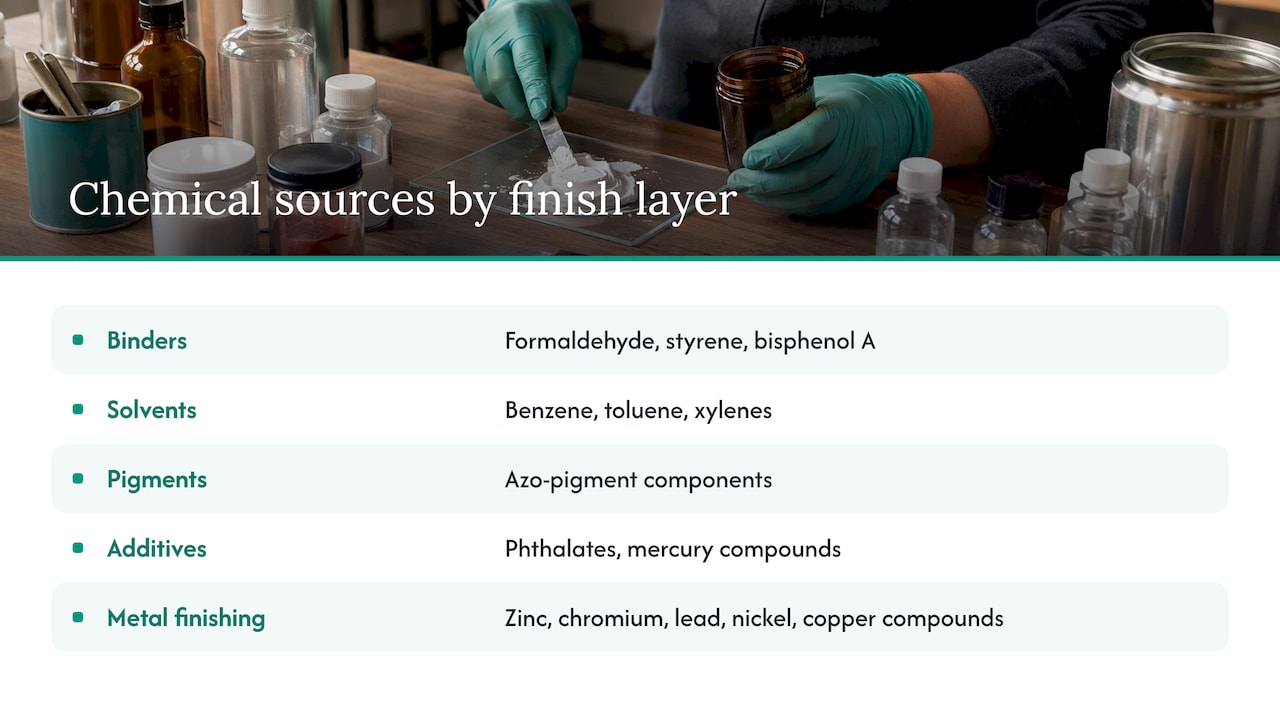
California’s Department of Toxic Substances Control goes deeper on coatings in its 2024-2026 Priority Product Work Plan. It reports candidate chemicals across the layers of a paint: binders may contain formaldehyde, styrene or bisphenol A, solvents may contain benzene, toluene or xylenes, pigments may contain azo-pigment components, and additives may contain phthalates or mercury compounds. Metal plating and finishing, including anodizing and electroplating, use zinc, chromium, lead, nickel and copper compounds.
Adhesives and packaging count too
A finish is rarely one material. It is a surface, an adhesive, often a primer, and the packaging that carries it. A compliance guide from Regilient points out that adhesives and sealants often contain toluene, formaldehyde, acrylates and isocyanates, and that packaging can trigger Prop 65 before the product does because consumers handle it directly. When you compare finishes, compare the whole system: substrate prep, adhesive, coating and packaging.
Dust, heat and fumes on the job site
Exposure also depends on installation. Sanding, heat guns, solvent-based coatings and demolition all create airborne particles or vapors that the finished product never would. Understanding the risks of builders’ dust helps you plan where that exposure can occur and how to clean up after a renovation. Fewer wet trades and less sanding mean fewer pathways to think about, which is a practical reason many project teams look at film for refreshes.

What a warning does and does not mean
A Prop 65 warning tells the consumer that exposure to a listed chemical may exceed the threshold. The Attorney General’s FAQ is explicit that this is not a regulatory finding that a product is “safe” or “unsafe,” and that consumers can ask the business about actual exposure levels to decide whether to accept, avoid or reduce it. OEHHA’s furniture fact sheet adds that some products containing listed chemicals carry no warning because exposures are too low to require one, while products with warnings may expose users to higher levels than those without.
For a specifier, the takeaway is simple. Treat a warning as a prompt for a conversation with the supplier, and treat a clean label as one input, not a certificate.
Who is responsible: manufacturer, supplier or you
OEHHA’s September 30, 2025 compliance presentation puts primary responsibility on manufacturers, producers, packagers, importers, suppliers and distributors. Retailers must warn in specific cases, for instance when they sell under their own brand, knowingly introduce a listed chemical, obscure a warning, or sell after receiving warning materials without displaying them. The OEHHA business Q&A explains that suppliers can either label the product or send written notice and warning materials to the retailer and get acknowledgment back.
Two details matter for design and construction teams:
- A component or ingredient maker is responsible for consumer warnings only if it knows the end use can expose a consumer to a listed chemical.
- In workplaces, occupational warning duties can be met through state and federal hazard-communication training and labeling. A 1997 Federal Register notice confirms that Prop 65’s consumer and environmental applications are unaffected by California’s OSHA state plan.
If you are a contractor or property manager who rebrands, imports or assembles finishes under your own name, you may step into the manufacturer’s shoes. The Attorney General recommends that any business that believes its exposure is below the threshold consult a scientist experienced in risk assessment.
What changed recently
The rules keep moving, so check the live OEHHA list before you finalize a specification. Recent points from the sources above:
- Vinyl acetate was added as a carcinogen, with its warning requirement effective January 3, 2026. Bisphenol S was listed for male reproductive toxicity, effective December 29, 2024.
- The warning regulation amendments effective January 1, 2025 require short-form warnings to name at least one listed chemical per health endpoint, allow “CA WARNING” as a signal word, and set a minimum type size of 6-point. Per the ABTL report, products manufactured and labeled before January 1, 2028 may still use the older language.
- Adherent’s summary notes new requirements for internet purchases, with a 60-day period for retailers to update online warnings after a manufacturer’s notice.
The list is updated several times a year, so a product reviewed two years ago deserves a fresh look.
A review routine for interior finishes
Use this sequence for any wall, door, furniture or fixture finish, whether it is paint, laminate, veneer or film.
- Map every layer. List the surface, primer, adhesive or binder, topcoat and packaging. Each can contribute chemicals.
- Request the manufacturer’s Prop 65 position in writing. Ask whether the product carries a warning, or whether the supplier has assessed exposure and concluded none is needed.
- Look at emissions, not just contents. For anything with composite wood or coatings, look for formaldehyde and VOC emissions data. The ANSI/BIFMA M7.1 chamber method is one way emissions are measured. Our guide to low-VOC interior finishes walks through how to read those claims.
- Match the finish to the exposure. A guest-room headboard wall that is touched daily is a different case from a ceiling soffit.
- Check performance alongside chemistry. A compliant finish that fails fire, abrasion or moisture requirements will be replaced early. Review ASTM E84 wall finish requirements and moisture resistance testing in the same pass.
- Keep the paperwork. File supplier letters, safety data sheets and any warning materials with the project record, and note the date, since the list changes.
- Re-check at each renovation cycle.
Special cases
Healthcare, hospitality and multifamily projects face tougher cleaning regimes and heavier touch traffic, which affects both exposure and durability. Our overview of hospital wall finish options shows how finishes are compared in a demanding setting.
Why film is a sensible route for a low-disruption refresh
Primers, paint, solvents and sanding each add a variable to a Prop 65 review. A finishing film replaces most of that chain with a single manufactured product applied over the existing surface, so there are fewer materials to document and less on-site mixing. Bodaq is a stretchable, self-adhesive architectural film made by Hyundai L&C. Its air-channeled adhesive is designed to make installation cleaner and easier, and the film adheres to eco-friendly standards. The result is a faster upgrade with less waste, which matters when a hotel floor or an office suite cannot sit idle.
That is also why the range is broad. The film is available in over 450 textures and colors across wood, metal, stone and marble, solid color, and fabric and leather collections, so a design team can carry one finish family through walls, doors, furniture and fixtures with consistent supplier documentation.
Explore the range
If you are specifying a refresh and want a single, documented finish family, start with the Bodaq interior film collections. You can request samples to see textures and colors in your own light, or browse a solid color such as Pure White to see how a clean, uniform surface reads on a wall.

Dealers, installers and project teams can also reach us about tools, dealer kits and certified installer training through Bodaq.
Our perspective
Prop 65 is often discussed as a label problem. We see it as a specification problem. The best moment to deal with it is before a finish is chosen, when you can still compare systems rather than stickers.
That is why we built Bodaq around a simple idea: a stretchable, self-adhesive film that transforms walls, furniture and doors without a trail of wet trades behind it. One engineered product, installed with an air-channeled adhesive, means a shorter list of materials to understand and a cleaner site while the work is under way.
Our film adheres to eco-friendly standards and is certified for durability in high-traffic environments, so a refresh lasts and does not have to be redone. With more than 450 textures and colors, designers do not need to compromise on look to simplify the material list.
If you are planning a project, request samples and see how the finish performs where it will actually live.
Bodaq
FAQ
Is a Prop 65 warning on a finish a reason to avoid it?
Not automatically. The California Attorney General describes the warning as information about exposure, not a decision that a product is safe or unsafe. It is a cue to ask the supplier about the specific chemical and how people could be exposed, then choose accordingly.
Do I need to test a finish to comply with Prop 65?
The warning regulations do not require testing. Businesses can rely on knowledge of their supply chain and product chemistry. When exposure is unclear, the options are to warn, assess exposure, or seek a safe use determination from OEHHA, and the business arguing no warning is needed must show exposure is below the threshold.
Does Prop 65 apply outside California?
It applies to any business whose products expose people in California, including out-of-state manufacturers and online sellers. Since many national projects and products reach California customers, specifiers across the country often use the same review routine.
Who is responsible for the warning, the manufacturer or the installer?
Primary responsibility lies with manufacturers, producers, importers, suppliers and distributors, who either label the product or send warning materials to the retailer. Retailers and others who sell under their own brand or knowingly add a listed chemical can take on that duty as well.
How often should I re-check a finish?
Whenever you start a new project or renovation cycle. OEHHA adds chemicals to the list over time, and each addition carries a warning requirement 12 months later, so an earlier review can go out of date.
Sources
- California Attorney General: Proposition 65 FAQ
- OEHHA: Clear and Reasonable Warnings Q&A for Businesses
- American Coatings Association: Clear and Reasonable Warnings under Proposition 65
- AHFA: Navigating the Prop 65 Workbook
- OEHHA: Furniture Products fact sheet
- DTSC: 2024-2026 Priority Product Work Plan
- Regilient: California Prop 65 Compliance Guide for Manufacturers
- Builders’ Dust and Your Health: Risks and Safe Clean-Up
- OEHHA: Proposition 65 Compliance Guidance and Regulatory Updates, September 30, 2025
- Federal Register, June 6, 1997: California OSHA state plan
- ABTL Orange County report, 2026
- Adherent: California Proposition 65 Quick Guide to Changes