A closet door wrap is a thin, self-adhesive architectural film applied over the face of an existing door, so a dated, scuffed or mismatched closet door takes on a new wood, stone, metal, fabric or solid-color look without replacement, sanding or paint. It works best on flat, sound, clean doors, and the result depends far more on preparation and film choice than on speed. Below, we walk through which doors qualify, how to measure and prep, how to apply film without bubbles, and how to care for the finish.
TL;DR
- Most flat closet doors (hinged, bifold, sliding panels, flush slab doors) can be wrapped when the surface is sound, clean and dry.
- Preparation decides the result: remove hardware, degrease, fill dings, and let the surface dry fully before film touches it.
- A stretchable film with air-channeled adhesive is more forgiving around edges, routed profiles and small repositioning corrections.
- Pros budget roughly 30 to 90 minutes per door, so a whole bedroom closet can be a one-day refresh.
- Choose the pattern first, then the sheen and texture, then order a sample to see it in your own light.
Table of Contents
- What a closet door wrap actually is
- Which closet doors can be wrapped
- Choosing a finish that suits the closet
- Measure, then buy with a margin
- Prepare the surface: where wraps succeed or fail
- How to apply the film without bubbles or creases
- What a wrap costs
- Durability, cleaning and long-term care
- Removing or replacing a wrap later
- Our perspective
- Ready to wrap your closet doors?
- FAQ
- Sources
What a closet door wrap actually is
There are two things people mean by the phrase, and it helps to separate them.
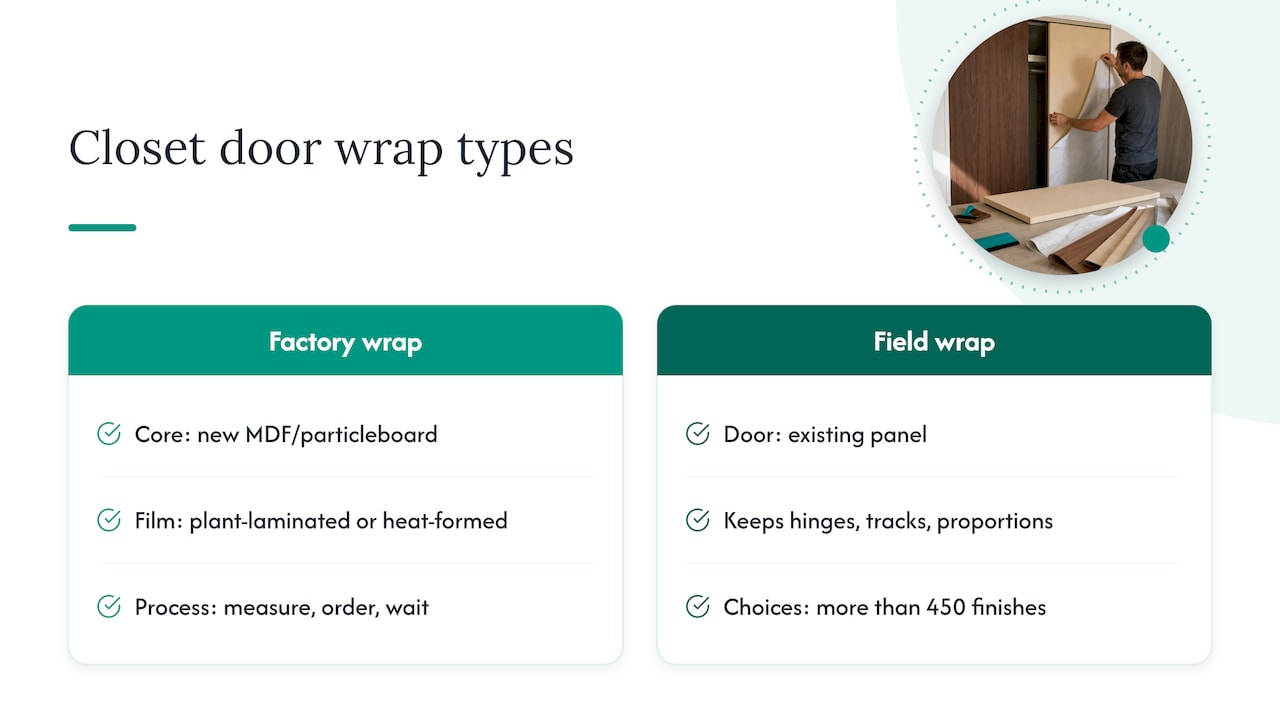
The first is a factory wrap: a door panel, usually an MDF or particleboard core, with a film laminated or heat-formed around it at the plant. Industry coverage of this category describes common overlay materials such as PP, PET, PVC and paper-based layers, with deep embossing used to create realistic woodgrain texture. Thermofoil, a vinyl heat-formed over a routed board, is the familiar version on shaker-style fronts.
The second is a field wrap, which is what most of our readers are asking about: architectural interior film applied to the door you already own. Nothing is removed from the opening, nothing is hauled to a landfill, and the door keeps its hinges, tracks and proportions. Only the surface changes.
That difference matters for planning. A factory-wrapped replacement means measuring, ordering and waiting. A field wrap means you can start with the doors you have and choose from a catalog of more than 450 textures and colors.
Which closet doors can be wrapped
Think of the door as a canvas. The flatter and more stable it is, the more refined the finish.
Good candidates
- Flush hollow-core and solid slab doors, whether painted, laminated or veneered
- Sliding closet panels, including framed panels with a flat insert
- Bifold doors with flat or lightly routed faces
- MDF and laminate wardrobe fronts
- Door frames and jambs, which can be refinished in the same film so the opening reads as one design (see our guide to door jamb wrap)
Needs extra care
- Louvered doors, where the slats make a continuous wrap impractical
- Deeply raised-panel doors, which need film stretched into recesses, ideally by a trained installer
- Doors with peeling paint, crumbling edges, or swollen, water-damaged cores
- Heavily textured surfaces that would telegraph through the film
A simple test: run your palm across the door in raking light. If you feel flaking, bumps or sticky patches, fix those first. Film follows the surface beneath it faithfully, which is wonderful on a smooth door and unforgiving on a damaged one.
Choosing a finish that suits the closet
A closet door is often the largest uninterrupted plane in a bedroom or hallway, so the finish sets the mood of the entire wall. Here is how we think about the main directions.
Wood: warm and quietly architectural
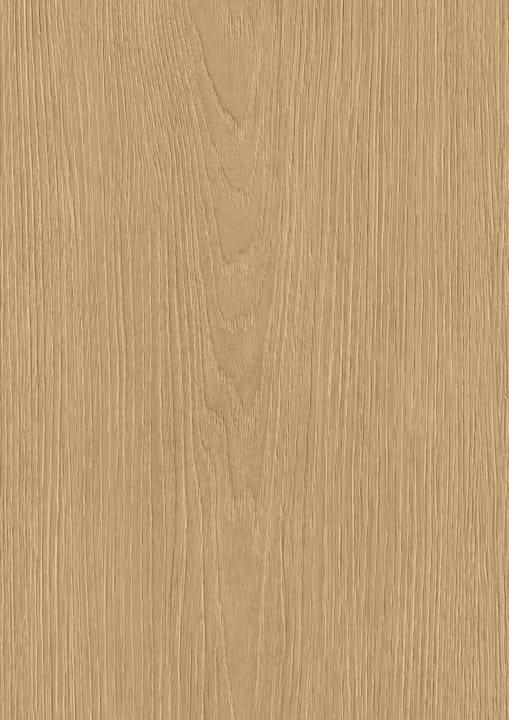
Wood grain is the natural first stop. A long, straight grain such as Natural Oak LW108 gives a calm, Scandinavian feel, while Deep Walnut Oak LW109 brings a richer, almost library-like depth. Lighter options such as Sandstorm Oak LW116 keep small rooms airy. For more on this direction, read about wood-look vinyl films.
Solid colors: the clean, color-drenched look
Wrapping the closet doors in the same hue as the walls makes them recede, an elegant way to hide storage. A deeper tone such as Deep Forest S266 turns the closet into a moody, cocooning backdrop, while Evening Snow S260 or Gentle Creme S257 keep things soft and bright.
Stone, metal and textile
Stone-look films add a sculptural, mineral quality to feature doors, for example Sierra Stone NS122. Metal finishes like Bronze RM011 suit a dressing room or a boutique-style walk-in. And fabric or leather looks echo a wider design movement: higher-end closet projects are increasingly specified in suede, vegan leather and other textiles, a mood you can approach with a film such as Steel Grey SL402.
Pro tip: Hold a sample against the door at the times of day you actually use the room. Gloss, matte and textured surfaces read very differently in morning window light and in evening lamplight. Browse the full interior film collections before you narrow down.
Measure, then buy with a margin
Measure each door face separately, even in a set that looks identical. Old doors drift out of square, and hand-cut panels vary.
- Measure height and width at three points each and note the largest.
- Add about 2 inches (5 cm) on every side as a trim allowance.
- For sliding panels, measure the visible face only, then allow extra if the panel has a channel or lip you plan to wrap into.
- Decide whether you are wrapping edges. Wrapping the edges gives a continuous, factory-like look but needs film that stretches around the corner.
- If the pattern has a directional grain, orient all doors the same way, and plan roll cuts so adjoining doors match.
For a bifold set, treat each leaf as its own piece and cut them from the same roll in sequence so the grain flows across the pair. Our team can help with quantities when you request samples or a quotation.
Prepare the surface: where wraps succeed or fail
Surface prep takes longer than application, and it is the step most people shorten. Do not.
- Remove hardware. Take off handles, pulls, latches and catches. On sliding doors, lift the panel off its track if you can, and work flat on padded sawhorses or a clean table.
- Clean. Degrease with a mild cleaner, rinse with a damp cloth, then wipe with isopropyl alcohol. Skin oils, furniture polish and kitchen-style grease residue are the usual enemies of adhesion.
- Repair. Fill dents, chips and screw holes with a quality filler, sand flush, and wipe away dust. Re-seal any bare or exposed MDF edges.
- Dry. Let everything dry completely. Trapped moisture or solvent can cause lifting later.
- Mind the room. Work in a clean, dust-free space at a comfortable room temperature. Dust under film shows up as tiny bumps in raking light.
For product-specific temperature, surface and cleaning guidance, consult our technical bulletins before you start.
How to apply the film without bubbles or creases
The best installers work in calm, deliberate sequences. A stretchable film with air-channeled adhesive gives you room to correct, which is why we recommend it for people wrapping closets for the first time as well as seasoned crews.
- Cut oversize. Cut the film with the trim allowance from your measurements.
- Start at one edge. Peel back a short section of liner, align the film to the top edge of the door, and tack it down lightly with your hand.
- Squeegee in overlapping strokes. Work from the center outward with a felt-edged squeegee, pressing firmly, and release the liner gradually as you move down the door.
- Lift and reset when needed. If a crease or bubble appears, lift the film gently back past the problem and smooth it down again. Air-channel adhesive helps trapped air escape instead of forming a blister.
- Handle corners and edges. Warm the film gently where it must wrap around an edge or a routed profile, stretch it evenly, and press it into the recess rather than pulling it tight across it.
- Trim. Use a sharp blade and a straightedge, changing the blade often. A dull blade drags and leaves ragged edges.
- Post-press. Go over edges and recesses again with firm pressure. Reinstall hardware once the door is finished, drilling fresh holes where you can.
For safe handling of blades, heat tools and ladders, see our note on interior film installation safety. Professionals tend to move quickly with the right tools, and our write-up on door wrap installation time explains how crews bring a door down to 30 to 90 minutes.
Common mistakes to avoid
- Wrapping over flaking paint or a waxy factory finish
- Pulling film taut over a recess, which leaves it prone to lifting later
- Overheating, which can distort the pattern or gloss
- Skipping the post-press on corners and leading edges
- Working in a dusty garage or a cold room
What a wrap costs
Cost depends on how many doors you have, how detailed their profiles are, which film you choose and whether you hire a professional installer. Our own breakdown, Door Wrap Cost: $150–$600 Per Door and a U.S. Buyer’s Checklist, walks through the factors and gives a buyer’s checklist. If you are also thinking about adjoining kitchen or bath fronts, the cabinet wrap cost guide compares DIY, professional and Bodaq film routes.
A useful way to compare: replacing a closet door means buying a new slab or panel, finishing it, fitting it and disposing of the old one. Wrapping keeps the door you have, so most of the spend goes into the finish you see.
Durability, cleaning and long-term care
A wrapped door lives a busy life. It gets brushed by sleeves, bumped by laundry baskets and handled with every grab. Bodaq is built as a durable architectural film for high-traffic interiors, and that suits closets well.
To keep the finish looking good:
- Wipe with a soft cloth and mild soapy water, then dry.
- Avoid abrasive pads, solvent cleaners and sharp tools.
- Keep heat sources, such as steamers and hot appliances, away from the surface.
- Check corners and edges once or twice a year and press down any that need it.
If you want an especially wipeable surface for a kids’ room or mudroom closet, look at the Easy Clean ECF01 high-performance film.
Removing or replacing a wrap later
One of the quiet advantages of a field wrap is that your taste can change. When it is time for a new look, warm the film gently with a heat gun on low, peel it back slowly at a low angle, and clean any remaining adhesive from the surface. Start in a corner and work in sections.
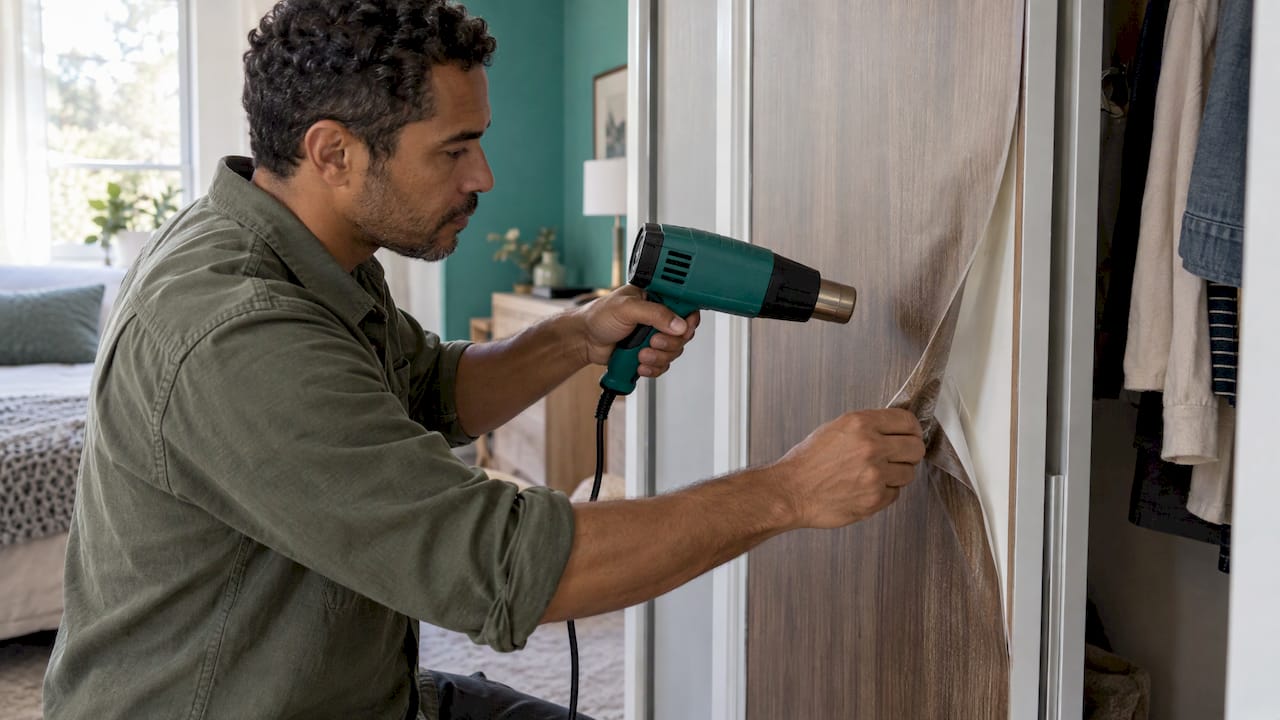
Before removing film from a door you have not touched in years, check the condition of the paint or veneer under it: weakly bonded layers can lift with the film. Fix or repaint afterwards, or simply apply a new film once the surface is cleaned and repaired.
Our perspective
We built Bodaq because surfaces should not be a reason to tear a room apart. A closet door is the perfect example: it is large, visible, and usually structurally fine, yet it is the first thing that makes a room feel tired.
Our film is designed to stretch, so it follows edges and profiles with less fuss, and its air-channeled adhesive is designed to let air escape as you work, which makes clean results easier to achieve. With more than 450 textures and colors across wood, stone, metal, fabric and solid collections, you can choose a closet door that either disappears into the wall or becomes the sculptural feature of the room.
For designers, property managers and hospitality teams, the point is just as practical: less waste, less disruption and a consistent look across dozens of doors without taking rooms offline.
Bodaq
Ready to wrap your closet doors?
Bodaq is a premium architectural interior film from Hyundai L&C, made for walls, doors, furniture and other surfaces in homes and commercial spaces. We also offer installation tools, sample requests and certified installer training for professionals.

Start by exploring the Bodaq collections, request a sample of your top two choices, and let us know your door count and sizes. If you want more ideas for every room, see our door wrap ideas.
FAQ
Can I wrap a sliding closet door?
Yes, in most cases. Sliding panels with a flat face are among the easiest closet doors to wrap because you can lay them flat on a bench. Remove the panel from its track if possible, wrap the visible face, and take care at the edges where the door meets the track.
Can I wrap a mirrored closet door?
A smooth, clean mirror or glass panel can generally take film, and wrapping is a popular way to retire an old mirror look. Clean thoroughly and confirm the panel is secure in its frame first. Request a sample and test it on a small, discreet area to check the finish you want.
How long does it take to wrap a closet door?
Experienced installers typically allow 30 to 90 minutes per door, depending on the door’s size and profile. If it is your first wrap, plan for more time per door and give your first one extra attention, since it teaches you the rhythm for the rest.
Can I wrap the door frame to match?
Yes. Wrapping the frame and jamb in the same film as the door gives the opening a seamless, built-in look. Our guide to wrapping door jambs covers the approach.
What is the difference between wrapping and replacing a closet door?
Wrapping changes only the surface and keeps your existing door, hardware positions and opening. Replacing means new doors, new fitting and disposal of the old ones. When the door itself is sound, a wrap delivers a new look with less waste and less disruption.
Sources
- 2DL shapes closet and cabinet design | Woodworking Network
- Trends in high-end closet design | Woodworking Network